


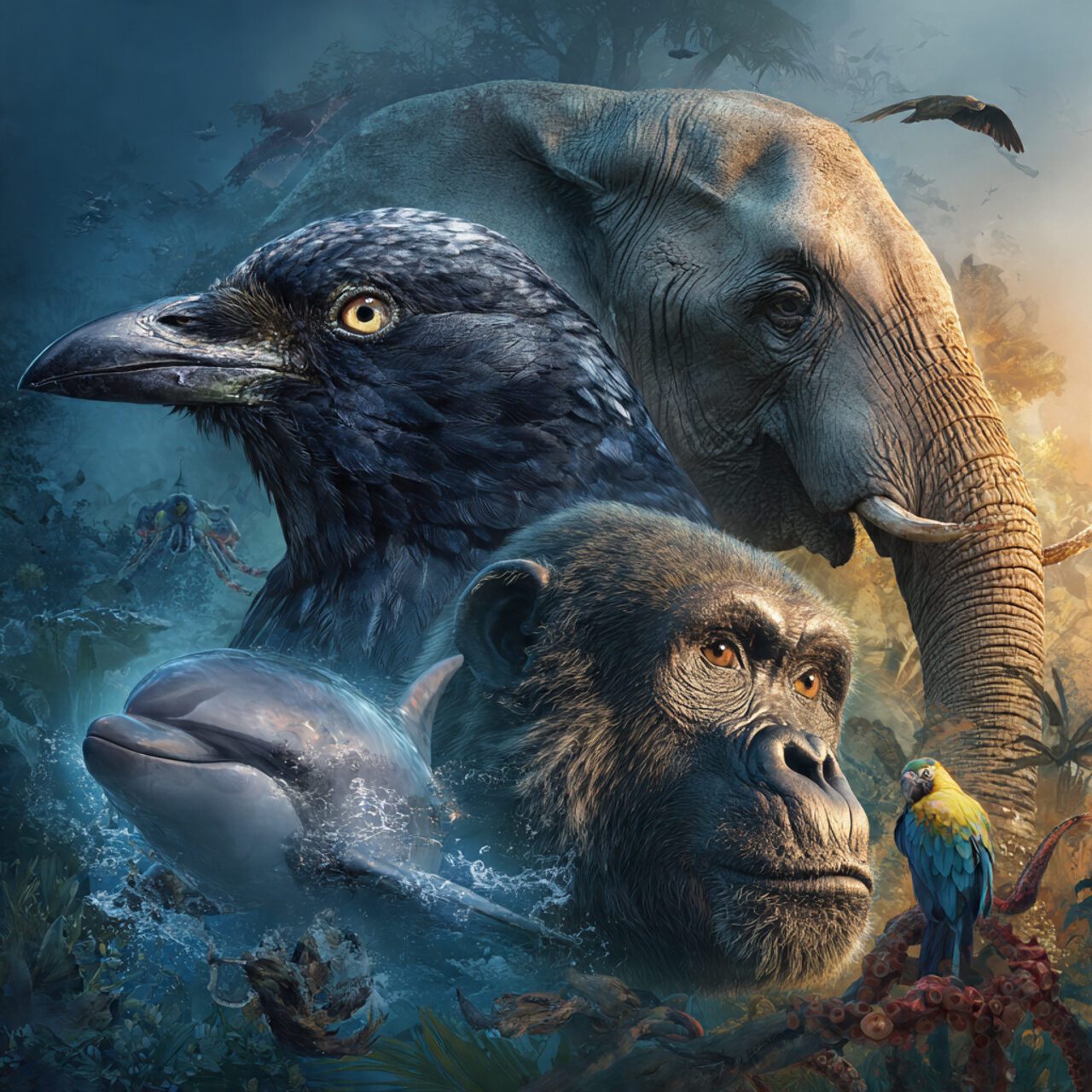
We’ve all heard the testimonies. The clever crow, the loyal dog, and the mischievous parrot. But for every animal celebrated for its smarts, there are dozens more lurking in forests, oceans, or even our backyards, whose highbrow lives are quietly first-rate. We frequently derive intelligence through a human lens—device use, language, and social complexity. But what if we looked deeper? What we’d find is a world teeming with cognitive marvels that challenge our very understanding of what it means to be “smart.”
This isn’t just about solving puzzles for a food reward. It’s about grief, deception, cultural learning, and perhaps even a sense of self. It’s time to look beyond the usual suspects and meet ten wildlife species whose hidden intellect will genuinely surprise you.

1. The Octopus: The Alien Genius of the Deep
Let’s start with a creature so profoundly different from us, it might as well be from another planet. The octopus possesses a distributed intelligence system—about two-thirds of its neurons are in its arms. This means each arm can, in a sense, “think” and react independently. Imagine your hand tasting and touching its way around a maze while you’re busy doing something else. That’s an octopus’s everyday reality.
Their problem-solving skills are the stuff of legend. Aquarium staff know them as notorious escape artists, capable of unscrewing lids, navigating drainpipes, and even slipping through tiny gaps. But it goes deeper. They exhibit play behavior—a key sign of advanced cognition. Scientists have observed octopuses repeatedly pushing plastic bottles into a current jet in their tank, only to catch them as they circle back, seemingly for the sheer fun of it. They use tools, carrying coconut shells to assemble portable shelters. Some even engage in deliberate deception, mimicking the shape and movement of more dangerous animals like lionfish or flatfish. This isn’t instinct; this is tactical, situational thinking. The octopus doesn’t just react to its world; it interacts with, manipulates, and even plays with it.

2. The Crow (and its Corvid Family): The Feathered Mastermind
“Bird-brained” is perhaps the most unfair insult in the animal kingdom, especially when directed at corvids—crows, ravens, rooks, and magpies. These birds don’t just use tools; they fashion them. New Caledonian crows are famous for carefully sculpting hooks from twigs to extract grubs from logs. They’ll also save tools for future use, showing foresight.
Their social intelligence is staggering. They recognize human faces and hold grudges. Researchers wearing “dangerous” masks have been scolded by crows years later, while those wearing “neutral” masks are ignored. They also hold “funerals”—gathering around dead companions, not just out of curiosity, but in a quiet, investigative ritual that may help them learn about threats.
Perhaps most mind-bending is their ability for analogical reasoning. In experiments, ravens had been shown to apprehend water displacement to get entry to floating food, a cognitive feat specific to human children. They plan for future occasions, barter with tokens, and their vocalizations contain complex information about predators and social dynamics. A crow isn’t just squawking; it is probably delivering an in-depth record.

3. The Elephant: The Empathetic Matriarch
An elephant’s brain is huge, complicated, and remarkably similar to our very own in terms of shape and neuron dependence. But their intelligence is profoundly expressed through empathy and social bonding. Elephants live in matriarchal societies led by the oldest, most skilled female, whose memory serves as the library of the herd. She remembers remote water holes, safe routes, and friendly or risky individuals across many years.
They display what appears to be genuine altruism and grief. Elephants will refuse to investigate the bones of their dead, lightly touching the skull and tusks with their trunks and toes. They assist wounded herd members, helping them to stroll. They used the usage of gear—chewing bark right into a ball to plug a water hollow, or using branches to swat flies.
Their verbal exchange is a low-frequency rumble that could journey miles through the floor, carrying messages of proximity, emotion, and danger. An elephant’s world is built on deep emotional connections, long recollections, and a cooperative spirit that ensures the survival of the group—an effective, collective shape of intelligence.

4. The Pig: The Misunderstood Cognitive Powerhouse
Forget “sweating like a pig” (they don’t) and “eating like a pig.” Domestic pigs are, in truth, one of the maximum cognitively sophisticated animals on the farm—rivaling dogs and even young primates. Studies show they can understand simple symbolic language, manipulate a joystick to move a cursor on a screen, and have excellent long-term memory.
Their social intelligence is rich. They shape complicated hierarchies, learn from each other, and can deceive each other to gain higher entry to food. A subordinate pig may no longer feign to realize where the food is hidden if a dominant pig is watching; it is simpler to retrieve it later.
They show clean emotional contagion—the premise for empathy. A harassed pig can speak that stress to its pen-buddies. They are also capable of play and pleasure, and can be optimistic or pessimistic based on their treatment. Their famed problem-solving capabilities and flexibility hint at an emotional and highbrow intensity we are simply starting to respect.

5. The Dolphin: The Self-Aware Socialite
Dolphins are well-known for their acrobatics and pleasant demeanor; however, their intelligence runs a ways deeper than overall performance. They possess one of the highest mind-to-body mass ratios within the animal kingdom. They have complicated, name-like signature whistles—precise calls that act as identifiers. When separated, they will call out another’s “call.”
They pass the self-awareness check with flying colors, using mirrors to investigate parts of their very own bodies. Their societies are fluid, dynamic, and based on alliances. Male dolphins form “gangs” to cooperatively herd ladies, and those alliances can last for life. They also exhibit cultural learning; certain foraging techniques, like the usage of sponges to guard their snouts while rooting on the seafloor, are passed down through matrilineal lines in unique populations—a clear sign of animal lifestyle.
Perhaps most haunting is their documented conduct of no longer besting their personal kind; however, different species, consisting of human beings, frequently support them to the surface to respire. This suggests a profound, cross-species understanding of another’s plight.

6. The Honey Bee: The Hive-Mind Strategist
An individual bee’s brain is the size of a sesame seed. Yet collectively, a honeybee hive represents one of nature’s most elegant and intelligent systems. This is swarm intelligence at its finest. Through a “waggle dance,” a foraging bee communicates the exact direction, distance, and quality of a food source to her sisters with geometric precision.
But the real genius lies in group decision-making. When a hive needs to swarm and find a new home, scout bees will fan out and return advocating for different sites. Through a process of debate and quorum sensing, they eventually reach a unanimous agreement on the best new cavity—a democratic process ensuring the survival of tens of thousands.
They also exhibit learning and memory, recognizing human faces, understanding complex concepts like “same” vs. “different,” and even demonstrating a basic grasp of zero as a quantity. For a creature with a microscopic brain, the bee operates within a cognitive framework that is both sophisticated and beautifully efficient.

7. The Raccoon: The Urban Problem-Solver
With their bandit masks and dexterous paws, raccoons have turned intelligence into an art of survival, especially in our cities. Their most remarkable feature is their sense of touch. Their front paws are incredibly sensitive, and they process tactile information in a brain region similar to where visual information is processed in other mammals. To a raccoon, “seeing” is often done with its hands.
This fuels their legendary problem-solving abilities. They can remember solutions to complex locks and puzzles for years. Studies from the early 20th century, like the famous “Harlow raccoon experiments,” showed they could unlock an intricate series of latches to get food, often without trial and error, as if they were thinking through the steps.
In the wild and in our garbage cans, they reveal an uncanny capability to evaluate, control, and overcome boundaries. Their interest isn’t random; it’s a calculated exploration of their surroundings, driven by way of a mind built for tactical wondering and reminiscence.

8. The Ant: The Master of Collective Computation
Much like the bee, the power of an ant lies not within the person but in the colony, often defined as a superorganism. An ant colony can solve logistical problems that could stump human engineers. They locate the shortest path to meals, allocate employees efficiently, and maintain climate control of their nests.
They achieve this through simple rules and constant communication via pheromones—a form of chemical computing. A trail to a good food source gets reinforced; a blocked path gets abandoned. When their nest is damaged, worker ants coordinate repairs without a central command. Some species practice agriculture, farming fungi in carefully tended gardens. Others keep “livestock” like aphids, protecting them in exchange for honeydew.
This decentralized, collective intelligence allows a colony with a fraction of a brain per individual to build, forage, wage war, and thrive with stunning efficiency. It’s a different paradigm of thought, where the network itself is the brain.

9. The Sperm Whale: The Deep-Diving Culturalist
Sperm whales possess the largest brain of any creature to have lived on Earth. We know less about their intelligence than dolphins, but what we do know is fascinating. They live in complex, matrilineal societies, and different clans, even in the same ocean, have distinct vocal dialects—sets of clicking patterns called “codas.”
These codas aren’t just random; they are learned, cultural markers, passed down through generations. A whale born into one clan will use its clan’s coda pattern, a sign of social studying. Their deep-diving hunts for large squid require outstanding coordination, communication, and probably shared mental maps of the abyssal landscape.
The sheer length and complexity of their brains, mixed with their long lives (as much as 70 years), wealthy social structures, and proof of subculture, suggest an inner world of enjoyment and understanding as great and deep as the oceans they inhabit.

10. The Border Collie (and Canine Cognition): The “Good Boy” Who Gets It
Yes, we know dogs are smart. But the intelligence of certain breeds, particularly border collies, goes far beyond “fetch.” Dogs like Chaser, who learned over 1,000 object names, or Rico, who understood “fast mapping” (inferring a word’s meaning by exclusion), show a startling capacity for referential understanding of human language.
They are astute readers of human social cues, following our gaze and pointing gestures better than our closest primate relatives. They can be deceitful; a dog that is aware of having accomplished something incorrect will display “guilty” frame language earlier than being scolded, studying the owner’s demeanor. They enjoy complex emotions like jealousy and anticipation.
This intelligence is a product of co-evolution. Over hundreds of years, dogs have been selectively bred not just for obligations but for the capacity to read and synchronize with human thoughts. Their brilliance is uniquely intertwined with our own, making them extraordinary companions in the realm of cognition.
Conclusion: Rethinking the Minds Around Us
Looking at this list—from the tentacled explorer to the dancing insect—one thing becomes clear: intelligence is not a ladder with humans at the top. It’s a vast, branching tree, with each species developing cognitive tools perfectly suited to its own ecological niche.
When an octopus performs, a crow holds a grudge, an elephant mourns, or a bee democratically votes, they may no longer be following blind intuition. They are enticing with their global perspective in a mindful, perceptive, and often astonishingly smart way. Recognizing this hidden cognitive wealth does more than satisfy our curiosity. It deepens our admiration for the herbal global and demands that we rethink our place within it. The planet is not honestly inhabited; it’s conceptually approximately solved, remembered, or even cherished in 1,000,000 distinct ways we are beginning to understand.



+ There are no comments
Add yours