


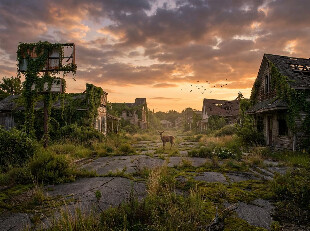
Picture a street you know. Now imagine an area where you do not pay attention to the noise of cars, the sound of humans wearing shopping bags, and the rumble of street cleaners. In their place, a wolf moves quietly across roads. A group of deer eats the flowers growing through a square with monuments. Thick vines, like snakes, cover the lower parts of tall buildings, and inside the empty lobby, a family of foxes sleeps where a security guard used to check IDs.
This is not an idea. This is not a film set. This is what happens when people leave. Shut the door behind them.
When human beings leave an area, whether or not it’s due to a catastrophe, problems, or a virus, it looks like an occasion. For nature, it’s like an opportunity. Within weeks of humans leaving, nature starts to evolve to repair itself. The place around Chornobyl, which was empty for forty years, now has wolves and bison. The canals in Venice, which had once been full of tourist boats, are clean now. Had dolphins. In Barcelona, wild boars walked down the street called Las Ramblas.
The question is there. It is a bit scary: What happens when people stop being in charge?. Why, no matter how strong our buildings seem, does nature always, in the end, take over?

The Science of Reclaiming: How Nature Takes Over
We act as if our cities are permanent. They’re not. They’re a brief rental agreement, and the moment we stop paying attention, the landlord—biology—starts eviction proceedings.
The process of nature moving back in has a scientific name: rewilding. It’s not a slow, gentle creep. It’s a cascade. A vacuum forms the second we stop trimming, mowing, trapping, and riding. And as the ancient physics adage goes, nature abhors a vacuum. Animals don’t philosophize about the vacancy; they just fill it.
The playbook follows a predictable chain called ecological succession. First, the pioneers: spores and seeds. Dandelions fracture concrete. Moss softens asphalt. Bugs and spiders follow the green. Then come the rodents, birds, and scavengers. With food and shelter plentiful, the middle-tier predators like foxes, raccoons, and wild cats arrive to hunt in cars and pipes. Finally, if the place stays abandoned, the top predators return. Wolves, bears, and big cats reclaim their hunting grounds, not caring that the ground is now paved.
Here’s what that timeline looks like on an accelerated scale:
- Days/Weeks: Pigeons, sparrows, rats, and cockroaches multiply. Without waste management, insects become a dense protein layer that feeds everything above them.
- Months: Deer, foxes, and raccoons establish territories. Empty yards and parks become ideal browsing zones. Fences mean nothing.
- Years: Wolves, bears, and lynx move in. The larger predators find structural collapse perfect for denning. A collapsed roof is a cave. A subway tunnel is a bat colony with air conditioning.
- Decades: Entire ecosystems rebalance. Wetlands reform in basements. Forests swallow strip malls. A food web that doesn’t involve a single grocery store flourishes.
Given time, nature always wins. Our structures are temporary. The natural world endures, adapts, and ultimately erases our hard edges.
Iconic Case Studies: Ghost Towns Turned Wildlife Sanctuaries
The theory is elegant, but the real-world stories give it teeth. Here are the places where the wild punched through the pavement in a way so striking it made humanity hold its breath.
Chornobyl & Pripyat, Ukraine (The Ultimate Example):
In 1986, reactor four exploded. A hundred thousand people were evacuated within 36 hours, leaving behind a fully furnished Soviet city. The expectation was a radioactive wasteland, a dead zone. Nearly 40 years later, the truth is far more complex and astonishing. The zone is now Europe’s largest accidental nature reserve. Wolves stalk the rusting amusement park. Brown bears dig through abandoned apartments. Endangered European bison—heavier than a pickup truck—wallow in the overgrown collective farms. Lynx and wild boar are everywhere.
Yes, radiation damages DNA. But as a 2020 study by Smith and others highlighted, the absence of humans is a far greater positive force than the lingering radiation is a negative one. A wolf in the zone faces no hunters, no cars, and no habitat destruction. It faces the invisible hazard of radionuclides, but evolutionarily, that’s a trade-off nature gleefully accepts. The contrast is so stark that scientists now openly debate whether the exclusion zone, a monument to human engineering failure, is actually safer for wildlife than our “clean” forests outside it.
The Lockdown Window: Venice, Italy:
When COVID-19 locked down Italy, all the tourist boats disappeared from the Grand Canal. The water got clear within days. You could see fish swimming and silver clouds of fish reclaiming the waterways. Then swans, ducks, and even dolphins showed up. The dolphins were spotted gliding near the port. It was not a change. The boats came back. But it showed how easily nature can take over. Wild animals are always a step away, waiting for the noise to stop.
Barcelona’s Downtown Strollers:
The empty streets of Barcelona during the pandemic attracted a kind of visitor. Wild boars out at night started to roam the streets. They walked down Diagonal Avenue like they owned the place. They sniffed the ground, and their babies played under cars. A city with 1.6 million people became a food source for animals that lived there before the Sagrada Familia was built.
Goats in the Welsh Streets:
A flock of goats from the Great Orme headland in North Wales came right down to the metropolis of Llandudno. They trimmed the hedges outside a college. They hung out in the churchyard. They even posed for photos in the middle of streets. They seemed comfortable, like they owned the town.
Sika Deer, in Japanese Ghost Towns:
In Nara Park, the deer are considered sacred. They bow for food. When tourism stopped and the streets emptied, the deer started to explore areas. They walked into silent subway stations. They overran empty shopping arcades, their hooves clicking on tile floors designed for salarymen, not ungulates. The image was jarring—a placid, park-dwelling animal suddenly looking like a stencil of the wild pasting itself over modernity.
The American Southwest’s Mining Towns:
Across Nevada and Colorado, old ghost cities that were once filled with human beings seeking out silver and gold are now thriving. These towns had been abandoned a long time ago, but now you may see elk walking around where miners used to work. The old wooden frames of saloons are hiding spots for mountain lions. The ground was once very bad because of the way people used to mine for gold and silver. Now it is getting better because of the native grasses and juniper trees that are growing there. This shows that even land that was hurt by people can be fixed if we just leave it alone.
Why Animals Thrive in Abandoned Human Spaces
What’s the secret sauce? Why does a leaking reactor town or an empty pandemic street become a paradise? It boils down to a handful of factors that, for wildlife, represent the ultimate jackpot.

- No human disturbance: The single greatest stressor for a wild animal is our presence. Remove the hiker, the hunter, and the traffic, and cortisol levels plunge. Animals feel safe, and safe animals breed.
- Abundant shelter: We leave behind ready-made real estate. An office block’s elevator shaft is a vertical bat cave. A collapsed roof is a badger sett with pre-installed insulation.
- Reduced competition: Without logging, farming, or industrial activity, the landscape’s resources—berries, cover, and water—suddenly have no human owner. There’s no hunting pressure, no competition for space.
- Silence & darkness: Industrial light pollution and chronic noise mess with migration, predation, and sleep. An abandoned town goes quiet and dark. At night, the animals that hunt in the dark are in charge again. The animals that are awake during the day can sleep deeply like they need to.
Becky Thomas, an ecologist at Royal Holloway, said, “The animals that live near us are very good at adapting. They will find food. Take advantage of new opportunities when we are not around.”
Being able to adapt is a powerful thing. A deer does not care that the warm and dry pipe it is sleeping in was built by people to drain water. The deer just cares about staying alive. And in a ghost town, survival comes easy.
The Bigger Picture: What This Reveals About Humanity & Nature
We normally think of those ghost towns as scary or unhappy, with Ferris wheels and empty faculty desks. If we study them otherwise, we can see that they are honestly full of life and boom. Ghost cities aren’t just reminders of what we misplaced; they may also be examples of what the Earth can benefit from while we’re not around.
There’s a deep, humbling paradox here. Chornobyl, arguably one of our most devastating self-inflicted mistakes, accidentally became one of nature’s greatest sanctuaries. The power plant that melted down created a haven for wildlife that Europe’s manicured national parks struggle to match. The tragedy didn’t destroy life; it just changed the rules about which life could be there.
This shows us something about ourselves: even when we are doing things that seem harmless, like hiking or visiting places, we are still having a big impact. We are loud and scary. We can be overwhelming to other living things. When we are not around, the pressure is. The Earth can flourish. The story of the Earth taking back its space is not a story; it is a story about love between the Earth and the plants that never stopped growing. The things we build are just temporary. The Earth has been growing and changing for billions of years.
Conservation & Ethical Considerations
The sight of wolves in Chornobyl or boars in Barcelona makes us think about questions. Should these unexpected safe places get protection? Is it right to destroy and rebuild them knowing how fast life comes back? In some places like Chornobyl, there is much wildlife, and the area has become a very important place for animals that are in danger elsewhere.

This isn’t about leaving ruins alone. It’s starting a movement to give land back to nature on purpose. Studies show that it doesn’t just help kinds of animals live there. It also takes carbon out of the air, reduces flooding, and even helps people’s mental health. Houses near these areas often become more valuable because people want to live with nature, not noise.
It’s not all news. Not every animal can return to living in the wild. During the pandemic, the macaques in Lopburi, Thailand, who were used to being fed by travelers, brought on chaos when the meals stopped. They fought over food, broke into homes, and caused issues.
Some animals get too used to people. Forget how to survive on their own. We have to help them transition, not just leave them.
Conclusion: The Haunting Beauty of Nature’s Victory
Ghost cities remind us that we are not as sturdy as we suppose, yes. They also show how sturdy nature can be. A wolf in a doorway, a tree developing through a manufacturing unit floor, and a dolphin in a transport canal. These are not signs and symptoms of the end. They prove that life is a force that will always come back.
The world is always. Moving. It does not care that we are gone. It moves into our spaces with a strength that should make us feel small. Every parking lot and closed factory is a space waiting for nature to take over.
When you see an old empty building, do not just see something broken. Think about the animals already moving in. A fox would possibly squeeze through a window, and an owl may nest inside the attic. Think about this: what if we left more spaces for nature to take over on purpose? Not as an escape. As a way to share. The beauty of nature winning is that it does not need us to win. It would be smart for us to permit it.
The world will always be right here long after we are gone. That is a concept that ought to make us humble.
We should reflect on how we can work with nature, not towards it. Maybe, just perhaps, we can study the ghost towns and the flora and fauna that remain.



[…] is the oldest lesson in wildlife history, and it still holds: predators do not just reduce prey populations. They redesign […]