


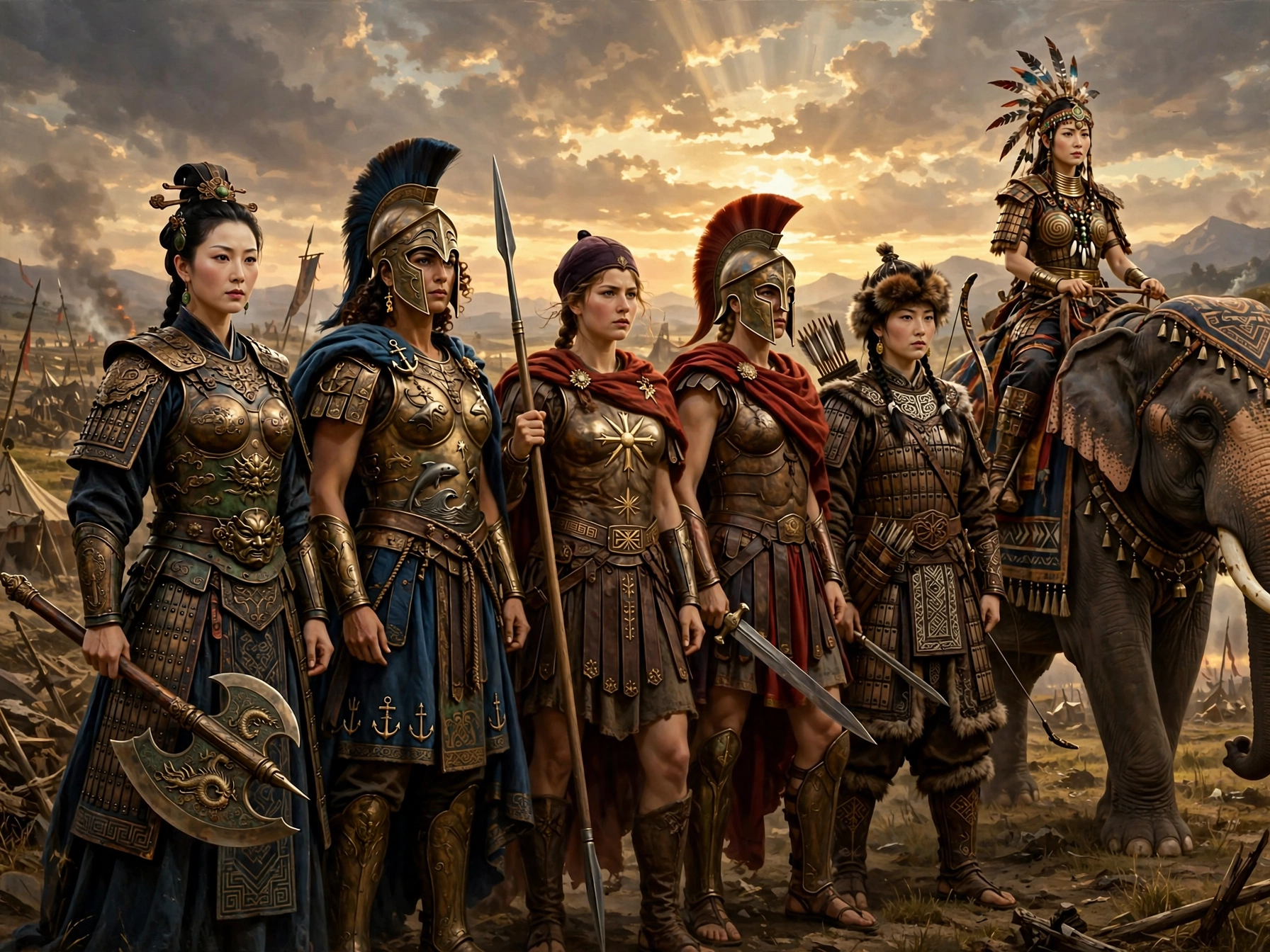
Pick up almost any history book covering ancient warfare. Flip through it. You’ll find Alexander. Caesar. Hannibal. Sun Tzu. Maybe Scipio Africanus if the author was feeling generous.
What you probably won’t find — not even in the footnotes — are the women who did the same job. Not because they didn’t exist. They absolutely did. They commanded real soldiers in real battles, made strategic decisions that changed the outcomes of wars, and in several cases outperformed every male general around them.
The problem was never their ability. The problem was who got to write the history books afterward.
So let’s talk about six of them. Not as symbols. Not as “empowering” historical curiosities. As what they actually were — military commanders who happened to live in a world that preferred not to remember them.

Fu Hao—China’s First General (And She Was a Woman)
Here’s a name that should be taught in every world history class and rarely is: Fu Hao.
She lived around 1200 BC, during China’s Shang Dynasty, as one of the wives of King Wu Ding. Now, Wu Ding had many wives—that was standard for rulers of the period. Most of them left behind little historical trace. Fu Hao left behind something entirely different: oracle bone inscriptions—some of the oldest written records in Chinese history—that describe her leading military campaigns on multiple fronts simultaneously.
We’re not talking about symbolic leadership here. The inscriptions specifically record her commanding 13,000 troops. That was the single largest army mentioned anywhere in those texts. Larger than any of the male generals of the same period.
She fought against the Tu Fang, the Ba Fang, the Yi, and the Qiang. She won. Repeatedly. She also served as high priestess, which in Shang China carried enormous political weight. Military power and religious authority, both in one person. The king sent her to fight his most difficult wars and trusted her with his most important rituals.
For a long time, scholars treating these inscriptions weren’t sure what to make of them. The assumption — unstated but obvious in retrospect — was that a woman commanding 13,000 soldiers seemed unlikely, so maybe the texts were being misread.
Then in 1976, her tomb was found near Anyang, in Henan Province. Untouched. Inside are bronze weapons, battle axes, jade pieces, and ceremonial objects. The physical evidence of exactly what the inscriptions had described all along.
She was real. The army was real. The doubt was the only thing that wasn’t.
Artemisia I — The Admiral Who Told Xerxes He Was Wrong (He Was)
The Persian invasion of Greece in 480 BC is one of the most written-about military conflicts in Western history. You know the story — Thermopylae, the 300 Spartans, the Battle of Salamis.
Here’s a piece of that story that gets left out almost every time: one of Xerxes’ most capable naval commanders was a woman named Artemisia I, ruler of Halicarnassus on the western coast of modern Turkey.
She commanded five ships in the Persian fleet. That doesn’t sound like much until you consider that Herodotus — a Greek historian writing for a Greek audience, with every possible motive to minimise her — went out of his way to praise her judgement. He described her as the one commander in Xerxes’ council who actually gave him useful advice before Salamis.
Her advice was: don’t fight the Greek fleet here. Your land army is stronger. Use it. The sea conditions favour the Greeks. This is a bad position.
Xerxes listened to his other commanders instead. The Persian fleet was destroyed at Salamis.
During the chaos of that battle, Artemisia found herself boxed in—Greek ships closing from one side, Persian allied ships blocking the other. She made a decision that was either brilliant or ruthless depending on how you look at it: she rammed and sank one of her own allied ships to break through the line and escape.
The Greeks watching saw a ship go down and assumed she had switched sides. They called off the chase. She got out.
When Xerxes was told what she had done, what he reportedly said was this: his men had become women, and his women had become men. It was meant as a compliment to her and an insult to everyone else.
She was the one who told him not to fight that battle. She was also the one who survived it.

Cynane — The Half-Sister Alexander Never Got Credit For
Alexander the Great had a half-sister named Cynane. You almost certainly haven’t heard of her. That’s not an accident.
Her mother was Audata, an Illyrian princess — and Illyrian women were raised with military training as a cultural norm. Cynane got that upbringing in full. Philip II, her father, recognised what he had and didn’t waste it. She trained seriously and fought seriously, and according to ancient sources, she once killed an Illyrian queen named Caeria in single combat during a military campaign.
Think about what that actually means for a second. Not symbolic battlefield presence. Not leading from the rear. Single combat with an enemy commander, who did not survive it.
After Alexander died in 323 BC and his generals immediately started carving up the empire and fighting each other, Cynane didn’t run or quietly step aside. She raised her own army and marched into Asia with the specific goal of forcing a royal marriage for her daughter Adea – a move that would have given her significant political leverage in the post-Alexander power struggle.
The Macedonian generals found this threatening enough that they had her killed mid-march.
It backfired completely. The soldiers who witnessed the assassination — men who knew exactly whose daughter and sister she was — turned on the generals who ordered it. The outrage was immediate and genuine enough that Adea received exactly the political position Cynane had been trying to secure.
She was assassinated because she was dangerous. That’s the most honest assessment of how seriously people took her.
Arachidamia — She Walked Into the Council Room With a Sword
Sparta had a well-known reputation for treating women differently than the rest of Greece. Spartan women exercised, owned property, and were expected to raise sons who could fight. That’s the reputation anyway.
What happened in 272 BC tests even that reputation.
Pyrrhus of Epirus was marching on Sparta. This was not a minor threat — Pyrrhus was arguably the finest tactical general of his era. The Romans, who eventually fought him, acknowledged his genius even while defeating him. The Spartan army was largely away on a campaign elsewhere. The city was exposed.
The council met and came up with a plan: evacuate the women and children to Crete before the siege began. Keep the remaining men to defend what they could.
Arachidamia walked into that council meeting carrying a sword and told them, without much diplomatic softening, that the women of Sparta considered the idea insulting. They had no interest in outliving a city they weren’t allowed to help defend.
The evacuation plan was dropped.
What followed was an all-night operation organised largely by Arachidamia—women, older men, and enslaved people digging a defensive trench across the likely approach routes, working through the dark so that the fighting men could sleep and be ready for the assault at dawn.
Pyrrhus attacked. Sparta held.
He never took the city. Most histories of the engagement credit Spartan warriors and tactical positioning. Arachidamia, who organised the night’s defensive work that made that stand possible, gets a sentence at best.

Lady Triệu — Nineteen Years Old, Thirty Victories
Vietnam in the third century AD was under Chinese occupation—specifically under the Wu Kingdom, which was aggressive about maintaining control over the territories it held.
In 248 AD, a young woman named Triệu Thị Trinh decided she had seen enough.
She was somewhere between nineteen and twenty-three years old, depending on which sources you trust. She gathered fighters — estimates range from a few hundred to several thousand — and launched a military campaign against Wu forces. What followed wasn’t a single dramatic last stand. She won more than thirty engagements before the Wu Kingdom responded with a force large enough to finally overwhelm her.
When people compare her to Joan of Arc, they usually mean it as a compliment. The comparison actually undersells her — she came first by more than twelve centuries.
Vietnamese oral tradition built a mythology around her over time: nine feet tall, a voice like a bell, riding a white elephant into battle. That kind of legend doesn’t attach itself to people who didn’t do something genuinely remarkable. It grows around someone whose real deeds needed a larger-than-life frame to feel accurate.
She died at twenty-three. Vietnam never forgot her—she has temples, a national holiday, and a place in the country’s foundational story. Most people outside Vietnam have never heard her name.
Khutulun — The Mongol Warrior Nobody Could Beat
Khutulun sits at the edge of the timeframe this article covers – she lived from around 1260 to 1306 AD. But leaving her out would be a mistake.
She was the great-great-granddaughter of Genghis Khan. Her father, Kaidu Khan, was one of the most powerful rulers in Central Asia at the time. She fought alongside him for years, and the accounts of her on the battlefield are consistent across sources from multiple cultures: she was ferocious, effective, and physically imposing in a way that made her genuinely feared.
One specific tactic she used repeatedly — breaking through enemy formations and physically pulling enemy soldiers out as captives to bring back to her father — is described in sources ranging from Persian chronicles to Marco Polo’s accounts. She wasn’t riding at the back of the army. She was the one going in first.
Her marriage rule is what most people remember when they do know about her: any man who wanted to marry her had to beat her in wrestling first. Lose, and he owed her one hundred horses. She never lost. She accumulated over ten thousand horses. She also never married until she chose to, on her own terms.
Marco Polo wrote about her. Persian historians wrote about her. She was not obscure in her own time. She became obscure to us.

So Why Don’t We Know Any of This?
It’s worth asking directly.
These weren’t minor figures operating at the edge of events. Fu Hao commanded the largest single army in the written records of her era. Artemisia was trusted by the most powerful ruler in the ancient world and praised by the enemy historian most motivated to ignore her. Cynane was literally Alexander the Great’s sister. Arachidamia helped save a city from one of history’s best generals. Lady Triệu won thirty battles before she lost. Khutulun was written about by Marco Polo.
The erasure required active work. Male historians wrote for male audiences in cultures that had already decided what military leadership looked like—and it didn’t look like this. When women appeared in military contexts, they were reframed as anomalies, footnotes, or myths. Their contributions were credited to the men beside them or quietly left out of the record.
The shift is coming, slowly. Fu Hao’s tomb forced a reassessment. Archaeological discoveries of armed female skeletons in Scythian burial mounds — women buried with weapons and horses, in warrior graves — put a serious dent in the long-held assumption that Amazons were pure myth. Physical evidence keeps surfacing that the written record deliberately omitted.
History didn’t forget these women. It decided not to write them down in the first place.
What Stays With You
Fu Hao led 13,000 soldiers at a time when most of the world hadn’t yet invented the kind of writing that could record it. Artemisia gave correct strategic advice to an emperor who ignored her and then survived the disaster she’d predicted. Cynane was killed because the men around her found her too politically dangerous to let live — and her plan succeeded anyway. Arachidamia dug trenches in the dark to save a city the men wanted to abandon. Lady Triệu was nineteen and won thirty fights before she lost. Khutulun collected ten thousand horses and chose her own life on her own schedule.
None of this is mythology. None of it is modern invention. These are documented people whose documentation was buried, minimised, or simply never emphasised.
You know their names now. That’s a start.



+ There are no comments
Add yours