


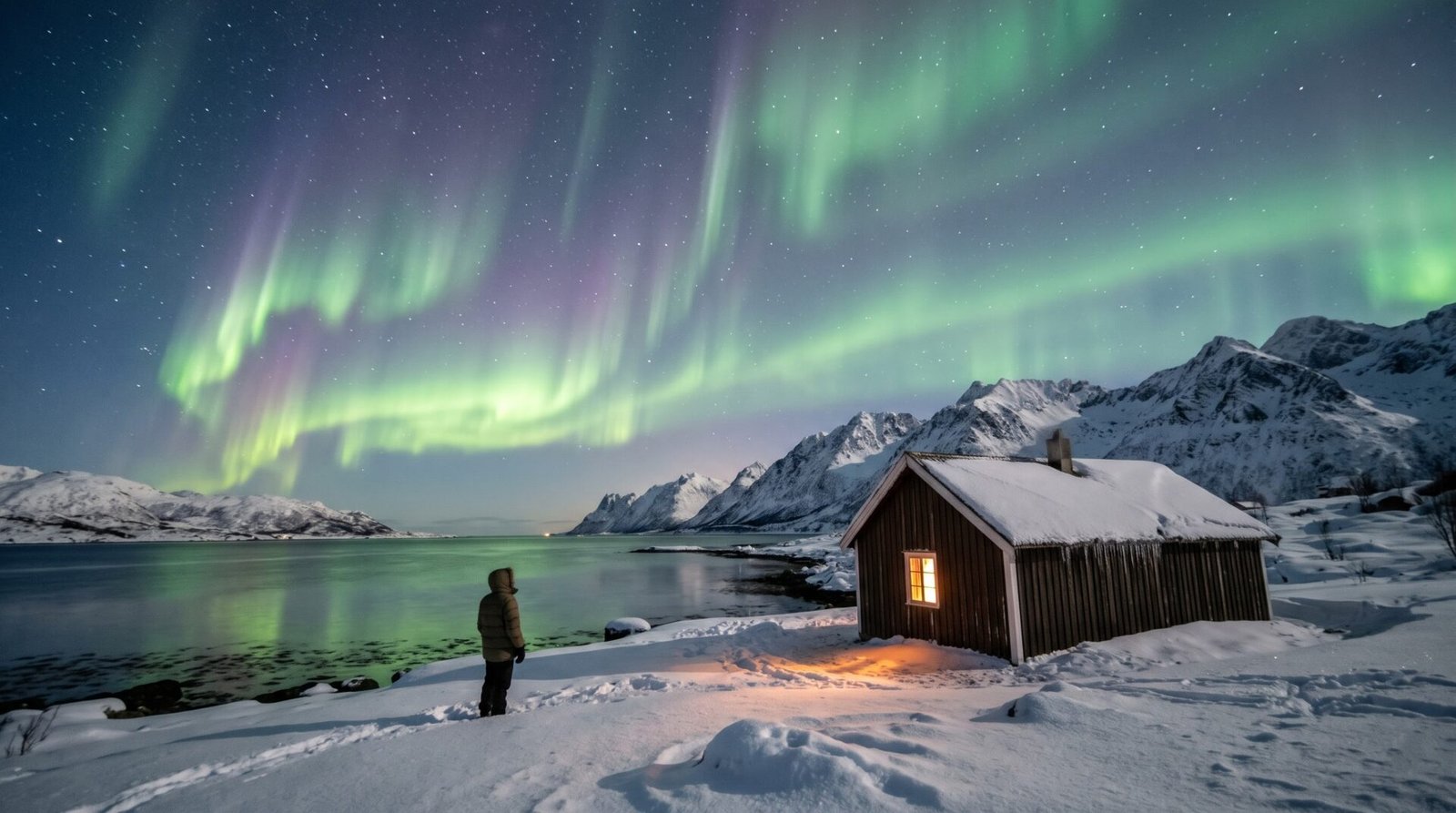
Back in May 2024, a strong geomagnetic storm lit up skies that rarely see the aurora. People in Spain, Florida, and even parts of Asia wandered outside and discovered the night sparkling pink and green. A second massive hurricane showed up in October. If you adore the Northern Lights, 2024 felt just like the year the whole lot arrived right now.
Then the sun passed its peak, and the conversation moved on. A lot of people quietly decided the best years were over, so there was no point booking anything.
I think that’s the wrong call. If you’re thinking about heading north this winter, 2026-27 isn’t a leftover season. For anyone who cares about the price tag as much as the show, it may be one of the smarter ones to pick.
What “After the Peak” Actually Means
The Sun works on a cycle of about eleven years. The current one, Solar Cycle 25, hit its sunspot maximum around late 2024, according to the US space weather agencies. That’s why you keep hearing that we’re on the downslope.

Sunspots, though, are one of the simplest ways the Sun shakes Earth’s magnetic field. The aurora happens when charged particles from the Sun slam into it, and particles are available in most important approaches. The dramatic one is a coronal mass ejection, a massive burst of plasma, and these are most frequent near the peak. The quieter way is a coronal hole, a dark patch in the Sun’s outer environment that shall we fast solar wind pour out for days at a time.
Coronal holes tend to grow bigger and last longer as a cycle winds down. Solar researchers have noticed for decades that geomagnetic activity often has two humps within a cycle, one around the maximum and another during the decline. The standard example is the Halloween storms of October 2003. They hit roughly two and a half years after the previous cycle’s peak, and they set off auroras and satellite headaches around the planet.
So the lights don’t shut off when the maximum passes. They alternate their habits. You get fewer once-in-a-decade nights; however, a steadier trickle of sunshine keeps things busy.
There’s also something people overlook. If you’re standing in Tromsø, Finnish Lapland or northern Iceland, you’re already under or near the auroral oval, the ring around the magnetic pole where displays happen most often. You don’t need a record storm up there. A modest disturbance will do, because the oval is practically above your head. The solar maximum mattered most to people at lower latitudes, who were waiting for the aurora to come to them. If you’re willing to travel north, your odds are always better.
One honest caveat: nobody can promise this winter beats the last one. Space weather can’t be forecast months in advance. What I can say is that the season is still lively, and the cost side has probably improved.
Why Your Wallet Might Like This Year
Peak years bring peak demand. When aurora pictures flood each feed, flights north top off, cabins sell out many months early, and charges climb to suit. Once the excitement fades, bookings often cool off a little. I won’t promise a bargain, since Nordic travel is pricey in any year. But you’ll usually find more choice and more flexibility around your own dates.
The other money-saving factor is a habit rather than a discount, and it’s the most useful rule in this whole guide.
The Three-Night Rule
Stay at least three or four nights in one place. If you remember one thing from this article, make it that.
The lights need two things: activity in the sky and a clear view of it. You control neither. Clouds can ruin an entire evening even when the sun is doing its job. One night is a gamble. Four nights give you a real shot at one clear window, and the cost per night often ends up lower than a hurried one-night trip that gets clouded out.
When to Go
In the Nordic location, the season runs from kind of September to early April. Earlier than that, the sky is too bright, and later the nights are too short.
Two stretches are worth your attention.
The equinox months. September and October, and then late February through March, usually bring a small rise in geomagnetic activity. There’s a name for the reason: the Russell-McPherron effect. Around the equinoxes, the tilt between Earth’s magnetic field and the Sun’s wind makes it easier for particles to get in. The skies are dark enough, and the weather is kinder than in midwinter.
Deep winter. November to January offers you the longest nights. In Tromsø, the polar night lasts from late November to mid-January, and the sun in no way clears the horizon, so you can begin searching in the afternoon. The price you pay is more cold, more storms, and short, gloomy days for everything else on your itinerary.
If you’re watching your budget, late February to March is a great compromise. Daylight comes back, so you can hike or sightsee. The evenings are still properly dark. And prices tend to sit below Christmas and New Year levels.
On any single night, the likeliest window is more or less 9 p.m. To 1 a.m., though a display can pop up on any dead night. It usually arrives in bursts, from a few minutes to an hour or more. Patience beats perfect timing.
Check the Moon, too. A bright full moon washes out faint auroras and makes photos harder, though a strong show punches through anyway. A quick look at a moon calendar while you pick dates costs nothing.

Reading the Forecast Without a Science Degree
You don’t have to treat space weather as a hobby. Two numbers and one map are enough to change how you plan your evenings.
The Kp index runs from 0 to 9 and measures how disturbed Earth’s magnetic field is. A higher number pushes the oval farther south. At Kp 5 or above, the lights can reach northern Britain or the northern US. But if you’re in Tromsø or Lapland, Kp 1 to 3 can be plenty, provided the sky is dark and clear. A Kp 2 night under open sky beats a Kp 6 night under heavy cloud every time.
The second number is Bz, which describes the direction of the magnetic field carried by the solar wind. When Bz points strongly south (shown as a negative value), Earth’s field links up more easily with the solar wind, and the aurora gets stronger. Many forecast apps show it next to solar wind speed. Anything above about 500 kilometres per second is a good sign.
The map that matters most is cloud cover. Check it first, always. Yr from the Norwegian Meteorological Institute, the Icelandic Met Office and the Finnish Meteorological Institute all publish solid cloud forecasts. NOAA’s Space Weather Prediction Center offers free aurora forecasts, and several free apps repackage the same data in a friendlier form.
So the routine goes: clouds first, then Kp, then Bz. If the sky is clear and the numbers look ordinary, put your coat on and go outside anyway. The aurora doesn’t always follow the forecast.
Base One: Tromsø, Norway
Tromsø sits at about 69.6°N, right under the oval. It’s an island city with an international airport, a small centre and a busy tourism trade. For a first-time aurora traveller, it’s the easy option, with short transfers, lots of hotels and guesthouses, and a long list of tour operators.
The coast keeps temperatures milder than you’d expect that far north. The catch is that the sea brings cloud, so hunting for a clear patch of sky is a normal part of the trip. That’s why operators run buses and minibuses up into the mountains or across the border toward Finland and Sweden when the coast is socked in.
Those tours can be great, but they’re also the biggest single expense, often in the low hundreds of pounds or dollars per person. A cheaper plan is to mix things up: book one guided chase for the night you most want to go all out, and spend the other nights near town.
You don’t have to travel far. Prestvannet, a lake on the edge of the city, is popular with locals because you can walk there from the centre and the light pollution is lower than on the streets. Telegrafbukta, a beach on the island’s northwest side, is reachable by public bus and has an open sky over the water. Both are free, and the bus fare is a sliver of what a tour costs.
For food, supermarkets like Rema a Thousand and Coop promote sandwiches and ready food at a fraction of eating-place prices. A thermos of something hot
Base Two: Finnish Lapland
Finnish Lapland is a different sort of trip. It’s quieter and more spread out, with forests, frozen lakes, and small cities rather than a city. The inland air is less warm and drier, which often means clearer skies than at the Norwegian coast. Regional tourism forums say the lights can show up on well over 100 nights a year within the far north, and the quantity frequently quoted for the northernmost areas is around two hundred. Take that figure loosely, but the point stands: Lapland is a robust bet.
You have numerous bases to choose from. Rovaniemi, on the Arctic Circle, is a perfect choice, with an airport and a railway station. Levi and Ylläs are ski resorts with a complete winter calendar. Saariselkä, Inari and Utsjoki lie farther north, are quieter and darker, and tend to look at the lighting fixtures more often, although they take longer to reach.
The biggest saving is in the way you get there. Domestic flights to Rovaniemi can be high-priced, mainly in the winter. Finland’s rail network is cushy and dependable, and the overnight train from Helsinki to Rovaniemi gives you a mattress and saves a night’s accommodation. Often the most inexpensive course is to fly into Helsinki, where worldwide fares are lower, and carry on north by train or bus.
Be careful with the famous glass igloos and aurora cabins. They’re adorable, and they’re also one of the various approaches to seeing the lights. On a tight budget, pick out an easy cabin or condominium with a kitchen and book one out-of-doors excursion for the night you want to revel in the total. Many Lapland towns have unlit spots far away from streetlights, and a rental car shared by 3 humans can cost much less than a few excursion tickets, even while letting you circulate every time the sky opens up.
And dress seriously. Inland Lapland can fall well below minus twenty degrees Celsius, which is a very different kind of cold from the coast.

Base Three: Iceland
Iceland sits a bit farther south, with Reykjavík at about 64°N. It’s not directly under the oval, but it’s close enough that a decent geomagnetic night can put on a real show, and the size of the island and its road network give you room to move around.
What Iceland has going for it is variety. If clouds damage a night, you’re nonetheless within a quick drive of waterfalls, geothermal pools, black-sand beaches, and glaciers. That’s the quiet secret of a good aurora experience: pick an area you’d revel in touring even though the sky does nothing.
For a budget plan, make Reykjavík your base. The Grótta lighthouse, simply west of the town, is one of the best uncrowded viewing spots, with dark water, open sky, and a quick drive from the centre. An automobile, in case you’re confident on wintry roads, opens up Þingvellir National Park and the south coast. Many groups sell combined day excursions and aurora evenings, which may be true value when the portions are priced collectively.
Winter riding in Iceland merits admiration. Roads get icy, the climate changes quickly, and the countrywide street authority and weather carrier post live updates and warnings. If you’re uncertain, an excursion is more secure than a bet.
On meals, the supermarkets Bónus and Krónan are the price-range-friendly choice, and Icelandic faucet water is unfiltered and incredible, so bypass the bottled stuff.
Where the Real Savings Come From
A Northern Lights trip has a reputation for being expensive. Some of that is earned, since Norway, Finland, and Iceland are costly countries. But some choices depend more on than any cut-price code.
Shift your dates. Moving from Christmas week to past-due February or early March can reduce flight and lodge charges, and it regularly makes the trip better too.
Cook for yourself. Choose an area with a kitchen, keep on the grocery store, and shop for eating place meals for one special evening.
Mix tours and independent nights. One nicely selected guided chase improves your odds on a cloudy night, and the opposite nights can be valued for nothing.
Stay a little outside the centre. A cabin or guesthouse 20 minutes to half an hour from town is regularly less expensive and darker and now and again lets you watch the sky from the doorstep. Count the cost of an automobile or switch first.
Borrow or buy second-hand for the cold. Thermal layers, insulated boots, wool socks, mittens and a right hat aren’t optionally available. Renting equipment on arrival is feasible; however, it adds up quickly. Ask pals, check second-hand stores, and test everything at home earlier than you fly.
Compare packages carefully. A package of flights, lodging and excursions may be an excellent cost, but best in case you fee the identical portions one after the other and compare in reality.
Book the stay, not the single night. Once more: three or four nights in a single area beats a one-night ride, however cheap it appears.
A Few Notes for the Night Itself
Give your eyes 15 to 20 minutes to adjust away from lights. Many shows begin faint, like a pale grey band, and phone cameras often pick up the shade earlier than your eyes do.
For photos, a phone with nighttime mode and something consistent to rest it on is sufficient. A small tripod helps, and so does the timer, which spares you the shake of the urgent button. Cold drains batteries quickly, so maintain spare heat inside your jacket.
Dress for standing still. The cold you feel at 11 p.m. when you’re not moving is much harsher than on a daytime walk. Hand warmers, a flask and a folding seat pad all make a difference.

A Simple Season Planner
As I write this, it’s 10 November 2026, so the season is already underway and the longest nights are just ahead.
September to October 2026: Equinox activity and milder temperatures. This window has passed for this year.
November to January: Polar night in Tromsø, maximum darkness, and the coldest, cloudiest conditions on the coast. Christmas and New Year weeks cost the most.
Late February to March 2027: A second equinox rise, returning sunlight hours, and commonly better costs. For many travellers, that is the pleasant balance.
Early April 2027: The season fades as nights brighten, even though the far north can still produce late suggestions.
If you’re analysing this and considering the coming winter, there’s still time. Flights and rooms for February and March are frequently available, specifically out of faculty vacations.
The Bottom Line
The idea that the northern lights vanish after solar maximum is a myth. The Sun is easing off, but the oval hasn’t moved, coronal holes still send fast wind our way, and Arctic nights are as dark as ever. What has changed is the pressure: fewer headlines, slightly less demand, and more room to plan a trip on your own terms.
Pick a base you’d enjoy without the lights. Give yourself three or four nights. Check the clouds before the numbers. And remember that the best aurora stories rarely come from a perfect forecast. They come from someone who stayed out in the cold a little longer than was sensible, looked up, and watched the sky start to move.



+ There are no comments
Add yours