


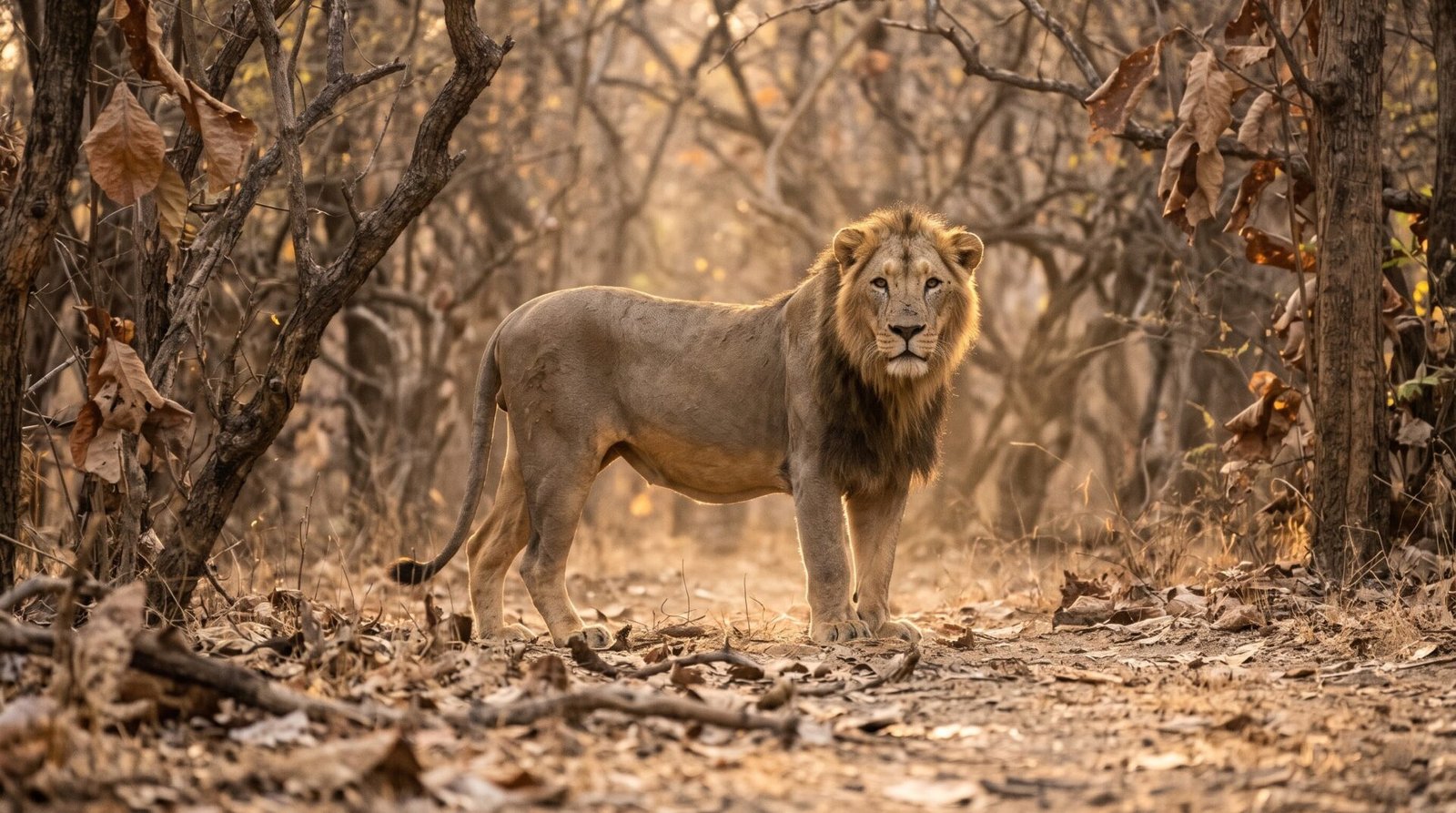
Go back a few centuries, and you wouldn’t have needed a safari to see a lion in India. They hunted over the open plains of Punjab, Haryana, Rajasthan, Madhya Pradesh, and Bihar. Now, outside Africa, there’s exactly one place on the planet where wild lions still live: a stretch of dry forest in Gujarat called Gir.
Read that again, because it’s a strange sentence. An animal that once ranged across half of Asia is down to one corner of one Indian state. How did we get here, and why Gir and not somewhere else?
A lion from Greece to Bengal
The Asiatic lion (Panthera leo persica) is its own subspecies, close kin to African lions but not the same animal. Its old range ran from southeastern Europe through Turkey and the Middle East, across Persia and Pakistan, and into northern and central India. Herodotus wrote about lions going after the camels in Xerxes’ baggage train. Assyrian kings had lion hunts carved on their palace walls. Closer to home, lions sit on top of Ashoka’s pillars.

So these weren’t rare animals. People lived with them, feared them, and borrowed their image for power.
Then firearms got cheap and accurate. Shooting a lion became a way for kings, army officers, and colonial officials to show off. Forests were cleared for farms, and the deer and antelope that lions ate were shot out. By the mid-1800s, most of India had lost its lions, and the last northern ones were gone a few decades later. West Asia lost them around the same time. By the early 1900s, a small remnant hung on in Gir. Nobody counted carefully back then, and estimates run from about a dozen to a few dozen animals.
Picture the whole subspecies fitting on a single school bus. That’s how close it got.
The Nawab
So why, Gir? Partly because of one man.
The Nawabs of Junagadh ruled the princely state that held Gir, and at some point they decided the lions should be left alone. The story of how that began changes depending on who’s telling it. A popular version says Lord Curzon, the Viceroy, was invited to shoot a lion around 1900 and turned the offer down once he heard how few remained. I wouldn’t bet money on the details. What’s clear is that the Nawab imposed hunting restrictions and kept them in force when hardly anyone else nearby was doing anything similar.
I don’t want to make him a saint. These were rulers, not conservationists in today’s sense, and honoured guests were still allowed to shoot now and then. But set against the era, a king who limited hunting at all was unusual. It probably kept the species from disappearing for good.
After independence, the Gujarat government inherited the job. Gir became a sanctuary in 1965 and, as part of it, a national park in 1975. Numbers crept up, from around 177 lions in 1968 to more than 500 by 2015.
Why this forest worked
Protection alone doesn’t explain it, because the place itself suited them. Gir is a dry deciduous forest, scrubby in places, grassy in others, with rocky hills and a mix of teak, acacia and banyan. It’s far less lush than the tiger country of central India, but it’s full of the prey lions need: chital, sambar, nilgai, wild boar and chinkara. And the lions also take cattle, which leads to the next part.

The neighbours
Living in and around the forest are the Maldharis, herders who keep cattle, buffalo and goats. Their families have shared this ground with lions for generations. It’s not all peace and harmony. They lose animals, and they don’t enjoy it. Yet plenty of Maldharis talk about the lions the way you’d talk about an awkward neighbour you’ve known your whole life, and visitors from other countries are often startled by how tolerant some of these communities are.
That tolerance matters more than any signboard. A big cat can’t survive on rules and fences alone. In places where villagers poisoned carcasses or shot lions on sight, the cats didn’t last. Had that happened in Gir, the recovery simply wouldn’t have occurred. Compensation for livestock killed, rescue teams for lions that stray into villages, and jobs in tourism and forest work have all helped keep the goodwill from running out.
A real comeback
The most recent count, the 16th Asiatic Lion Census, took place in May 2025. It covered roughly 35,000 square kilometres across 58 talukas in 11 districts, and it came up with 891 lions. In 2020 the figure was 674, so that’s about a 32 per cent jump in five years. Go back to 2001, and the count was 327.
What surprised me most is where they are. About 384 lions live inside the protected Gir area, and around 507 live outside it. More than half, in other words, are no longer in the forest that made them famous. Amreli district alone has 332, more than any other district outside Gir. Barda Wildlife Sanctuary near Porbandar now has about 17, the first settled lions there in well over a century. And the census counted 330 adult females, which bodes well for the years ahead.
These lions rest in sugarcane fields, work coastal scrub, and cross farmland at night, and a few have wandered right down to the sea. A wider range is good news for the species. It also means lions share space with villages, highways and railway lines, and that’s where trouble starts.
So why only Gir?
If they’re thriving, why hasn’t a second population taken hold anywhere else?
Because nobody has pulled it off. Not for lack of planning, though.
In the 1990s, wildlife scientists suggested moving some lions to Kuno National Park in Madhya Pradesh. The reasoning was simple: if disease or disaster struck Gir, there’d be a backup. In 2013, the Supreme Court ordered the relocation. More than ten years on, it hasn’t happened.

Gujarat has pushed back, and the reasons are tangled. There’s pride, there’s politics, and there’s a real scientific argument too. Many people in the state treat the lion as a symbol of Gujarat’s identity and don’t want to part with it. Others say Gir’s lions are already spreading on their own across Saurashtra and don’t need to be moved. Meanwhile, Kuno ended up with a different cat altogether, the cheetah, brought from Africa from 2022 onwards. That muddied things further.
Project Lion, launched in 2020, now concentrates on creating new habitat and better monitoring inside Gujarat. Barda is the clearest example so far, and it’s progress. Critics point out, though, that every one of these sites lies in the same state and the same general ecosystem. That’s not real insurance.
All the lions in one basket
Biologists have a name for this: the single-population problem. It’s the reason conservationists keep raising it.
In 2018, canine distemper virus killed more than two dozen lions around Gir in a matter of weeks. Forest officials moved fast, vaccinating animals and separating the sick ones, and the outbreak was contained. Still, it shook people. Imagine something nastier spreading through the region, or a cyclone and flood at the wrong moment, or a drought that wiped out the prey. The whole wild subspecies would be exposed in one stroke.
Genetics adds another worry. Today’s lions all descend from a tiny founding group, so there’s little genetic variety among them. That doesn’t doom them, but it does leave them less able to cope with new diseases.
Everyday hazards pile on top. Open wells in farm fields trap lions that fall in. Trains and highways cutting through their range have killed some. Illegal traps and electric fences on farms are a problem too, and so is the occasional attack on livestock, or very rarely on people. Forest staff have put parapet walls around thousands of wells, set up rescue teams and tried to slow trains in risky stretches. It helps. But the pressure grows the further the lions spread into busier country.
What to make of it
You could tell this as a straightforward win, and honestly a lot of it is one. A subspecies that dropped to maybe a dozen survivors now numbers nearly 900. That rarely happens in conservation. A large part of the credit belongs to Gujarat’s forest staff, to local communities, and to a degree of everyday tolerance that’s hard to explain to outsiders.
But the full picture is shakier. Survival still hangs on one region, one state government’s choices, and not much room for error. Most experts agree the best next step is a genuine second home, far enough from Gir that a single disaster can’t reach both.

Until that happens, the honest answer to why the last Asiatic lions live only in Gir is a bit of history and a bit of unfinished business. They’re there because a few rulers, then a few governments, and a great many villagers decided to let them be. They’re still only there because no one has agreed on where else they could go.
If you ever get the chance, go. Sit quietly in a jeep at dawn and listen for the langurs and deer sounding their alarm calls. Whatever you end up seeing, remember that you’re looking at an animal that came back from the very edge.
Quick answers
Are Asiatic lions found anywhere other than Gir?
Wild ones live only in Gujarat, mostly in the Gir landscape and nearby districts. A few are kept in zoos and breeding centres elsewhere.
How many Asiatic lions are left?
The 2025 census estimated 891 in Gujarat.
Why were they nearly wiped out?
Mainly hunting, habitat loss, and fewer prey animals, most of it in the 1800s.
Why haven’t lions been moved to Kuno?
The Supreme Court ordered it in 2013, but Gujarat has resisted, and the move hasn’t gone ahead.



+ There are no comments
Add yours