


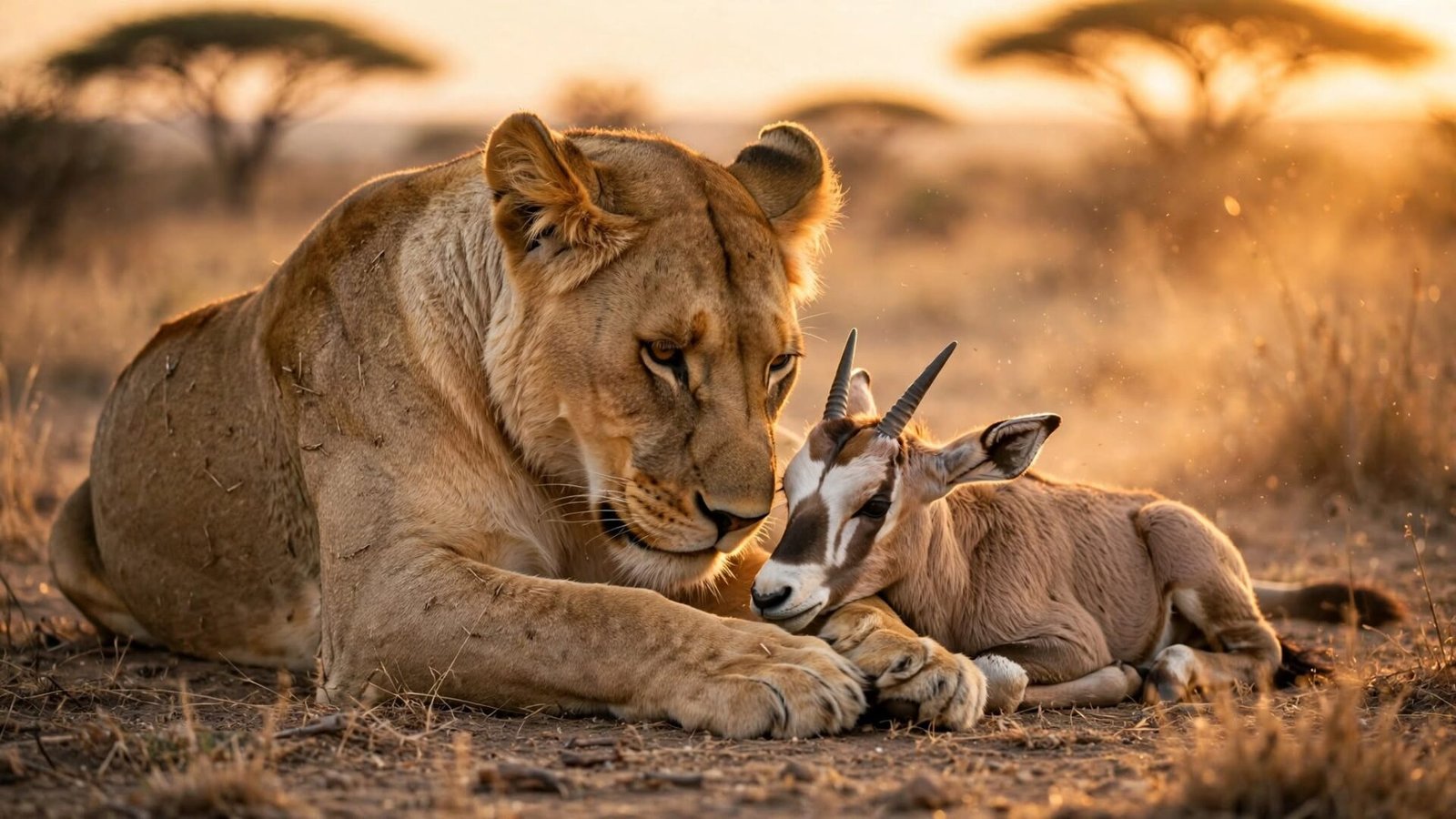
Every year or two, the same video makes the rounds online again. A lioness in Kenya’s Samburu National Reserve — an animal that, by every biological rule, should look at a baby oryx and see a meal — instead wraps herself around the calf like it’s her own. And she didn’t do this once. Rangers watched her do it with roughly six different oryx calves over the years. They eventually named her Kamunyak, which means “blessed one”. But honestly, the protection isn’t even the strangest part. The strangest part is that none of this is supposed to happen, according to how evolution is meant to work.
That contradiction is really what this whole topic comes down to. Animals aren’t wired to burn their limited energy raising something that doesn’t carry their genes forward. The logic of natural selection is pretty blunt about it: pass on your own bloodline, don’t waste resources on someone else’s offspring, and definitely don’t waste them on offspring from an entirely different species. And yet this rule keeps getting broken — in oceans, in forests, on open grassland, across completely unrelated corners of the animal kingdom.

The Cases That Shouldn’t Exist
The ocean gives us some of the clearest examples, so let’s start there. Off the coast of French Polynesia, researchers came across a bottlenose dolphin — already a mother to calves of her own — who had taken in an abandoned young melon-headed whale. This wasn’t some brief, confused moment either. The young whale genuinely settled into life among the dolphins. It swam with young male bottlenoses, picked up their habits, and even started surfing and leaping through waves the way they did. People who study dolphin behaviour point out that female dolphins occasionally “borrow” calves from rivals during social squabbles, but that’s a short-term thing. Sustained, ongoing care for a completely different species is a whole different category of behaviour.
Then there’s a case that sounds almost too on-the-nose to be real: a pod of sperm whales took in a sickly, malformed dolphin and simply let it travel with them, as though it had always belonged there.
Primates give us some of the more baffling examples. There’s a documented case of capuchin monkeys raising a baby marmoset as one of their own, despite the two species looking and behaving nothing alike. Among the great apes, researchers studying gorillas in Rwanda noticed something unexpected: when young gorillas lose their parents, it’s often the wider troop that keeps them alive — and interestingly, it isn’t just the females stepping up. Dominant adult males play a real role in that survival too. Bonobos push this even further. Researchers working inside the Democratic Republic of Congo have watched bonobos absorb infants from absolutely special social agencies, no longer simply orphans from inside their personal troop.
Birds might be the hardest cases to make sense of, though. Bald eagles have been recorded raising chicks belonging to red-tailed hawks, and in some cases, even seagull chicks — birds an eagle could just as easily hunt. In one particularly odd instance, an eaglet ended up acting almost like a protective older sibling to a frightened seagull chick sharing its nest. King penguins, meanwhile, have been seen actively defending the chick of a skua — a bird that, under normal circumstances, preys on penguin chicks without hesitation.

Even fish do this. Cichlids are one of the few fish families that actually bother caring for their young at all, and some have been observed extending that care to the offspring of other species too — something that rarely happens among fish and invertebrates, mostly because parental care itself is rare in that part of the animal world to begin with.
Why This Breaks the Rules of Evolution
Here’s where it gets genuinely interesting if you’ve ever sat through a biology class. For decades, the dominant way of explaining animal behaviour has revolved around what’s often nicknamed the “selfish gene” idea — the theory that animals, deep down, are built to prioritise their own survival and their own genetic legacy above nearly everything else. Under that lens, taking care of an unrelated baby, let alone one from a totally different species, gives you nothing back. You’re pouring your energy, your milk, and your protection into an animal that will never carry your genes into the next generation. Purely by the numbers, it’s a loss with no return.
And it’s not a minor loss. Raising young eats up serious resources — time, food, energy that could otherwise go elsewhere. For plenty of species, caring for even their own biological offspring can push back a mother’s next chance at reproducing. Now add an extra mouth from a completely different species into that equation, and the math gets worse, not better. So when biologists actually witness this happening in the wild, their gut reaction tends to be some version of ‘This shouldn’t be occurring, so what’s going on here?’
A few explanations have been floated. None of them fully close the gap, but they’re worth walking through.
One theory points to hormones rather than any kind of conscious decision. In almost each documented case of a mammal adopting a child from another species, the adoptive mom is lactating — meaning her body is already saturated with the hormonal indicators tied to nurturing and milk manufacturing. Some researchers assume that hormonal flood might temporarily short-circuit the standard instinct that could commonly tell an animal, “This isn’t always mine, and it isn’t even my species.” Basically, once the maternal transfer flips on, it might not be that selective about what it latches onto.

A second theory has more to do with social structure than biology. Species that live in close, cooperative groups — elephant herds, wolf packs, primate troops, dolphin pods — seem to show this adoption behaviour far more often than solitary animals like most wild cats, bears, or rhinos. That pattern hints that living in tight social units might make this kind of flexible caregiving more likely to surface in the first place, almost as a byproduct of the cooperative instincts those groups already depend on.
And then there’s a less flattering but honest possibility worth mentioning: not every case may be pure kindness. A mother who recently lost her own baby might simply redirect her maternal drive toward whatever vulnerable creature happens to be nearby, almost out of leftover instinct rather than deliberate compassion. That doesn’t make what she’s doing any less real or any less moving to watch — it just complicates the idea that this is some kind of conscious, selfless choice.
The Question Nobody Can Fully Answer
This is really where science runs out of road, and that’s part of what keeps this subject so interesting. Researchers can document exactly what happened — who adopted whom, how long it lasted, what seemed to set it off — but explaining why it happens in a way that fits comfortably into evolutionary theory is still an open question. It’s pushed some scientists toward bigger, messier questions: is it possible animals experience something close to empathy, rather than acting purely on instinct? Could emotion be doing as much of the work here as biology?

It’s worth being careful, although. Slapping complete human-style compassion onto a lioness or a dolphin risks reading our personal emotions into behaviour we do not absolutely apprehend. But brushing it off as not anything extra than hormonal confusion feels just as unsatisfying, especially once you’ve certainly seen footage of Kamunyak curled up asleep beside an oryx calf she has no organic motive on this planet to defend.
Maybe the most honest component to say is likewise the least tidy: nature maintains producing behaviour that refuses to suit the models constructed to give an explanation for it. Every time researchers suppose they’ve got animal parenting discovered, some other lioness, every other dolphin, or another eagle indicates up and quietly proves the model incorrect.
And that’s probably exactly why these stories never stop making the rounds. They’re a reminder that even after decades of careful research, the natural world still holds onto a few genuine mysteries — the kind that don’t fully unravel no matter how closely you study them.



[…] if you look out into the wild, the truth is actually a little humbling. Many animals have way better social lives than we do. And science has the receipts to prove […]