


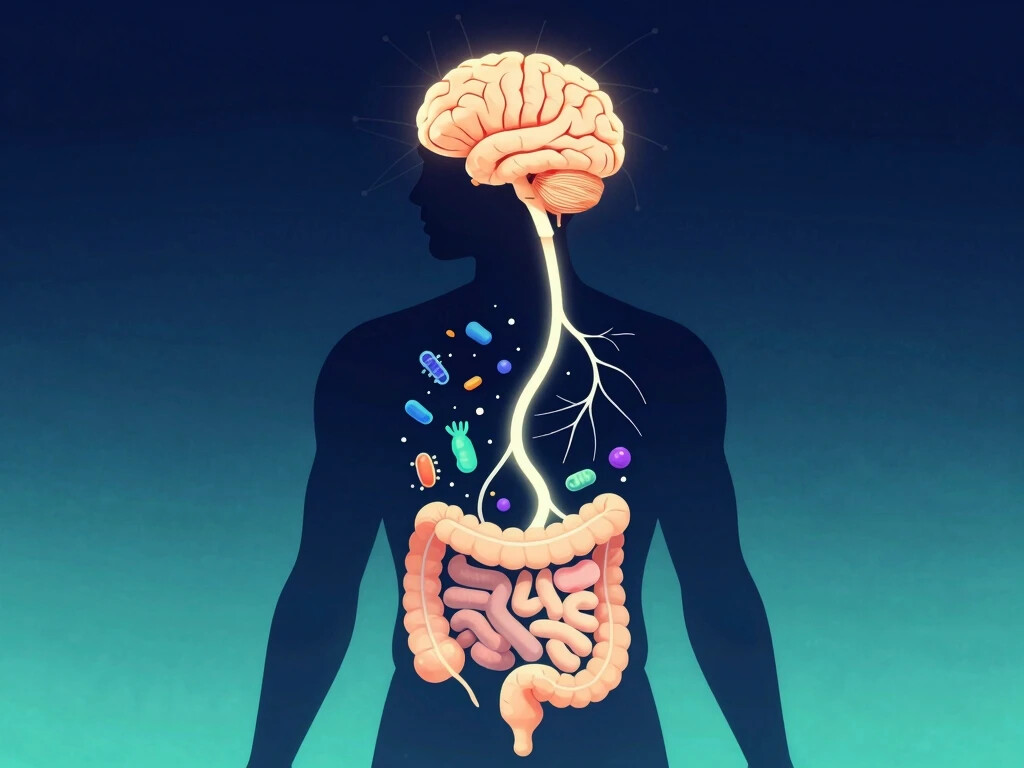
For years, doctors told anxious people it was “all in their head.” Turns out, they had the wrong organ.
The Stomach Knows First
Here is something no person actually talks about. Before your brain consciously registers that you are nervous about a social scenario, your stomach already knows. It tightens. Your appetite disappears. A weird nausea settles in somewhere just below your ribs, and it stays there until the whole thing is over.
We have all been trained to think this is just anxiety trickling down from the brain — that the gut is simply reacting to whatever the mind has already decided. The brain panics, and the stomach follows. That is the story most of us grew up with.
But researchers have been quietly dismantling that story for the past fifteen years. And what they have found is strange enough to make you rethink something as basic as where your emotions actually come from.
Your gut bacteria — the trillions of microorganisms living in your digestive system right now — are not just along for the ride. They are producing brain chemicals. They are firing signals up to your brain through your nervous system. And in ways that are still being worked out, they appear to be shaping how socially anxious you are, how much you dread crowded rooms, and how quickly your threat response fires when a stranger looks at you the wrong way.

This is the gut microbiome and mental health connection. It is not fringe science anymore. It just has not quite reached the general public yet.
What Actually Lives in Your Gut
Most people vaguely know they have gut bacteria. Fewer people appreciate the scale of it.
Somewhere between 38 and 100 trillion individual microorganisms live in your digestive tract. Bacteria, fungi, viruses, archaea—a whole ecosystem unique to you, shaped by everything from how you were born (vaginal delivery versus C-section) to the antibiotics you took at age eight to what you had for breakfast this week.
The single most important measure of a healthy microbiome is diversity. More species and more variety in what those species can do generally mean a more resilient system. When that diversity collapses — through a bad diet, prolonged stress, illness, or repeated rounds of antibiotics — things start going wrong in places you would not expect.
One thing most people genuinely do not know: about 70 percent of your immune system is physically located in your gut. Not near it. In it. And those intestinal microorganisms aren’t simply sitting there—they are producing vitamins, controlling inflammatory responses, and producing neurotransmitters. The identical neurotransmitters your mind relies upon directly to alter mood, fear, sleep, and how safe you feel around other humans.
That last part is what makes this whole area of research so interesting. And a little uncomfortable, honestly.
The Vagus Nerve Is the Part Nobody Taught You About
There is a nerve called the vagus nerve. It starts in your brainstem, wanders through your chest—past your heart and your lungs—and ends up in your gut. It is the main physical cable connecting your brain to your digestive system, and for a long time, scientists assumed most of the traffic flowed downward. The brain sends instructions; the gut obeys.
The actual breakdown is almost the reverse. Around 80 to 90 percent of the signals traveling along the vagus nerve go upward — gut to brain, not brain to gut.
Read that again, because it matters. Your gut is sending more information to your brain than your brain sends back down. It is less a subordinate organ and more like a co-pilot that your conscious mind is barely aware of.
The gut also produces around 90 to 95 percent of your body’s serotonin. Not the brain. The gut. Serotonin is the neurotransmitter most associated with emotional stability and well-being—the thing antidepressants are designed to boost. Gut bacteria are directly involved in making it. They also produce GABA, which is your nervous system’s main brake pedal, and they influence dopamine and norepinephrine levels too.
Researchers call the enteric nervous system—the dense web of neurons lining your gut—the “second brain.” It is not a catchy metaphor. It is a functioning neural network with more neurons than your spinal cord. It processes information. It sends messages. And when your gut microbiome is disrupted, those messages get garbled.

The Studies That Changed How Researchers Think About This
The most cited piece of evidence came from a huge 2019 study in Nature Microbiology. Researchers pulled gut bacteria statistics from thousands of humans across more than one international location and looked for patterns connecting microbiome composition to intellectual fitness diagnoses.
Two forms of microorganisms—Coprococcus and Dialister—were confirmed to be constantly depleted in humans with depression and anxiety across populations or even after accounting for antidepressant use (which itself adjusts gut microorganisms). People with more of these bacteria tended to report higher quality of life. People with fewer of them tended to struggle.
The animal studies are harder to dismiss. Scientists raised mice in completely sterile conditions—no gut bacteria at all—from birth. These germ-free mice were measurably more anxious, more reactive to stress, and significantly more avoidant of social interaction than normal mice. Then researchers took gut bacteria from anxious mice and transplanted them into calm ones. The calm mice became anxious. When the transplant went the other way, anxiety levels fell.
The implication—that gut microorganisms can really switch something corresponding to an emotional state—is the kind of finding that makes neuroscientists sit up straight.
One greater piece of the puzzle came from University College Cork, where researchers discovered that a selected probiotic strain, Lactobacillus rhamnosus, decreased anxiety behaviors in mice by modulating GABA receptors within the brain. The effect disappeared completely when the vagus nerve was reduced. That single experiment confirmed the mechanism: the bacteria had been signaling through the vagus nerve, at once adjusting how the mind handled stress. Cut the road, lose the effect.
Why Social Anxiety Specifically Has a Gut Story
General tension and social tension are associated, but they may no longer be identical elements. Social tension is that precise dread—of judgment, embarrassment, rejection, or being seen and located looking. And it has a gut-brain pathway that is really worth information on its own terms.
When your microbiome becomes imbalanced (researchers call this dysbiosis), it tends to trigger a low-grade infection at some stage in the body. Some of that irritation reaches the brain and sensitizes the amygdala—the region that detects danger and initiates worry responses. An infected, overreactive amygdala starts analyzing social situations as more threatening than they simply are. An impartial facial feature receives a file under “hostile.” A room full of strangers becomes a gauntlet.
This is also why so many people with social anxiety disorder report gut problems alongside their mental health symptoms. The IBS, the chronic bloating, the nausea that hits before any social event — these are not coincidences. They are probably different expressions of the same underlying gut-brain dysregulation. The gut is not reacting to the anxiety. It may be partly causing it.
A 2015 study from UCLA backed this up from the other direction. Women who regularly ate probiotic-rich fermented foods showed less activity in brain regions tied to emotional reactivity — including the amygdala — when shown images of threatening or aggressive faces. Their gut microbiomes were healthier. Their brains responded more calmly to perceived social threats.
What You Can Actually Do With This Information
The reasonably good news is that the gut microbiome changes. It is not a fixed trait. What you eat this week will look different in your microbiome within a few days.
The most impactful thing, based on current evidence, is dietary diversity. A study tracking hundreds of people found that eating 30 or more specific plant meals per week—no longer 30 servings of the same 3 vegetables, however different the species—became associated with significantly higher microbiome diversity. Fruits, veggies, legumes, whole grains, nuts, seeds, herbs, and spices. Each one feeds a unique network of microorganisms.
Fermented foods are worth taking seriously. Kefir, kimchi, sauerkraut, herbal yogurt, miso, kombucha—these introduce beneficial bacteria into the gut. A 2021 Stanford trial published in Cell discovered that people who ate a high-fermented-foods diet for ten weeks showed both accelerated microbiome diversity and reduced inflammatory markers. Both changes happened. At the same time.

Prebiotic fiber—from garlic, onions, oats, leeks, bananas, and asparagus—feeds the bacteria already dwelling in your gut. Without it, even an awesome probiotic supplement has very little to build on.
Sleep and exercise both independently increase microbial diversity, separate from diet. Which means the basics really do keep compounding on each other.
One Thing Worth Being Honest About
Gut health is not a cure for social anxiety. That needs saying clearly.
Social anxiety disorder is a real medical condition. It responds to cognitive behavioral therapy. Sometimes it needs medicine. Eating better fermented ingredients is honestly useful, but it isn’t always a substitute for correct mental fitness guidance, and absolutely everyone who tells you in any other case is overselling the science.
What the studies simply indicate is something more modest but significant: a more fit gut can decrease your baseline anxious system reactivity, lessen the inflammatory indicators that maintain your amygdala on high alert, and make the alternative stuff you do—remedies, way of life modifications, and medicine, if suitable—more likely to work.
Think of it as clearing static from the line. The communication between your gut and your mind gets cleaner. Whether this is enough to meaningfully shift your social tension depends on lots of things that vary from person to person.
If tension is significantly affecting your existence, communicate to a health practitioner or therapist. The gut-mind axis is a real piece of the puzzle—not the whole picture.
The Bottom Line
Your gut was never just a digestive organ. It was always this—a second nervous system, a serotonin factory, a two-way broadcast system running alongside your conscious brain, shaping your moods and fears in ways nobody fully mapped until recently.
The microbiome-mental health connection is not a fashion statement. The studies have been building for fifteen years throughout dozens of nations and research establishments, and the direction they continue pointing is the same: what lives in your gut impacts what goes on in your head. Including — and maybe especially — how safe you feel around other people.
Next time your stomach tightens before a social situation, it is worth remembering that the feeling is coming from somewhere specific. And that somewhere is more changeable than you might have thought.



+ There are no comments
Add yours