


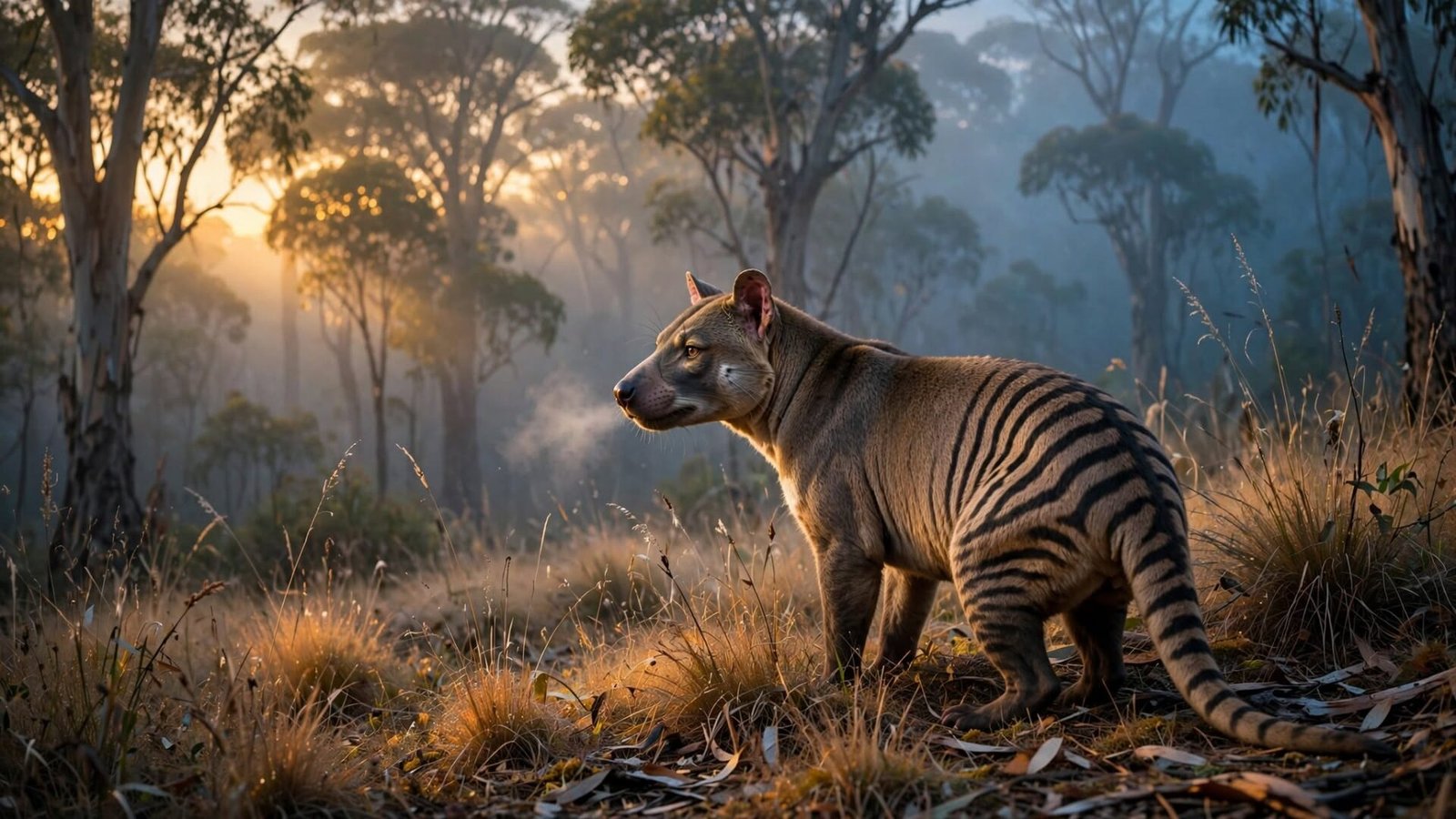
Someone once told me that the saddest photograph ever taken is not of a war or a famine or a natural disaster.
It is a Thylacine.
The last one. Hobart Zoo, Tasmania, 1933. The animal — striped like a tiger, built like a dog, uniquely itself — is standing in a concrete enclosure and looking at the camera with an expression that is genuinely hard to categorise. It is not afraid. It is not angry. If anything, it looks the way you or I might look while waiting for a bus. Mildly present. Occupying space. Unaware that three years later it would be dead and that its entire species would cease to exist, not because of anything dramatic, but because a colonial government had decided it was inconvenient and put a bounty on its head.
I keep coming back to that photograph. Not because it is graphic — it is not — but because of what the animal does not know. It has no concept of what is happening. No access to the word extinction. No way to understand that the humans staring at it through the bars are the same species that is erasing it.
We knew. That is the part that stays with you.

A Number That Should Stop You Cold
Before we go any further, here is a figure worth actually sitting with rather than skimming past.
Under natural conditions — before factories, before industrial agriculture, before shipping containers carrying invasive species to every corner of the planet — Earth lost somewhere between one and five species per year. Across all of life. That was the background rate. The normal pace of things coming and going as evolution does its slow, grinding work.
Today, depending on which study you read, we are losing species at somewhere between one thousand and ten thousand times that rate.
Read that again. One thousand times. Ten thousand times.
Since 1800 alone, between five hundred and one thousand vertebrate species have been confirmed extinct. And that number is almost certainly an undercount — it does not include the invertebrates, the plants, the obscure fungi, or the species that slipped away before anyone with a notebook happened to be watching. It does not include what biologists call “functional extinction” – animals still technically alive but in numbers so small that the species are, for all practical purposes, already gone.
People tend to hear statistics like this and feel briefly terrible and then move on to the next thing. I understand that impulse. But I think it is worth resisting, just for a moment, because what these numbers describe is not an abstraction. Every one of those species was an entire world. A complete evolutionary experiment, millions of years in the making, gone in a human lifetime or less.
Three to Five Billion Birds
Here is something almost impossible to picture.
Stand in the forests of eastern North America sometime in the early 1800s and look up. The sky above you is gone. Not cloudy — gone, replaced by a single flock of Passenger Pigeons so enormous that the flapping of their wings sounds like a river, and the sun disappears behind them for hours. John James Audubon — the man whose name now graces the most famous bird conservation society in America — wrote about watching a single flock pass continuously for three entire days.
Ornithologists who have tried to reconstruct the population from historical accounts believe there were somewhere between three and five billion Passenger Pigeons in North America at their peak. The most numerous bird on the continent. Possibly one of the most numerous birds that has ever existed anywhere.
Martha — named after Martha Washington, which is a detail that hits differently once you know it — died on the first of September, 1914, in a cage at the Cincinnati Zoo. She was the last of her kind. The species had gone from three to five billion individuals to a single elderly captive bird in roughly a hundred years.
Here is what makes this particular story so strange: it was not a mystery while it was happening. People could see the flocks getting smaller. Hunters who had been shooting pigeons by the barrel for decades noticed the numbers dropping. And yet the hunting continued, the forest clearing continued, and the assumption that there were simply too many birds for anything humans did to really matter continued right up until it was too late.
The Passenger Pigeon had evolved for abundance. It needed the flock — the social density of millions of birds together — to trigger its breeding behaviour. Once the population fell below a certain point, the remaining birds could not recover even when the pressure eased. The collapse, when it came, was faster than anyone expected.
Nobody thought it could actually happen. This is, unfortunately, a recurring theme.

The Dodo Was Not Stupid — We Were
The Dodo has been a punchline for so long that the actual tragedy of what happened to it tends to get lost in the joke.
The standard version goes something like this: the Dodo was a fat, flightless, hopelessly naive bird that waddled up to Dutch sailors and essentially volunteered to be eaten. A natural dead end. Something that was never going to last.
This is wrong in almost every particular.
The Dodo was a large pigeon — a descendant of birds that had flown to Mauritius, an island in the Indian Ocean, and, over time, evolved flightlessness because there were no land predators there. Why burn energy maintaining wings you never need? The island was its own self-contained system. Everything the Dodo needed was there. Nothing on Mauritius was trying to kill it.
So when Dutch sailors showed up in the late 1600s, the Dodo did not run. Why would it? Nothing had ever given it a reason to run. That is not stupidity. That is the perfectly logical behaviour of a creature whose entire evolutionary history had unfolded in the absence of the threat it was now facing.
The sailors killed some birds for food. But what really collapsed the Dodo’s population were the animals the sailors brought with them without thinking: rats that escaped from the ships, pigs, cats, and dogs introduced for various practical purposes — all of which immediately began destroying Dodo nests and eating eggs. The birds that survived being hunted could not replace themselves fast enough because their nests were being raided faster than they could lay.
Within about eighty years of the first Dutch ship arriving, the Dodo was gone.
I find this story more useful than most people do, because the Dodo keeps showing up. The lesson it offers — that an animal perfectly adapted to one environment can be entirely unprepared for a threat it has never encountered in its evolutionary history — applies to almost every extinction we have caused since. We keep arriving somewhere and introducing things, and the things that were there before have no framework for what hits them.
The One Nobody Has Heard Of
Ask someone to name an extinct animal, and you will probably get the Dodo, maybe the Passenger Pigeon, maybe a woolly mammoth if they are feeling prehistoric.
You will rarely get the Quagga.
Which is strange, because the Quagga is one of the most visually striking animals that ever existed. A subspecies of plains zebra from South Africa, it was striped like a zebra across its head and front half, then faded to a plain brown with no stripes at all on its back half and legs. It looked, depending on the angle, like two different animals stitched together. Photographs from the 1870s — the only ones that exist of a living Quagga — show something that is genuinely unlike anything alive today.
Hunters killed them throughout the 1800s, partly for their meat and hides and partly because they competed with livestock for grazing land, and it seemed easier to eliminate the competition than to share. The last wild Quagga was shot in 1878. The last captive one died in Amsterdam in 1883. For a while after that, nobody was entirely sure what the Quagga even was — a distinct species? A colour variant? Just an odd-looking zebra?
DNA work done in the 1980s confirmed it was a subspecies of plains zebra, distinct but not separate. This led to the Quagga Project in South Africa, which has been selectively breeding plains zebras to bring back the Quagga’s distinctive colouration. The project is genuinely impressive, and some of its animals are starting to look remarkably similar to those old photographs.
But here is the thing. They are not Quaggas. They are zebras that have been bred to look like Quaggas. The animal that existed, the specific genetic lineage that produced that extraordinary half-striped half-brown coat, is gone. You can approximate the appearance. You cannot bring back what was actually lost.

The Goddess Nobody Noticed Leaving
The Baiji – the Yangtze River dolphin – was not hunted. Not really. No one woke up one morning and decided to eradicate it.
It was killed by everything else.
The Baiji had lived in the Yangtze River for twenty million years. Twenty million. It had navigated ice ages and continental shifts and whatever the Yangtze threw at it across that unimaginable span of time. It found its way through murky river water using echolocation, eating fish, largely invisible to the humans who had lived along the same river for thousands of years. Chinese culture had a name for it — Goddess of the Yangtze — and fishermen had long treated it with something close to reverence.
Then the river industrialised.
Cargo ships multiplied until the Yangtze was one of the busiest waterways in the world, and the engine noise was so constant and so loud that the Baiji’s echolocation — the biological sonar it had relied on for millions of years — was effectively useless. Fishing nets stretched across the river and drowned dolphins that were not even the target. The Three Gorges Dam changed water levels and destroyed fish populations. Factory runoff turned the water toxic in stretches. The Baiji had survived twenty million years of natural challenges. It took about fifty years of industrial activity to finish it off.
A formal survey of the entire Yangtze River in 2006 found no Baiji. None. The species was declared functionally extinct. No dramatic last stand. No conservation campaign that gained traction before it was too late. It just stopped being there, in a river it had inhabited longer than our genus has existed.
The world barely noticed. I think about that a lot.
The One We Could Have Saved
Some extinctions, in hindsight, feel like they were always going to happen. The forces were too large, the intervention would have had to start too early, and the political will could never have been assembled in time.
The Western Black Rhino is not one of those extinctions. And that is what makes it so hard to sit with.
The subspecies lived across the grasslands of central and West Africa and was doing fine until the twentieth century, when commercial hunting — the kind that shot animals for sport and for horns and for the simple fact that large dangerous wildlife was considered something to be eliminated — brought the population crashing down. By the middle of the century it was nearly gone. Conservation efforts in the 1930s stabilised things temporarily, and for a few decades there was genuine cautious hope.
But poaching accelerated again, driven by demand for rhino horn in certain Asian markets where it was prized for medicinal purposes despite no credible evidence that it does anything at all medically. The remaining population in Cameroon shrank. Enforcement was underfunded. International pressure to curb the horn trade moved slowly. A survey in 2006 found no Western Black Rhinos remaining. The subspecies was officially declared extinct in 2011.
Here is what separates this from the Passenger Pigeon or the Dodo: at multiple points in the twentieth century, the people who knew what was happening had the knowledge to stop it, had animals still alive to save, and had the political structures that could theoretically have acted. The tools existed. The timeline was not yet closed. The extinction happened anyway because the enforcement was not resourced properly, because the funding was inconsistent, and because international will to address the horn trade moved too slowly.
This was not an inevitable tragedy. It was a management failure. And that distinction matters, because the same conditions exist right now for species we still have time to save.

Right Now, Today, This Minute
It is tempting to think of this as a historical problem — something that happened before we had the science to understand ecosystems, before we knew about extinction rates, before wildlife conservation existed as a field.
The Vaquita has a current estimated population of somewhere between ten and twenty individuals. It is a small porpoise that lives only in the northern Gulf of California, and it has been accidentally caught and drowned in fishing nets set for another species. Conservation teams are literally in the water right now attempting to keep it from disappearing entirely. The prognosis, as of the most recent assessments, is not good.
The Yangtze Soft-shell Turtle — one of the largest freshwater turtles alive — had its last known female die in 2019 during an artificial insemination attempt. The remaining male is thought to be more than a hundred years old. There is now a search underway for any remaining individuals that might have been missed. When the current male dies, that is likely the end.
These are not historical footnotes. These are animals alive right now, or animals that died five years ago. The wave did not crest and recede. It is still running.
Because the Other Story Exists Too
I want to be careful not to end here, because the version of this conversation that concludes in pure despair is not entirely honest either.
The Arabian Oryx was declared extinct in the wild in 1972. Captive breeding programmes kept the species alive, and reintroduction efforts have brought the wild population back to over one thousand animals across the Arabian Peninsula. The Southern White Rhino dropped below fifty individuals in the late 1800s; today there are more than twenty thousand in the wild. The Bald Eagle, which was heading toward extinction in the continental United States within living memory, recovered after DDT was banned and protective legislation was passed and now numbers in the hundreds of thousands.
Recovery is not a fantasy. It is a demonstrated, documented reality. It requires sustained political will, consistent funding, targeted intervention, and — most critically — acting before the last individuals are gone rather than after.
The Thylacine in that 1933 photograph did not know what was happening to it. It had no language for extinction, no capacity to argue for its own survival, no way to tell the humans watching it through the bars what they were about to lose.
We have language. We have science. We have the demonstrated capacity to change course when we actually decide to.
That photograph keeps returning to me. Not as a reason to give up, but as a reminder of what giving up actually looks like.



[…] contradiction is really what this whole topic comes down to. Animals aren’t wired to burn their limited energy raising something that doesn’t carry their […]