


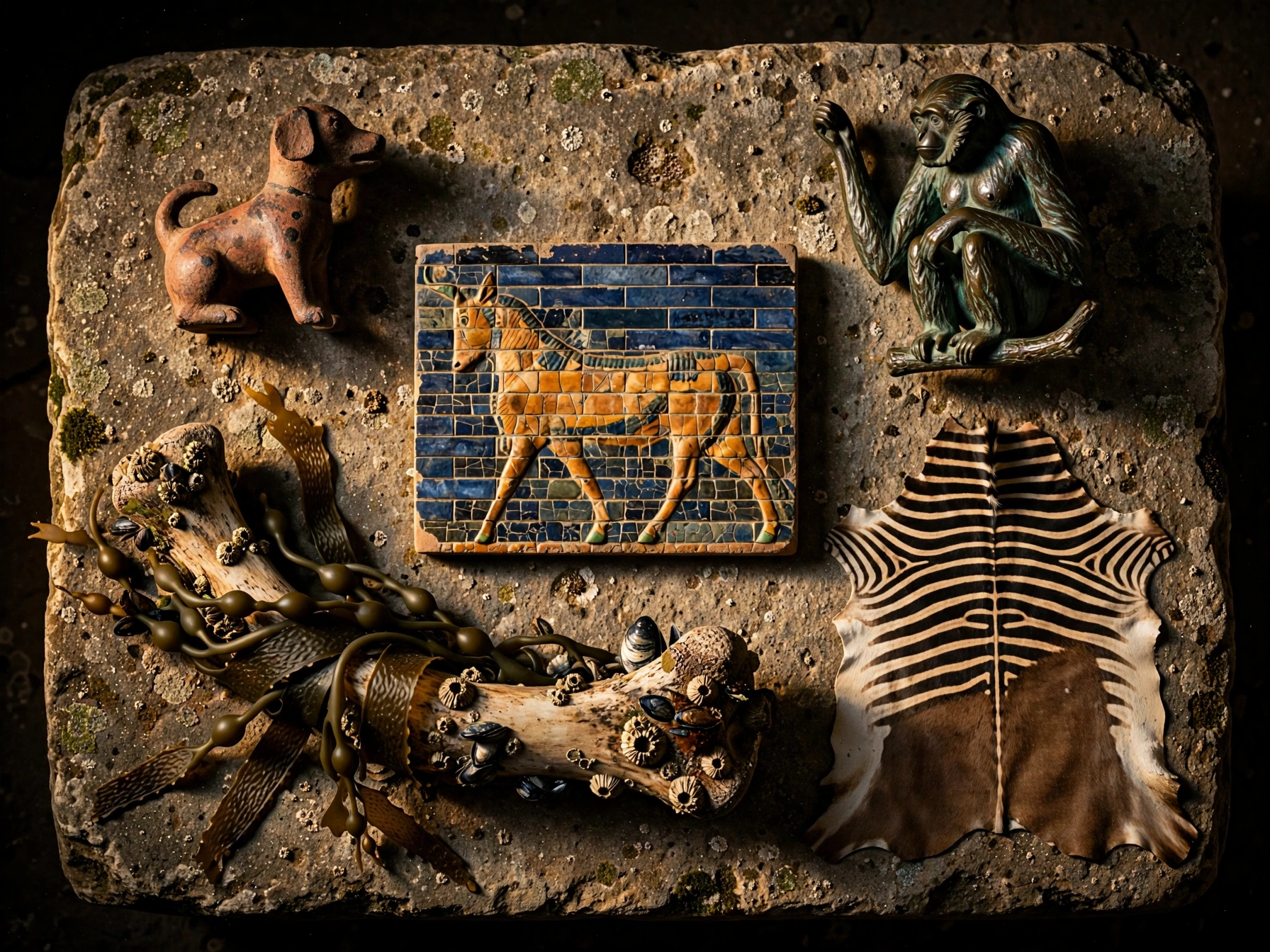
In 2004, archaeologists cracked open a 2,200-year-old Chinese tomb. Inside, along with jade carvings, lacquered carriages, and the bones of leopards and lynxes, they located a skull. It was small. It was a primate. And it belonged to no animal science had ever catalogued.
Somewhere in Mexico, ancient priests buried dogs alongside their dead — not as offerings, not as food, but as companions for the journey through nine levels of hell. In Babylon, a king carved the image of a wild bull onto the gates of his most sacred city as a direct message to his gods. In the North Pacific, a 10-tonne sea creature swam up to human hands to be scratched — and that trust sealed its fate within 27 years.
These animals weren’t just alive when ancient civilisations were at their peak. They were woven into the spiritual fabric of those civilisations. Sacred, loved, essential — and every single one of them is gone. Here are five of them, what made them extraordinary, and the exact moment history lost them.
1. The Techichi — The Dog That Guided the Dead Through the Underworld
Toltec & Aztec Civilization · Mexico · 9th century CE to ~1500s CE
This dog never barked. And that silence, the Aztecs believed, was sacred.
The Techichi was larger than today’s Chihuahua — closer to 10 to 20 pounds, with a sturdy build, oversized ears, and an alert, watchful face. Ancient sources describe it as mute, producing none of the sounds you’d expect from a dog. For the Toltecs, who first bred them in the Tula region around the 9th century, that silence wasn’t a flaw. It was a sign that the Techichi existed on a plane between worlds.

When the Aztec Empire absorbed the Toltecs in the 14th century, they failed to just inherit the dog – they expanded it into their complete cosmology. Aztec perception held that the underworld, Mictlan, was divided into a 9-level adventure that each vain soul had to complete. The terrain changed into something brutal: frozen rivers, screaming winds, and fields of obsidian wind. No soul could navigate it alone. The Techichi was the guide. Created, according to Aztec belief, by Xolotl – the dog-headed god of lightning and death – the Techichi was literally a divine creation sent to escort the dead through darkness.
When a person died, their Techichi was sacrificed and cremated alongside them. The logic was compassionate in its own way: the soul shouldn’t have to find its guide after death. Better to send the dog ahead.
Archaeological evidence locates Techichi remains in 74% of excavated Toltec tombs, dating back to 500 BC. Dogs have been located curled at their proprietors’ toes, adorned with beads, collars, and bells. Some have been placed as though still dozing. Beyond their religious feature, the Techichi, moreover, served a clinical feature — Aztec healers pressed the dogs’ heat onto our bodies in competition to unwell or painful areas of the human body, believing the animals needed to soak up infection through touch.
Genetic studies published in 2017 showed that the Techichi keeps DNA from surviving ancient Mexican dog breeds, with the current Chihuahua sporting Techichi mitochondrial DNA specific to pre-Columbian populations. The spirit guide lives on in your lapdog. Though it’s unlikely your Chihuahua has ever navigated nine levels of hell.
The Techichi disappeared in the 1500s at the same time as Spanish conquistadors arrived, ate the dogs during food shortages, and crossbred the survivors with European breeds. An animal that had guided souls for a thousand years turned into an erasure in a generation.
2. The Imperial Gibbon — The Royal Ape Nobody Knew Existed
Ancient China · Xi’an · 221 BC to ~18th century CE
The cranium located in Lady Xia’s tomb in 2004 sat in a garage drawer for years before all of us looked at it closely. When they did, the realisation was sluggish and then sudden: this had become not a known species. Not a mistake in classification. Not a misidentified fragment. An entirely new ape — one that had lived in China for possibly thousands of years and had simply never been recorded by science.
Lady Xia was no ordinary noblewoman. She became the grandmother of Qin Shi Huang – China’s first emperor, the man who constructed the Great Wall, who ordered the construction of the Terracotta Army, and who unified China under one rule for the first time. Her tomb cemented her reputation: it contained leopards, bears, cranes, and, as a minimum, one gibbon of a species that would be formally named Junzi imperialis inside the 2018 paper published in the magazine Science.
In China, gibbons were not exotic curiosities. They were cultural touchstones. Poets wrote about them for two thousand years — their calls at dawn were described as mournful, and their grace in the treetops a metaphor for freedom and philosophical detachment. The Daoist ideal of the scholar-gentleman in harmony with nature was frequently depicted alongside a gibbon. Only the highest imperial elite kept them, alongside rhinoceroses, panthers, and sun bears, all symbols of civilisational power.

The 2025 DNA analysis by Fu Qiaomei’s team at the Chinese Academy of Sciences confirmed the Imperial Gibbon as a distinct Nomascus species, most closely related to the Hainan gibbon – of which only around 37 individuals survive on a single island today. The Emperor’s grandmother’s pet is the closest extinct relative of one of the world’s most critically endangered animals.
The Imperial Gibbon’s decline began during the Ming Dynasty, when massive deforestation cleared the forests of central and southern China for agriculture. By the 18th century, gibbons had retreated to the far south. The Imperial Gibbon specifically — the one that had shared the palaces of emperors — was almost certainly gone by then, leaving behind only that single skull in a storage drawer, waiting 2,200 years to be recognised.
3. The Aurochs — The Bull That Built Civilizations and Terrified Julius Caesar
Egypt, Babylon, Rome, Europe · ~8000 BC to 1627 CE
Julius Caesar has turned into no longer a man without problems. He had crossed the Rubicon, conquered Gaul, and stared down the Roman Senate. But in his account of the Hercynian Forest within the Gallic Wars, he paused to explain an animal that surely unsettled him. The aurochs, he wrote, was “a little below the elephant in size” with horns shaped nothing like any cattle he had seen and “great strength and speed, sparing neither man nor beast”. Roman soldiers considered killing one a defining test of courage.
The aurochs – Bos primigenius – was the ancestor of every domestic cow alive today. It stood over six feet at the shoulder. It weighed more than a tonne. Its forward-curving horns were used for combat with a ferocity that made hunting one a life-risking enterprise. And for thousands of years, every major civilisation that encountered it treated it as something close to divine.
The Processional Way leading from the Ishtar Gate of Babylon was lined with sculptural reliefs of aurochs — representing Adad, the Babylonian god of storms and rain — in a message to all who entered the city that it was protected by the gods. Each striding bull carved in glazed blue brick promised rain, harvest, and divine protection to Babylon. In the Indus Valley, seals from Mohenjo-daro almost certainly depict the aurochs – the animal whose domestication, approximately 8,000 years ago in the Fertile Crescent, made agricultural civilisation possible in the first place. The aurochs didn’t just live alongside human civilisation. It enabled it.
The last wild aurochs herd was maintained in the Jaktorów Forest of Poland under royal protection – the world’s first documented conservation effort. In 1627, the last cow died. The Polish royal court recorded it. It was the first time in history that humans formally noted the extinction of an animal — a grim milestone for a species that had been worshipped on three continents.
4. Steller’s Sea Cow — The Giant That Trusted Us, and Paid for It
North Pacific · Commander Islands · Prehistoric to 1768 CE
Georg Wilhelm Steller became stranded on Bering Island in the North Pacific in 1741, his ship damaged and his team dying of scurvy. And then he noticed something that made him overlook, briefly, how determined his situation had changed. Thirty feet of sluggish-moving, bark-skinned, impossibly gentle animals were grazing kelp at the water’s floor, absolutely unbothered by the shipwrecked strangers on the shore.
Steller’s sea cow — Hydrodamalis gigas — became the most highly regarded member of the sirenian order, measuring 8 to 9 metres in length and weighing a predicted 8,000 to 10,000 kilograms. It had no teeth, feeding instead on kelp using keratinised plates in its mouth. Its skin was defined as similar to the bark of an old oak tree — dark, deeply grooved, nearly geological. It floated at the floor continuously, slightly able to submerge, growing to breathe in long, slow exhalations.

Steller referred to something in his discipline journal that reads, in hindsight, ‘The sea cows showed no worry of people in any way.’ They approached the castaways. They allowed themselves to be touched. When one turned into a harpooned one, others in the group didn’t flee; they swam around the injured animal, tried to dispose of the harpoon with their flippers, and stayed till it changed into lifelessness. Almost every element of the sea cow’s biology made it easier to seek: their kelp diet forced them into shallow water, their social behaviour meant they in no way hid, and their thick blubber kept them buoyant at the surface.
The total population in 1741 has been estimated at 2,000. By 1768, it had been completely exterminated—killed by Russian fur traders who used the sea cow’s meat to sustain themselves on long Pacific voyages. Twenty-seven years from discovery to extinction. The fastest recorded elimination of a large animal in human history. Steller remains the only scientist who ever saw one alive.
In London’s Natural History Museum, a surviving vertebra bears cut marks from the hunters’ blades. It is the most honest artefact in the building.
5. The Quagga — One Photograph, One Painting, and Then Nothing
South Africa · Khoikhoi people · Prehistoric to 1883 CE
It looks like someone began painting a zebra and stopped halfway. The front half — head, neck, and shoulders — was covered in the familiar black-and-white stripes. The rear half faded into plain reddish-brown, closer to a horse than a zebra. The tail was white. The normal impact changed into that of an animal that could not decide what it desired to be.
The quagga – Equus quagga quagga – roamed the Karoo plains of South Africa in enormous herds before European settlement. The Khoikhoi human beings, who lived alongside them for hundreds of years, named them onomatopoeically: “kwa-ha-ha”, the sound the animal made while startled. Quaggas have been identified in cave art attributed to the indigenous San people of Southern Africa, placing human recognition of the animal back thousands of years before any Europeans arrived. European settlers found them more docile and tameable than other zebras, and some local farmers even trained them to guard livestock against predators — using a quagga’s alertness and loud call as an early warning system for lion and leopard approaches.
The last wild quagga was shot in 1878. The last captive specimen — a mare at the Artis Zoo in Amsterdam — died on August 12, 1883. Nobody noticed for months. There was no announcement, no mourning, no ceremony. It was only when a zoologist tried to order more specimens from Africa that someone checked the records and realised there were no more specimens. There had been no more specimens for some time.
In 1984, the quagga became the primary extinct animal whose DNA was analysed, confirming it as a subspecies of the plains zebra, not a separate species in any respect. We hadn’t lost a species. We had removed a branch from a living tree and then were surprised when the wound didn’t heal. The Quagga Project, launched in 1987, is now producing third-generation “Rau quaggas” that look almost identical to preserved museum skins. The shape is returning. The animal itself — its particular call, its particular relationship with the Khoikhoi, its particular place in the Karoo ecosystem — is not.
The Pattern That Ancient Civilizations Understood — And We Still Don’t
Here is what connects all five of these animals: every single one of them was loved.
The Techichi was buried with its owner. The Imperial Gibbon was given a royal tomb. The aurochs was carved onto the holiest gate in Babylon. Steller’s sea cow was, for a brief few months in 1741, one of the most documented and carefully observed animals in the world. The quagga was photographed – a genuine act of attention.
And still. The Techichi was eaten. The gibbon’s forest was cut down. The aurochs was hunted for sport by emperors who worshipped it. The sea cow fed the same fur traders who had never heard of conservation. The quagga died alone in a zoo while the world looked the other way.

Reverence and destruction are not opposites. Humans have always been capable of treasuring something and dismantling it simultaneously. The Aztecs built an entire religion around their dog guide — and then fed the dogs to the conquistadors. The Babylonians carved the aurochs as a god – and then hunted it until it was gone.
The lesson isn’t that historic people were hypocrites. It’s that the relationship among humans and animals has usually been more complicated than the phrase “sacred” suggests. We declare things holy and then treat them as resources. We take photographs of the last one and call it documentation.
What Science Is Trying to Do Now
In Portugal and Croatia, the Tauros Programme has been selectively back-breeding cattle closer to aurochs traits for over a decade. The eighth-generation animals now roaming rewilded European landscapes are larger, wilder, and more aurochs-like than any domestic cow alive. In South Africa, Quagga Project foals now confuse first-time observers, who mistake them for museum pics come to life.
The shapes are coming back. The relationships – the Khoikhoi farmer and his livestock-guarding quagga, the Aztec priest and his mute spirit dog, the Chinese empress who slept in a palace where a gibbon she named and loved moved through the rafters – those are gone. You cannot back-breed a relationship.
Five animals. Five civilisations. Five thousand years of reverence. And the same ending, every time.
Which of these five do you think history treated most unfairly? The comment section is below — and for once, there isn’t an obvious answer.



[…] last one. Hobart Zoo, Tasmania, 1933. The animal — striped like a tiger, built like a dog, uniquely itself — is standing in a concrete enclosure […]