


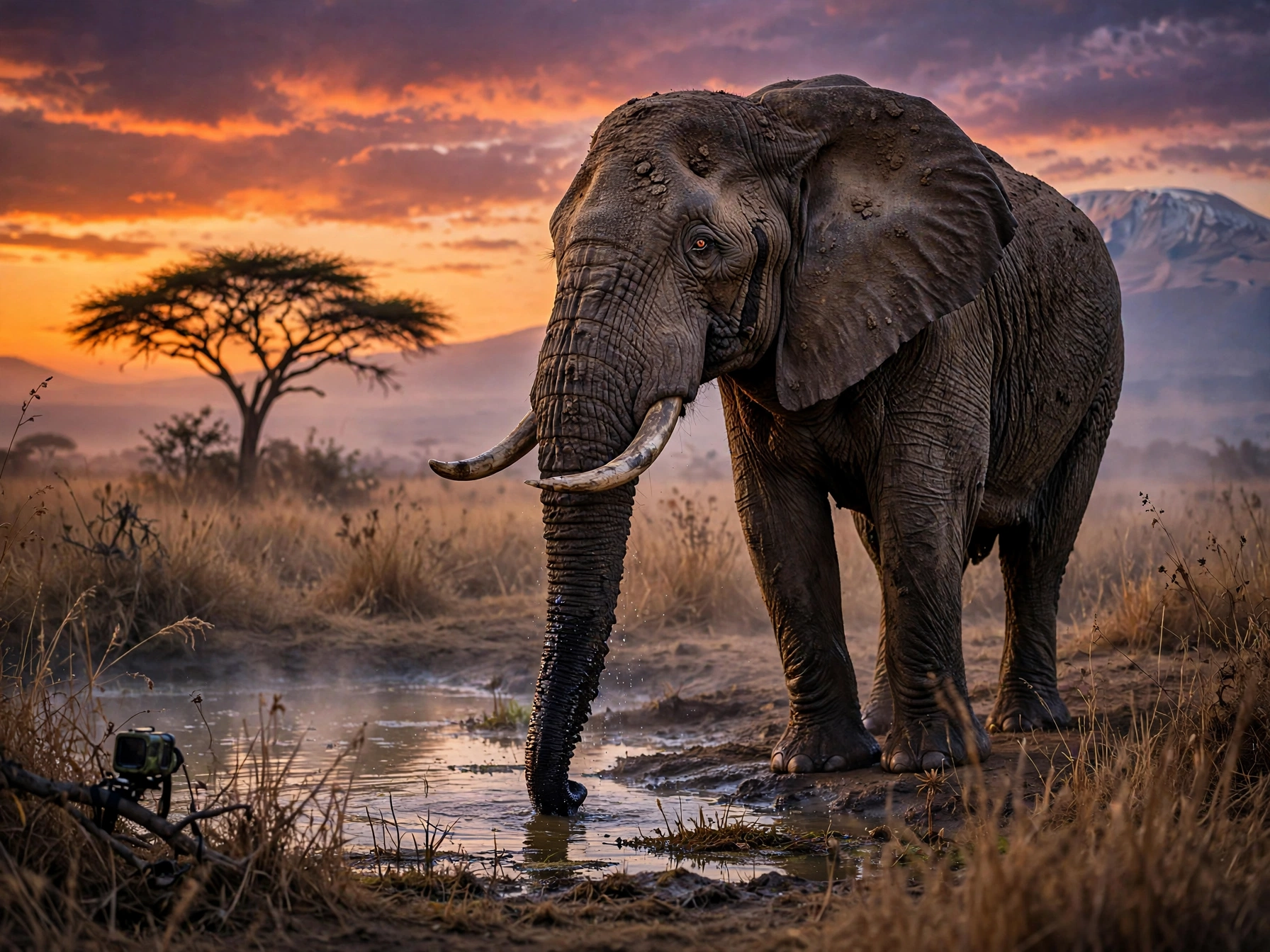
There is a forest in Gabon, deep in central Africa, where researchers once set up camera traps and walked away. No humans. No noise. Just hidden lenses blinking in the dark.
What those cameras caught over the following weeks changed how several scientists thought about animal behaviour entirely. Forest elephants — animals we had studied for decades — were doing things at night that nobody had documented before. Visiting the same clearings in specific sequences. Waiting. Watching. Behaving, in some ways, like they had an agenda.
That word – agenda – makes biologists uncomfortable. It implies intention. Planning. Inner life. And for most of the 20th century, the scientific community was deeply allergic to the idea that animals had anything resembling an inner life worth studying seriously.
That resistance has been crumbling. Slowly at first, and then faster, driven by camera traps, by satellite tags, and by acoustic recorders left running in the wilderness for months. The data that has come back is stranger, richer, and more humbling than most researchers expected.
This is a piece about what wildlife animals actually do when humans are not around. And some of it will genuinely surprise you.

The Surveillance Revolution in Wildlife Research
For most of the history of animal research, we watched animals while they watched us back. Field researchers crouched in hides, drove slowly through parks, and took notes from observation platforms. The animals knew someone was there — and they behaved accordingly.
This is a larger hassle than it sounds. Wild animals shift their behaviour notably in the presence of humans. Predators become more cautious. Prey animals cluster differently. Social dynamics change. What researchers were observing, in many cases, was not natural behaviour — it was the animal’s response to being observed.
The shift came with technology. Camera traps dropped in price and improved in quality. GPS collars became small enough to attach to animals as light as owls. Passive acoustic monitors — essentially waterproof microphones left in the field for months — could record everything from elephant rumbles to bat echolocation. Satellite imagery could track migration routes from orbit.
Suddenly, researchers could watch without being watched. And the picture that emerged was considerably more complex than the textbooks had suggested.
Elephants Have a Map — And They Share It
Of all the findings from the last two decades of covert wildlife observation, elephant cognition keeps producing the most unsettling results. Unsettling, not in a frightening way — in the way that makes you reconsider your assumptions about which creatures on this planet are actually paying attention.
A 2019 study tracking savanna elephants in Kenya found that herds navigate using what researchers described as a collective spatial memory. The herd’s oldest female — the matriarch — essentially functions as a living archive. She remembers where water was found during a drought twenty years ago. She remembers which routes were safe and which were not. When she died, the herds she had led showed measurably reduced ability to find water during dry seasons.
But it gets more specific than that. Research from Amboseli National Park confirmed that elephants can perceive and respond to the calls of over a hundred elephants – including those that they have not encountered in years. When researchers performed recordings of calls from elephants who had died, the surviving herd individuals confirmed clear physiological strain responses.
They knew the deceased. And they reacted with something that, functionally, looks very similar to grief.
Karen McComb, a behavioural ecologist at the University of Sussex who has spent years reading elephant conversation, has been careful with her language. She does not say elephants grieve the way human beings grieve. What she says is that the behavioural and physiological evidence is consistent with complex emotional processing — and that dismissing it without explanation is not scientific caution. It is scientific bias.

Wolves Do Not Just Hunt — They Negotiate
The reintroduction of grey wolves to Yellowstone National Park in 1995 has come to be one of the most studied wildlife stories of the current generation. What the long-term digital camera and monitoring data revealed about wolf social dynamics was no longer what everyone anticipated.
Most people, asked to describe wolf behaviour, would say something about packs and hierarchy. Alphas. Dominance. The oldest, strongest wolf is at the top, and everyone else is below.
That model was built almost entirely from studying captive wolves — animals living in artificial groups under stress. In the wild, the picture is fundamentally different.
Wild wolf packs are, in most cases, family units. A mating pair and their offspring. What looks like hierarchy is actually closer to parenting — the older wolves guide, and the younger ones defer, but the system is far more fluid and cooperative than the captive studies suggested. And the cooperation extends beyond the pack.
Researchers tracking a couple of packs in Yellowstone discovered something they initially logged as a statistical anomaly: packs frequently held back from killing prey at the threshold of contested territory, even when they were hungry and capable of making the kill. It took years of observation to recognise what was taking place.
The wolves were negotiating. Not with words, obviously. With behaviour – scent marking, vocal patterns, and deliberate restraint – they were maintaining boundaries that reduced conflict and conserved energy across multiple packs sharing overlapping ranges. It is, functionally, a territorial system built on mutual recognition and practised de-escalation.
Dave Mech, one of the world’s most important wolf researchers, spent a long time revising his personal advance paintings as the wild statistics accumulated. “The more we watch,” he advised an interviewer, “the less certain we turn out to be about things we have been as soon as very certain of.”
Crows Are Holding Grudges — And Teaching Them
The corvid research coming out of universities in North America and Europe over the last fifteen years has a quality of the slightly absurd to it. Not because the findings are implausible, but because the animals involved are animals most people walk past without a second thought.
Crows. Ravens. Jackdaws. Birds.
Here is one finding worth sitting with.
Researchers at the University of Washington, led by John Marzluff, conducted an experiment where they trapped crows on campus while wearing specific masks. The crows were handled — briefly, harmlessly — and released. In the weeks and months that followed, those same crows, when they spotted someone wearing the mask that had been used during the trapping, began dive-bombing them. Scolding them. Mobbing them.
Not unusual so far. But here is where it gets interesting.
The scolding behaviour spread. Crows who had not been trapped — who had only observed the commotion from surrounding trees — began responding to the masks with hostility. And their offspring, raised in the area, showed the same response without ever having been trapped themselves.
The crows were teaching their young which humans were dangerous. They were transmitting social knowledge across generations. That is, by one reasonable definition, culture.
Further research showed that crows can recognise individual human faces (not just masks), that they bring gifts to humans who feed them reliably, and that they will sometimes leave objects – buttons, pieces of foil, small shiny things – at the spots where food has been placed. Whether this is intentional reciprocity or something else is still debated. The behaviour itself is not.

Octopuses Were Not Supposed to Dream
Move from forests and plains to cold Pacific water, and the surprises keep coming.
In 2021, researchers at the Okinawa Institute of Science and Technology published photos of octopuses undergoing what was regarded to be REM-like sleep cycles. During these cycles, the octopus’s skin — normally capable of producing complex, controlled colour patterns for camouflage — began flickering. Rapid, involuntary colour changes moved across the body in waves.
The interpretation that immediately suggested itself: they were dreaming. Replaying visual experiences during sleep, the way mammals are thought to do.
This is genuinely strange. Octopuses and mammals last shared a common ancestor somewhere around 600 million years ago. The neural architectures are almost entirely different. If something that looks like dreaming evolved twice — independently, in such divergent lineages — it suggests that whatever dreaming does for a brain, it does something important enough that evolution found it separately.
The researcher who led the study, Sylvia Medeiros, was careful not to overclaim. “We don’t know if they’re dreaming,” she said in interviews following the publication. “What we know is that something is happening that looks remarkably similar to what we’d expect if they were.”
That careful language — acknowledging the data without overstating the interpretation — is the sound of science working properly. And it is becoming more common in wildlife research, as the data keeps arriving and the old certainties keep giving way.
What All of This Is Actually Telling Us
There is a pattern in everything above. It isn’t always complicated; however, it is well worth declaring plainly.
For most of human history, we drew a bright line between ourselves and other animals. We had language, a way of life, emotion, memory, and making plans. They had intuition. The line made us snug. It justified how we handled the natural world, how we conceptualised our place in it, and what we felt we owed to other creatures.
The data from camera traps and satellite tags and acoustic monitors is making that line harder to draw. Not impossible — there are real differences, and serious researchers are not claiming otherwise. But the differences are of degree, not of kind. Other animals have more memory than we thought. More emotion. More social complexity. More capacity for learning and teaching and something that sits uncomfortably close to culture.
This is not a sentimental argument for treating animals like people. It is something more demanding than that.
It is an argument for intellectual honesty — about what we actually know, about what the evidence actually shows, and about how much of what we assumed was certainty was really just convenience.
The animals were always doing these things. We just were not watching carefully enough to see it.

The Researchers Who Changed Their Minds
Perhaps the most telling element in all of this is how a number of the scientists who’ve pushed those findings began their careers with conventional assumptions — and ended them somewhere very exceptional.
Frans de Waal spent a long time documenting empathy, reconciliation, and equity-seeking behaviour in primates. He faced significant expert resistance early in his career for using words like “empathy” on the subject of animals. By the time he died in 2024, his framework had turned out to be mainstream.
Jane Goodall went to Gombe in 1960, waiting to study simple behaviours. What she found — tool use, complex social hierarchies, warfare between chimp communities — redrew the map of animal cognition.
The pattern repeats across species and researchers. Someone goes to watch. They stay long enough. They stop projecting their assumptions onto what they’re seeing. And what emerges is nearly always richer, stranger, and more morally complicated than what they went in waiting for to locate.
The desert has been conducting its very own experiments for millions of years. We are only now, slowly and imperfectly, starting to read the effects.
And the results suggest that the secret lives of wildlife animals were never really secret. They were simply waiting for us to pay the right kind of attention.



[…] entire system of public spectacles. He expanded the calendar of official games, brought in exotic animals from Africa and Asia, and presided over spectacles himself in ways that were meticulously staged to […]