


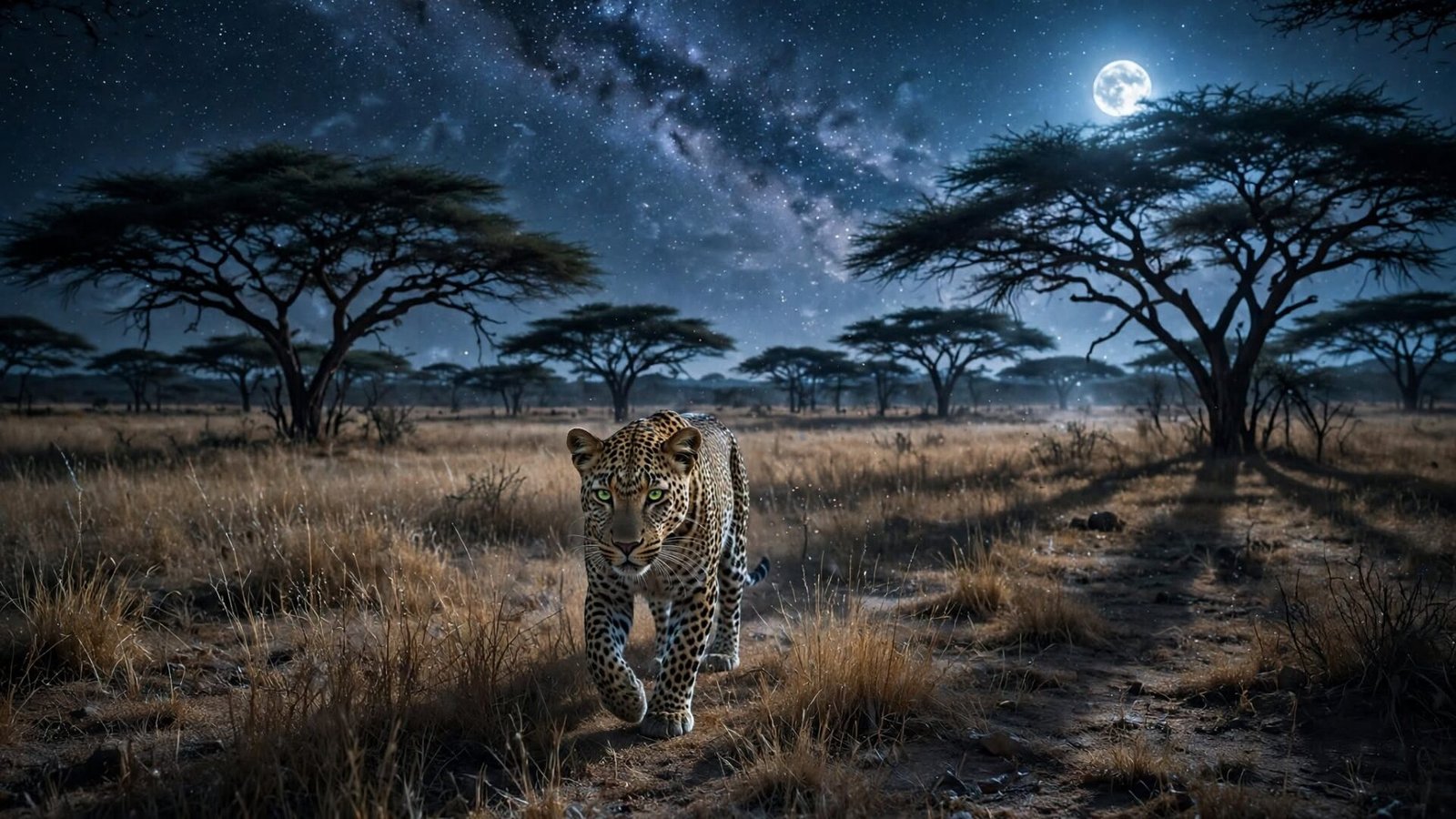
Nobody warned me about the silence.
Not the silence itself — there isn’t any, really — but that particular moment just after sunset when the daytime noise cuts off, and something else takes over. The birds go quiet. The heat lifts. And somewhere out in the dark, something you can’t see yet starts moving.
I’ve spoken to enough safari guides over the years to know that most of them will say the same thing unprompted: the tourists who only do morning and afternoon drives are, in a very real sense, watching half a film and calling it done. The second half — longer, stranger, in some ways more honest — starts the moment everyone else heads back to camp for dinner.
This is that second half.
The Africa Nobody Photographs
Here’s the thing about the African savanna that the postcard industry doesn’t advertise: a huge portion of its wildlife is actively trying to avoid the hours when tourists are most awake and most excited.
It makes complete sense when you think about it. Daytime in East or Southern Africa is hot. Brutally, persistently hot. The big predators are visible, rested, and hungry. For anything smaller and slower — or simply anything that prefers its business kept private — the middle of the day is a bad time to be out.

Night changes the math entirely. Temperatures drop. Visibility shifts in unpredictable ways, which suits animals with better low-light senses than their predators. And the sheer human traffic of the daylight hours — the jeeps, the cameras, the excited whispers — just… stops.
What moves into that space is remarkable.
The Leopard Doesn’t Need the Dark. The Dark Needs It.
I want to push back slightly on how leopards are usually described in travel writing, because “elusive” undersells it. A leopard isn’t hiding from you the way a shy animal hides. It’s simply operating on a completely different set of rules, and darkness is where those rules favour it most completely.
Leopards hunt alone. No coordinated ambush, no running prey to exhaustion in a pack. Just one animal, moving through broken light and shadow, getting close enough to strike before anything notices it’s there. Their pupils can open wide enough that they’re pulling in something like seven times the light a human eye manages in the same conditions. Add scent marking and chemical tracking through glands in the roof of the mouth, and you have an animal that doesn’t just see the dark – it reads it.
Camera trap data from reserves in South Africa suggests roughly seven in ten leopard movements happen between dusk and dawn. That spotted coat, which in afternoon light looks almost decorative, breaks up the animal’s outline against moonlit grass in a way that’s genuinely difficult to track even when you know it’s there.
Seeing one on a night drive — that brief amber flash of eyeshine before the darkness closes back around it — doesn’t feel like a wildlife sighting. It feels like the leopard allowed it.
The aardvark is doing more work than anyone gives it credit for.
Here is an animal that gets almost no attention and probably should be one of Africa’s flagship conservation stories.
The aardvark looks improvised. A long rubbery snout, enormous ears, and the stumpy body of something still being figured out by whoever drew the original sketch. It’s so biologically distinct — no close relatives, its own isolated mammalian order — that comparing it to anything else is a bit pointless. It simply is what it is.
What it is, specifically, is a demolition machine that comes out after dark.
Each night, an aardvark can cover several kilometres searching for termite mounds. When it finds one, it doesn’t investigate politely — it tears into the compacted earth with claws strong enough to break through surfaces that would require a pickaxe. Then the long sticky tongue goes in, and termites come out by the thousands.
But here’s the part that deserves more attention: the holes it leaves behind. Aardvarks dig extensively and then abandon their burrows regularly. Warthogs take them over. Hyenas shelter in them. Porcupines, monitor lizards, Egyptian mongooses, wild dogs – entire communities of animals depend on aardvark construction work that happened months or years before.
It is, without any drama or fanfare, one of the most important ecological engineers on the continent. And it does all of this between 8 pm and 4 am, invisible to almost everyone.

The Bush Baby Will Find You Before You Find It
There’s a specific sound that cuts through the African night in a way that stops conversation mid-sentence. Sharp, rising, a bit too loud for something that small — the cry of a bush baby carries further than it has any right to.
The galago (to give it its less charming scientific name) is a small primate, palm-sized, with eyes so large relative to its face that it looks like a piece of concept art rather than an actual animal. Those eyes aren’t decorative. They’re the whole strategy — massive pupils collecting every available photon in conditions that would leave most mammals stumbling blindly.
The ears are independently mobile. Each one can rotate on its own, which gives the bush baby a kind of real-time acoustic map of its surroundings that’s hard for a human to really picture. On a still night, it’s processing sound from multiple directions simultaneously, building a picture of the dark around it that’s more detailed than what you’re getting from your spotlight.
When a beam catches one in the trees – and usually guides find them by sweeping torchlight slowly through the canopy and waiting for the eyeshine – the reflection is startling. Two bright discs staring back from the darkness, absolutely still, giving nothing away.
Then it leaps. Distances that seem wrong for something that size, branch to branch, and it’s gone.
The Pangolin: The One Sighting That Makes Guides Emotional
Ask a safari guide – and I mean a guide with fifteen or twenty years in the bush – what their rarest sighting was. Not their favourite. Their rarest.
Pangolin comes up constantly.
This is an animal so secretive, so nocturnal, and so perfectly designed for invisibility that many working guides in prime pangolin habitats have never seen one outside of camera trap footage. The ones who have described it the way people describe seeing something they weren’t sure was real — quietly, a bit stunned, and wanting to stay longer than makes practical sense.
The pangolin looks prehistoric because it essentially is. Overlapping keratin scales, the same protein in your fingernails, cover it from nose to tail tip. When it curls into a ball — which it does when threatened — even a lion has trouble making progress against that armour. It has no teeth. It has a tongue that, in some species, is longer than its body when fully extended. It eats termites and ants and grinds them in a muscular gizzard rather than chewing.
It is also, heartbreakingly, Africa’s most trafficked wild mammal. The illegal trade — driven primarily by demand in parts of Asia, where the scales are used in traditional medicine despite having no proven effect — has pushed all eight pangolin species toward various degrees of threat.
Seeing one on a night drive is, to many people who’ve spent serious time in the African bush, the ultimate sighting. Rarer than a rhino. Rarer, by many accounts, than a wild dog pack. Something you hold onto.

The Honey Badger Has Genuinely Never Cared
Some animals are dangerous, and some animals simply don’t register danger as a relevant category. The honey badger is the second kind.
It comes out at night, usually alone, and it does what it wants. That includes raiding beehives, because the thick, loose skin and dense fur mean stings aren’t much of a deterrent. It includes taking on puff adders, whose venom it seems to recover from with annoying efficiency. Documented encounters with lions chasing honey badgers away from food exist. The honey badger, in these accounts, is described as not running so much as redirecting.
The intelligence is real and documented — not anecdotal. Tool use, problem-solving that suggests multi-step planning, and memory for solutions across time gaps. For an animal most visitors to Africa have never encountered, it carries a personality that’s somehow larger than its frame.
It’s also, for what it’s worth, quite beautiful in its own blunt way. That broad white stripe down its black back and the compact, powerful build. Built entirely for function, with no concessions to charm whatsoever.
What You Hear First
Something that gets left out of most night safari writeups: the experience doesn’t start with something you see. It starts with something you hear, usually while the vehicle is still moving and your eyes are still adjusting.
The African bush at night runs on sound. The distant sawing cough that means a leopard is somewhere downwind and claiming territory. The hyena’s whoop is a sound that carries three kilometres on a still night and sets off a chain reaction of similar calls across the dark. Insects are so numerous and so persistent that their collective frequency feels physical, felt in the chest rather than just heard.
Good guides read this like a map. A sudden insect silence means something large has moved close by. The alarm bark of an impala tells you the direction of a predator before any spotlight finds it. A shift in the wind, and the whole acoustic picture changes.
Standing in that bush, listening before you can see anything, is one of the genuinely disorienting sensory experiences available to a person without buying a plane ticket to space. There’s a moment where you stop being a tourist and start being a reasonably small, reasonably soft mammal standing in the dark with things that are much better equipped for it than you are.
It’s uncomfortable. It’s extraordinary.

Book the Night Drive. Seriously.
The morning game drive is where you’ll see the lions. The afternoon drive is where the light turns gold, and everyone’s photographs look professional. These are not trivial things.
But the night belongs to a completely different set of characters—ones who have been running their own version of Africa since long before the first safari camp existed. The aardvark, solitary and purposeful, tears apart the earth. The pangolin moves through darkness with the quiet of something that has survived unchanged for millions of years and intends to keep doing so. The bushbaby stares at you from a branch with those impossible eyes, deciding in about three seconds that you’re boring and vanishing.
The question isn’t really whether these things are worth seeing. They obviously are.
The question is whether you’re willing to stay up for them.
Night drives are available at most private reserves across Kenya, Tanzania, Botswana, Zimbabwe, and South Africa. For the best pangolin and aardvark chances, look at South Luangwa in Zambia, the Central Kalahari in Botswana, or the private concessions around Kruger. Go in the dry season, when animals concentrate near water and guides can work the riverbeds after dark.



+ There are no comments
Add yours