


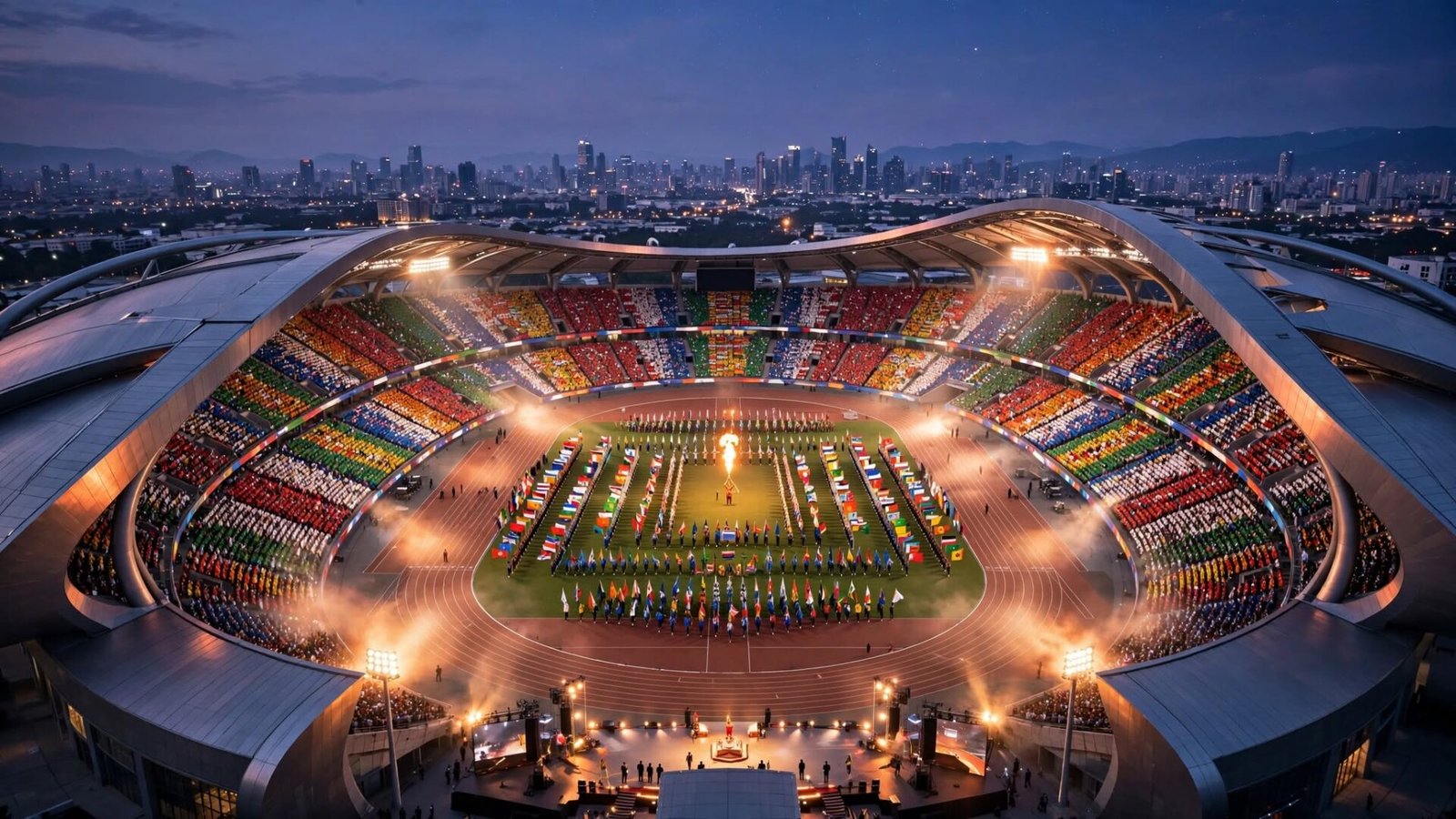
Boycotts, Cold War politics, a forgotten founder, and the quiet dignity of athletes from countries most of the world can’t find on a map. What the medal tables never show you.
Nobody finishing a race thinks about geopolitics. That much, at least, seems safe to say. The sprinter coming off the bend in the final hundred metres is thinking about one thing — the tape. Not the Cold War. Not colonial memory. Not whether his government recognises the government of the athlete in the next lane. Those concerns belong to the people in suits sitting in the dignitaries’ box. And yet, with the Asian Games, it has always been impossible to fully separate the two. The suits and the spikes have been tangled together from the very first morning this competition existed — and understanding why tells you something that the medal tallies never will.
The first edition opened in New Delhi on March 4, 1951. India had been an independent nation for less than four years. The wounds of Partition were not old wounds yet — they were current ones, still open, still producing refugees and violence and grief on a scale that is hard to comprehend today. The National Stadium had been finished in a hurry. Some reports suggest construction was still happening in the week before the athletes arrived. Eleven countries sent 489 competitors. They ran on a cinder track. They lifted weights in a hall that smelt of fresh paint.
And somehow, looking at the photographs from that day — the flags, the formations, the faces — what you feel is not the smallness of it. You feel the audacity.

The Man Behind It Whom History Largely Forgot
His name was Guru Dutt Sondhi, and the fact that you have probably never heard of him is, in itself, a minor historical scandal. Sondhi was an Indian member of the International Olympic Committee, and he began pushing the idea of an Asian Games as early as 1948 — while sitting in the stands at the London Olympics, two months after his country’s independence. He started talking to other Asian delegates. He circulated a proposal. He was not a man with a powerful institution behind him or a large budget or political protection. He just had an idea and the stubbornness to keep explaining it to people.
Sondhi had no organisation, no budget, and no political cover. He had one idea and the persistence to keep explaining it to humans until they stopped pronouncing no.
The Asian Athletic Federation formed the same year. A draft constitution for what would become the Asian Games Federation followed in 1949. And then, two years later, the Games actually happened. There is no statue of Sondhi in any major stadium. His name does not appear in casual sports coverage. If you mentioned him to most people who have watched every Asian Games since 1982, they would draw a blank. Sport has a long tradition of forgetting its actual founders in favour of the institutions those founders created, and this is a textbook example.
The motto Sondhi and his colleagues chose — “Ever Onwards” — was not sports marketing language. These were people from countries that had spent decades being told, in various colonial idioms, that they were behind. That they were lesser. The motto was an argument against that idea, put into Latin and stitched onto a banner.
Jakarta, 1962: The Moment Sport and Politics Stopped Pretending to Be Separate
If you need to apprehend what the Asian Games have usually been about, the 1962 Jakarta version is where you should begin looking. Indonesian President Sukarno refused to trouble visas for athletes from Israel and Taiwan. His reasons were explicitly political — unity with the Palestinian cause and aid for the People’s Republic of China over the Republic of China in Taipei. The International Olympic Committee replied by suspending Indonesia from the Olympic movement completely.
What happened next is the part that tends to get left out of the official histories. Rather than apologise or reverse course, Jakarta hosted its own alternative sporting event the following year — the Games of the New Emerging Forces, GANEFO — explicitly framed as a sporting option for countries that felt the IOC was a tool of Western interests. Athletes from the Soviet Union, China, the United Arab Republic, and over fifty other nations participated.
Think about what that actually was. A newly independent nation, twelve years removed from Dutch colonialism, decided that the rules of international sport as written by Western bodies did not bind them. And rather than just boycott, they built an alternative. Whether you agree with Sukarno’s politics or not, the move was not irrational. It was a perfectly coherent response from a country that did not trust the neutrality of the institutions it was being judged by. Asia was not going to sit quietly in the corner and accept disqualification from people whose empires had, until recently, been running the place.

| Edition | Official Story | What Was Actually Happening |
|---|---|---|
| 1951 — New Delhi | First Games, 11 nations, cinder track | Post-colonial Asia announcing itself to a world that hadn’t asked |
| 1962 — Jakarta | Indonesia hosts a strong regional showing. | Israel and Taiwan excluded; IOC suspends Indonesia; GANEFO born |
| 1974 — Tehran | China enters for the first time. | Israel expelled from the federation; Cold War chess moves in sports clothing |
| 1986 — Seoul | South Korea’s slick, modern games | A country destroyed by war 33 years earlier, showing it had rebuilt completely |
| 2010 — Guangzhou | China dominates the medal table again. | The scale of hosting itself was the message — larger than most Olympics. |
| 2018 — Jakarta | Esports debuts as a demonstration event. | Asia telling the rest of the world what “sport” means in the 21st century |
| 2023 — Hangzhou | Largest Games in history, 481 events | China’s post-pandemic statement of continuity and scale |
What China’s Arrival Actually Did to the Competition
Before 1974, watching the Asian Games medal table was genuinely interesting. Japan ruled via the Nineteen Fifties and into the Sixties, which made sense — it had industrialised earlier than most of its neighbours and had the sports activities infrastructure to suit. South Korea, India, the Philippines, and Thailand all had strong showings on extraordinary occasions. No single state turned into this point in advance so that the general end result felt predetermined.
Then China entered. And the arithmetic of the competition changed permanently.
This is not a complaint. China’s dominance is a product of scale, planning, and sustained investment — not anything unfair. A country of 1.4 billion people with a centralised elite sports development pipeline and the money to build world-class training facilities in virtually any discipline was always going to produce this outcome. By the early 1990s, China was at the top of the table by a margin that made the overall race feel somewhat academic.
But here is what that dominance actually produced in the rest of Asia: urgency. South Korea decided to get extraordinarily serious about specific sports — archery, taekwondo, and short-track speed skating — and built systems that eventually made it one of the best nations in the world in all three. Japan, stung by years of slipping behind, invested heavily and eventually returned to genuine competitiveness. Smaller nations found niches. Bahrain and Qatar began recruiting and naturalising athletes from Africa for track and field. The competitive pressure that China created cascaded through the entire continent and ultimately produced better Asian representation at the Olympics than existed before China entered the picture.
The Sports That Don’t Exist Anywhere Else — And Why That Matters
There is a school of thought that says the Asian Games are just a smaller Olympics with a narrower geographic range. This is wrong, and the programme is where you can see most clearly why.

Kabaddi has been an Asian Games event since 1990. It is a historical South Asian contact sport wherein a raider crosses into the opposing group’s 1/2, tries to tag as many defenders as possible, and must go back to his own 1/2 on a single held breath at the same time as chanting “kabaddi” continuously to show he hasn’t inhaled. India has won every gold medal since the sport was included. Watching a good kabaddi match live is genuinely alarming — people are much faster and stronger than the rules of the sport initially suggest, and the collisions are real.
Watching kabaddi live is genuinely alarming. The collisions are real. The held breath is real. It does not look like something invented for television.
Sepak takraw entails a rattan ball and players who execute bicycle kicks that, in every other context, could be described as bodily not possible. Dragon boat racing. Wushu. Pencak silat, the Indonesian martial art. Kurash, that is, Uzbek upright wrestling with continuous records stretching back over three and a half thousand years.
These are not token inclusions. They are in a deliberate argument about whose traditions get to count as legitimate sport. The Olympic programme is, historically, a European document. The Asian Games programme says, edition by edition, that the sporting cultures of this continent have their own validity and do not require Western endorsement to be taken seriously. Esports becoming a medal event at the 2023 Hangzhou Games — still mocked in some quarters as a concession to youth culture — was actually just the most recent version of exactly the same argument. Asia has the largest competitive gaming population on earth. The Asian Games Federation was not pandering. It was reflecting reality while other bodies were still debating whether to look at it.
The Moments Nobody Puts in the Highlights Reel
The 1986 Seoul Games deserve more attention than they get. South Korea was still, in many Western minds, primarily associated with the Korean War — a country that had needed to be defended and rebuilt. The 1986 Games were the moment that framing became impossible to maintain. The facilities were world-class. The organisation was meticulous. The entire event ran as a direct advertisement for what South Korea had become in three decades of remarkable economic growth. Two years later, Seoul hosted the Olympics, and nobody was surprised. But 1986 was when the decision to award them the Games stopped looking like a risk.
Then there is the story the official records never tell — the athletes from Bhutan. From Mongolia. From Laos and Nepal and Timor-Leste. Countries that send delegations of four or six or twelve people, none of whom have any realistic chance of a medal, who train in conditions that would be considered inadequate at a regional level in wealthier nations. They show up anyway. They march in the opening ceremony. They compete and finish last and shake hands. The Asian Games have always been partly about the grand geopolitical statements and the dominant powers signalling their strength. But they have also always been about those athletes. The ones whose names never make the broadcast. The Games belong to them too, and sometimes — not often, but sometimes — one of them wins something, and that is a different kind of story altogether.
- Kabaddi — India has won every gold since 1990. The sport requires holding your breath while being tackled by six people. It is more intense than it sounds.
- Sepak Takraw — A rattan ball, no hands allowed, and bicycle kicks that defy reasonable expectations of human joints. Southeast Asia’s gift to spectators.
- Kurash — Uzbek upright wrestling, over 3,500 years old. Central Asia dominates. Included since 1999.
- Dragon Boat Racing — 20 paddlers, ornate boats, and the kind of team synchronisation that makes rowing look casual. In the programme since 1993.
- Esports — Medal sport since the 2022/2023 Hangzhou Games. League of Legends, PUBG Mobile, Dota 2. The crowd noise is indistinguishable from any other final.

Seventy Years and What They Actually Prove
The Asian Games have been a mess, at various points, in various ways. Boycotted. Delayed. Embarrassed by the aid of politics that spilled onto the sector after they had been speculated to live inside the stands. The 1970 Bangkok Games happened years after they had been imagined to because the unique host pulled out. The 2022 Hangzhou Games slipped a complete year due to COVID-19. There were doping scandals, monetary screw-ups, and versions in which the gap between the aspirational motto and the real complaints became extensive enough to power a bus through.
And yet none of it stopped the next edition from happening. Forty-five nations keep agreeing to come back. That is not a small thing when you look at the list of who those nations are — India and Pakistan, China and Japan, North and South Korea during the periods when Pyongyang has chosen to participate. Countries with unresolved territorial disputes, historical grievances, and diplomatic relationships that range from strained to actively hostile. They walk into the same stadium. They stand on the same starting line. They shake hands afterward.
Sport doesn’t fix those tensions. Nobody serious thinks it does. But there is something that happens when people from countries that are not on speaking terms are forced to occupy the same physical space and compete under the same rules. It is not reconciliation. It is not friendship. It is something smaller and more practical: the acknowledgment that the other person exists and is capable of running faster than you on a given Tuesday afternoon.
Guru Dutt Sondhi, standing in the stands at Wembley in the summer of 1948 with his proposal and nobody to give it to, probably could not have articulated exactly what he wanted the Games to become. He wanted Asia to have a stage. He got one. Whether anyone else noticed is — and this is the strange, quiet truth of the whole enterprise — almost beside the point. The athletes showed up. That was always the real argument.



+ There are no comments
Add yours