


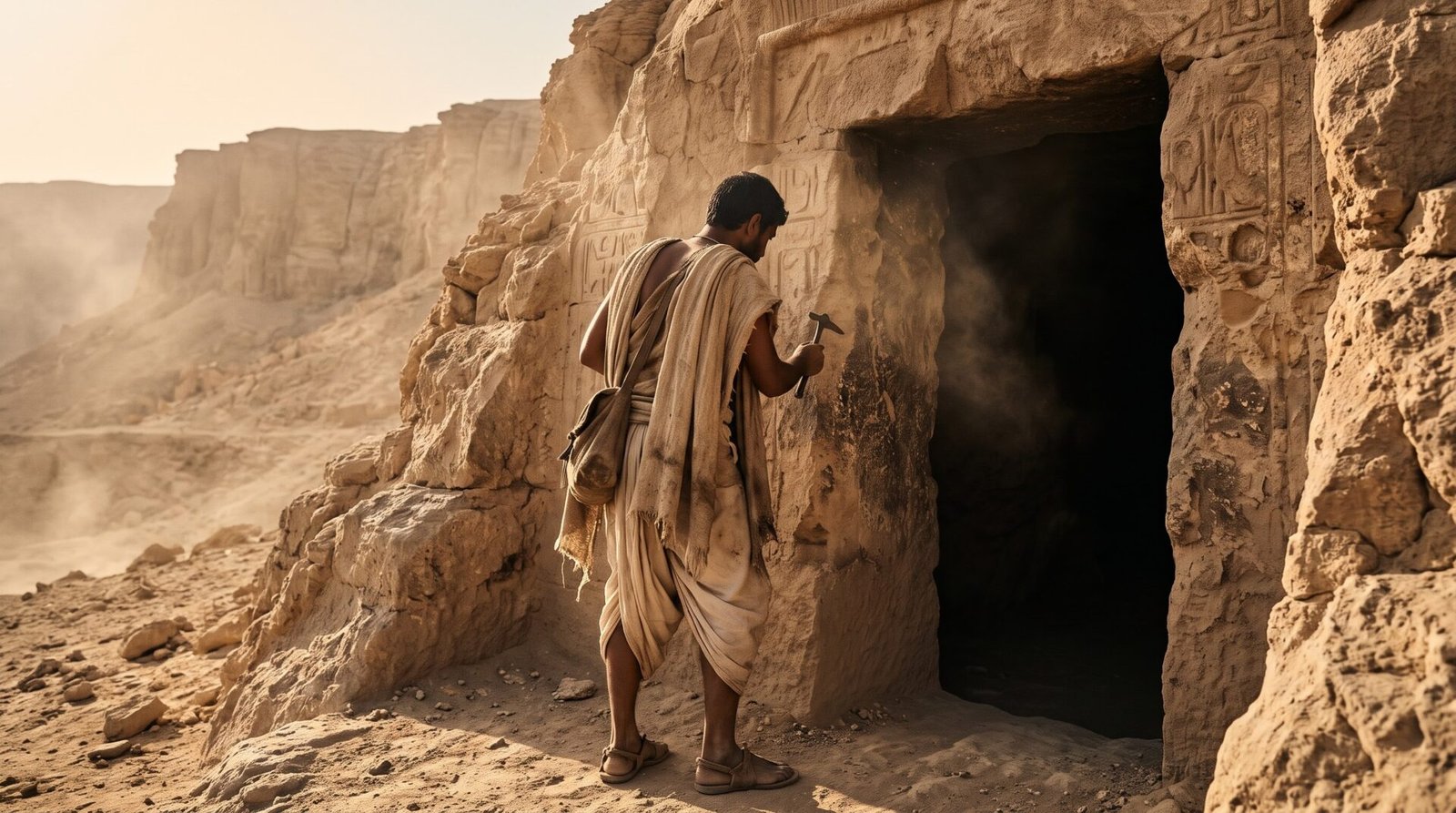
Imagine a sizzling afternoon in Upper Egypt, round a hundred and fifty CE. A guy ducks out of the glare and into a royal tomb that had already been ancient by the time his grandparents were born. He’s far from home, probably months of travel from anything familiar. He pulls out a sharp tool, picks a spot on the wall, and scratches in his name.
His name was Cikai Korran. It’s still there.
Scholars have now catalogued about 30 inscriptions in Indian languages inside the tombs of the Valley of the Kings, dated to roughly the first to third centuries CE. What makes this exciting isn’t gold or a lost chamber. It’s that we’re hearing from ordinary travellers, not kings or court scribes. That’s rare, and it changes how we picture ancient India and Egypt.

What the researchers actually found
The writing turned up in six tombs on the Nile’s west bank, near modern Luxor. It comes in 3 Indian languages: Old Tamil, written in Tamil-Brahmi, Prakrit, and Sanskrit. There’s also a single line in Kharosthi, a script from the northwest of the subcontinent.
Ingo Strauch, an Indologist at the University of Lausanne, and Charlotte Schmid of the French School of Asian Studies led the work. By the accounts I read, Strauch spotted the odd lettering while walking through the valley as a regular visitor. Among all the Greek scratchings, a few lines simply didn’t look Greek, and he knew what they were.
So why did nobody catch them for so long? Egyptologist Steve Harvey, who wasn’t involved, offered a simple explanation. People who examine Indian languages rarely have a look at graffiti in Egypt, and people who have a look at Egyptian graffiti rarely read Tamil-Brahmi. Greek and Aramaic scribbles have drawn interest for generations. These sat on the same walls, unread, because the right eyes never landed on them.
The man who couldn’t stop signing his name
Cikai Korran is the real character here. He wrote his name eight times in Old Tamil, which makes him responsible for nearly a third of all the Indian inscriptions found so far. He seems to have signed in several tombs, as if one wasn’t enough.
Strauch has described him as extremely excited about his visit, and honestly, the evidence backs that up. Above the entrance of Ramesses IX’s tomb, Korran’s name sits some five to six metres off the ground. How did he get up there? Nobody knows. A ladder, a makeshift scaffold, a friend’s shoulders. One of the scholars called the placement “weird”, which feels fair.
Then there’s the tomb shared by Tausert and Setnakhte. His name is the only graffiti on it, and it’s right by the entrance. That hints the inside was closed off when he showed up. He couldn’t get in, so he left his mark outside anyway. You can almost see him shrugging.
Another visitor, Indranandin, may have landed at the Red Sea port of Berenike and then crossed the desert to reach the valley. Strauch has floated the idea that some of these travelers could have been heading on to Rome, since Egypt belonged to the Roman Empire at the time.
“So-and-so came and saw.”
The phrasing is my favourite part. Several Indian inscriptions follow the same pattern as the Greek graffiti already covering the tombs: this person came and saw. Scholars read that as copying. The Indian visitors looked around, noticed what other tourists were doing, and did it too, in their own languages.

Think about that. Two thousand years ago, people from different continents stood in front of the same monument and felt the same urge. Greek and Roman visitors left well over a hundred inscriptions in these tombs, and back in 1926 French scholar Jules Baillet recorded more than 2,000 graffiti and drawings across the site. The Indian additions are a small corner of a very crowded wall. But they change who we imagine standing in those corridors.
Why this matters for Indo-Roman trade
Historians have known for a long time that goods moved between India and the Roman world. Coins, pottery, and written statistics all say so. What the graffiti adds is human beings, with names and voices.
The sea route is well documented. A Greek service provider’s guide from the first century CE, the Periplus of the Erythraean Sea, walks via ports around the Arabian Sea and what everyone traded. Roman ships used the monsoon winds to go from Egyptian harbours like Berenike and Myos Hormos to India and back again.
India sent west pepper, pearls, ivory, cotton cloth and gemstones. Rome sent back wine, glass, coral, metals and enormous amounts of gold and silver coins. Piles of Roman coins have been dug up across southern India. Excavations at the Red Sea ports of Berenike and Quseir al-Qadim have turned up Indian goods, including a pot with Tamil-Brahmi writing on it. And a well-known papyrus kept in Vienna records a loan agreement for a ship’s cargo headed to the Indian port of Muziris for a sum that still makes historians whistle.
Put the tomb graffiti next to all that, and the picture gets clearer. Ancient India-Egypt trade wasn’t a rare adventure. It was regular business, with people going back and forth.
Merchants, soldiers, or just tourists?
We don’t know exactly who these visitors were. Reports mention merchants and military men as likely candidates. The inscriptions came from people from the northwest, west, and south of the subcontinent, so they weren’t all from one place or one community.
Merchants are the obvious guess. If you’d spent months on a ship and a desert road, you’d probably want to see the famous sights while you were in town. Others may have been sailors, agents, or members of Indian communities living near the Red Sea ports. Graffiti doesn’t come with a job title, so we’re left guessing.
What we can say is that the Valley of the Kings was already a tourist stop by Roman times. Strauch has compared it to today’s visitor circuit, and that feels right. If you were in the area with a few free days, you went to see the old royal tombs.

Why nobody spotted it sooner
It’s a fair question, and the answer says a lot about how knowledge actually grows. Egyptologists are trained in hieroglyphs, Greek and Latin. Indologists are trained in Brahmi, Tamil and Sanskrit. Very few people are trained in both, and the two groups rarely end up in the same room. Anything written in the gap between them can sit unread for decades.
In a 2023 paper, Strauch argued that graffiti should count as a proper category of Indian epigraphy. This discovery gives that argument real weight. And it raises an obvious hope: if a visitor spotted these by chance, other tombs, temples and quarries along the Nile and the desert roads to the Red Sea may be hiding more.
A few cautions
A story this charming tends to get inflated online, so let’s keep it honest.
The inscriptions don’t prove that large numbers of Indians lived in Egypt. They show that some individuals visited, and others probably followed. The dates come from the style of the script and the surrounding evidence, so “first to third century CE” is a range, not an exact year. And any claim about an Indian presence in pharaonic Egypt goes far beyond what the evidence supports. The tombs are around 3,000 years old, yes, but the graffiti was added much later, when Egypt was a Roman province.
The true version is quieter, and I’d argue better. It’s about ordinary people moving around a connected world.
What it means for India
For readers in India, this reminds us that our ancestors weren’t stuck at home. Tamil traders were part of a network that stretched to the Mediterranean. Roman writers knew their ports, Muziris and Arikamedu among them. Their script, which took shape around the third century BCE, now shows up on the wall of a pharaoh’s tomb.
And for everyone else, it’s a nice jab at the idea that the ancient world was cut off. People travelled, traded, gossiped, and went sightseeing long before airports and visas.

Quick answers
Did ancient Indians really visit Egypt?
Yes. Inscriptions in Tamil-Brahmi, Prakrit and Sanskrit in the Valley of the Kings show that visitors from India reached Egypt around 2,000 years ago.
Who was Cikai Korran?
A traveller who wrote his name in Old Tamil at least eight times across several tombs. Beyond the graffiti, we know nothing about him.
How old is the Indian graffiti in the Valley of the Kings?
Roughly the first to third centuries CE, when Rome ruled Egypt.
What does it say about Indo-Roman trade?
It adds personal evidence to what coins, pottery, and texts already showed: steady sea trade between India and the Roman world through Red Sea ports.
One last thought
Most of what survives from the ancient world belongs to the powerful: palaces, laws, royal boasts. This belongs to somebody else. A person crossed an ocean and a desert, stood in front of something astonishing, and wanted the world to know he’d been there.
Two thousand years on, it worked.



+ There are no comments
Add yours