


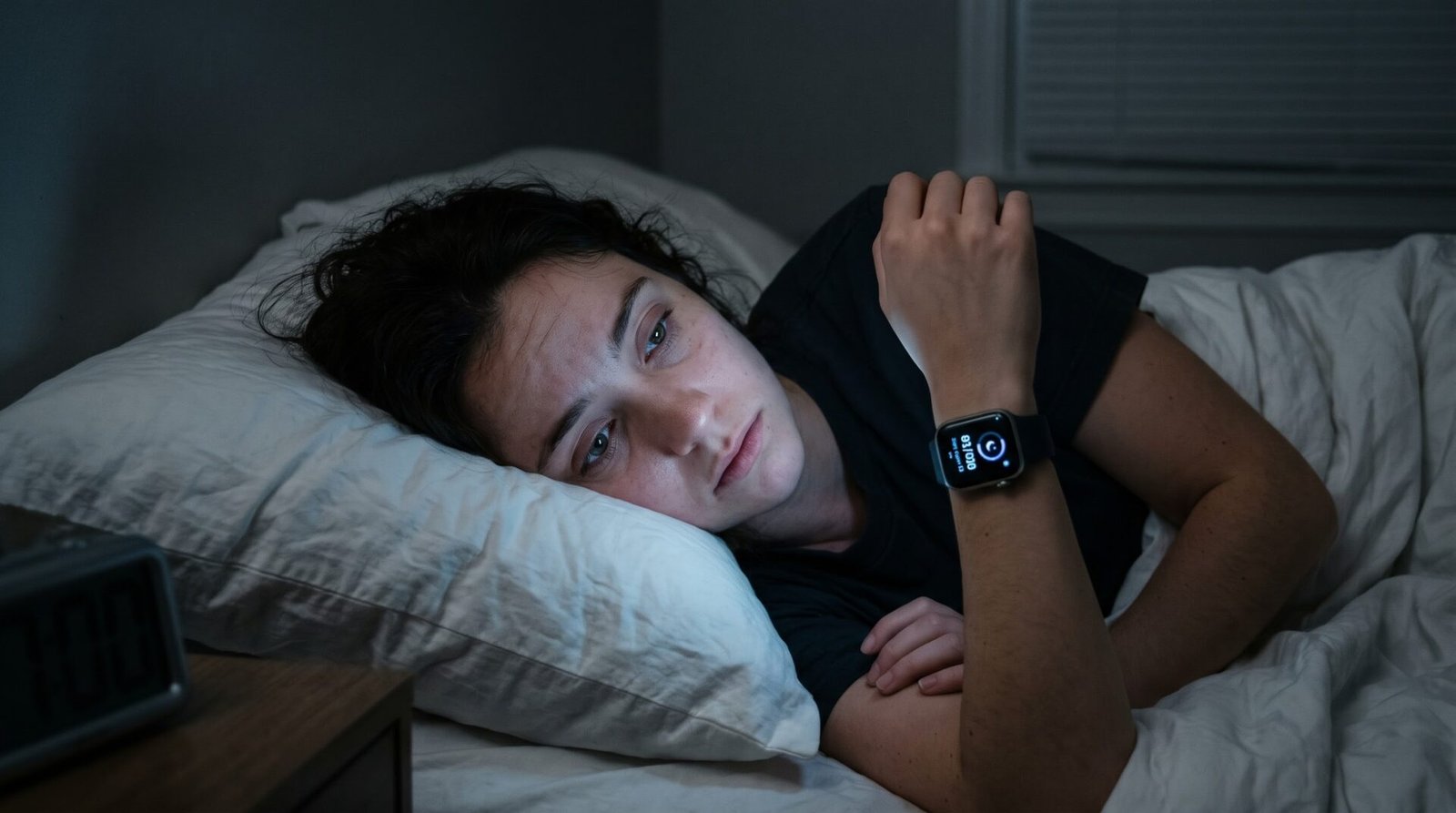
At some point in the last two years, sleep stopped being something you just did and became something you had to optimise.
You know the drill. A smartwatch on your wrist logs your REM cycles. An app scores your night out of 100. A Reddit thread tells you that your 74 is basically failing, and have you tried mouth-taping, a weighted blanket, magnesium glycinate, and a fan set to exactly 68°F? There’s a whole vocabulary now — sleep hygiene, sleep debt, circadian rhythm syncing — and if you’re not using it, you’re apparently doing it wrong.
This is sleepmaxxing. And for a lot of people, it has made sleep dramatically worse.

The Irony Nobody Talks About
Here’s the thing about obsessing over your sleep data: the obsession itself keeps you awake.
There’s actually a clinical name for this. Orthosomnia — coined by researchers at Rush University Medical Center — is the condition where someone becomes so preoccupied with achieving perfect sleep scores that the anxiety around those scores disrupts their actual sleep. The tracker meant to help you rest is now giving you something to lie awake worrying about.
I think about one particular scenario a lot. You go to bed feeling genuinely tired. You fall asleep at a reasonable hour. You wake up feeling… fine, actually. And then you check your app. It says your deep sleep was low. Your heart rate variability was below your personal average. Your sleep score is 61.
Suddenly you don’t feel fine. Suddenly you’re recalculating the night. Was that headache from the bad sleep? Are you going to be foggy all day? Should you nap? Should you not nap? The data has rewritten your own lived experience of the night, replacing something that felt okay with something that is labelled inadequate.
That’s not wellness. That’s a different kind of suffering.
How Sleepmaxxing Took Over
The sleep-maximising fashion didn’t come out of nowhere. It arrived along with a broader cultural shift towards biohacking — the idea that the human body is basically a device that can be debugged, kept up to date, and optimised in the manner you’ll update software.
Sleep was low-hanging fruit. We all know we’re supposed to get more of it. Most of us feel perpetually tired. And not like a food regimen or workout, sleep feels like something that has to be passive — something that simply takes place. So whilst others offered to degree it, to offer it a score, and to tell us concretely whether or not we were doing it right, thousands and thousands of people grabbed that product straight away.
The Oura ring. The Whoop band. Fitbit. Apple Watch. Garmin Eight Sleep mattresses that monitor your temperature and movement through the night. The marketplace for consumer sleep tech is now worth billions of bucks annually, and it continues developing.
None of these products are inherently bad. Some people genuinely benefit from the data — athletes, people with sleep disorders working alongside doctors, individuals who identified real problems (like sleep apnoea) through wearable alerts. The technology itself isn’t the villain.
The problem is what happens when, every day, fairly properly-sleeping people begin treating a score on an app as more authoritative than how they simply sense. When the goal shifts from rest to numbers. When going to bed becomes a performance, you’re graded on it.

What the Research Actually Says
Sleep science is extra complex — and more humbling — than the health enterprise loves to admit.
Most client sleep trackers measure movement and heart rate, then use algorithms to estimate your sleep ranges. They’re not measuring your brain waves. They’re inferring. And multiple peer-reviewed studies comparing consumer wearables to polysomnography (the actual clinical gold standard, where electrodes measure brain activity directly) have found meaningful inaccuracies — particularly in detecting deep sleep and REM sleep.
In other words, your score of 61 might be wrong. Your “low deep sleep” might be a measurement error. But you’re lying awake worried about it anyway.
A 2019 study published in the Journal of Clinical Sleep Medicine found that patients who fixated on their sleep tracker data reported higher levels of daytime fatigue — regardless of what their actual sleep looked like. The belief that they’d slept badly, reinforced by a number, made them feel worse than the sleep itself warranted.
Your brain is remarkably easy to trick in this direction. Tell it you slept poorly, and it will find evidence for that conclusion everywhere.
The 7-Step Simple Sleep Routine (No Tracker Required)
None of this indicates you need to throw your watch in a drawer forever. But if the information is making you traumatised, in case you awaken, and your first pass is to test a rating rather than checking in with yourself, it is probably worth stepping back from the metrics for a while.
These seven steps aren’t a protocol. They’re not a system to optimise. They’re just a collection of things that consistently help people sleep better — none of which require you to measure anything.
Step 1: Pick a wake time and actually hold it.
Not a bedtime. A wake time.
Most sleep recommendations lead with bedtime, but that is harder to control than you think — you can’t force yourself to nod off; however, you may manage when you get up. Pick a time that works seven days per week, such as weekends, and hold it. Your body will start calibrating backward from there. Within a few weeks, you’ll naturally start feeling sleepy at a more consistent hour because your circadian rhythm will have something to anchor to.
This is boring advice. It works remarkably well.
Step 2: Let yourself wind down, not power down.
The phrase “sleep hygiene” has made bedtime feel like a medical procedure. Wash your face, dim the lights, put your phone away, do exactly 10 minutes of light stretching, and start your box breathing — it’s exhausting before you’ve even closed your eyes.
Wind-down doesn’t have to be structured. It just has to be genuinely calm. Read something you enjoy. Sit with a cup of tea. Have sluggish, boring communication with a person you adore. The aim is to offer your worried system a sluggish off-ramp, not a checklist.
Step 3: Make your bedroom slightly cooler than you think it needs to be.
Your core frame temperature obviously drops as you doze off. A cooler room helps that method. Most sleep researchers point to somewhere between sixty-five and sixty-eight°F (18 and 20°C) as the sweet spot, even though you may want to regulate to your very own comfort.
You don’t need an eight. Sleep mattress to do this. Open a window. Turn down the thermostat. Kick off one layer of blankets.

Step 4: Stop eating at least two hours before bed.
Not because of metabolism myths. Because digestion is a bodily active process, and your body handles it higher while it’s now not additionally trying to initiate sleep. A full stomach can cause pain, increase your core temperature slightly, and interrupt the early stages of sleep more than most people recognise.
This does not suggest you can’t have a small snack. A handful of almonds or a banana won’t hurt anything. It means a full dinner at 10 PM before a midnight bedtime is probably working against you.
Step 5: Take morning light seriously.
Sunlight in the first hour after waking up is one of the most effective — and most ignored — tools for better sleep. It’s not magic. It’s biology. Morning light exposure suppresses residual melatonin, resets your circadian clock, and sets a timer running in your body that helps trigger melatonin production again about 14–16 hours later.
Ten to twenty minutes outside, even on a cloudy day, is enough. You do not want blue-light-blocking glasses, a SAD lamp, or any precise product. Just cross the stand out of doors and study the sky for a couple of minutes.
It sounds ridiculous. It genuinely helps.
Step 6: Stop sleeping with your phone within reach.
Not because of blue light — that effect is real but probably overstated for most people. Because of what happens mentally when the first and ultimate objects you interact with every day are ones that convey social stress, notifications, and a limitless flow of factors annoying your attention.
The transition into sleep works better while your mind believes the day is surely over. That perception is hard to keep while your smartphone is six inches out of your face, and a notification could arrive at any 2d. Put it across the room. Charge it in another room entirely, if you can. Old-fashioned alarm clocks still exist and still work.
Step 7: When you can’t sleep, get up.
This is the most counterintuitive one and the most evidence-backed.
Lying in bed awake for a long time trains your brain — slowly, over many nights — to associate your bed with wakefulness and frustration rather than sleep. If you’ve been lying there for 20–25 minutes and nothing is happening, get up. Go to another room. Do something calm and boring in low light — read, stretch, just sit there — and go back when you genuinely feel sleepy.
It feels wrong. The instinct is to stay horizontal and wait it out. But waiting it out in bed, staring at the ceiling, is what makes this harder the next night.

The Score Isn’t the Point
There’s something worth saying plainly at the end of all this.
You are not a number. Your sleep is not a grade. The whole point of rest is that it’s one of the few things in modern life that doesn’t have to be productive. It doesn’t have to be optimised. It doesn’t have to prove anything.
The people who sleep best — and I mean this both as an observation and as a conclusion supported by sleep research — are not the people who monitor their sleep most carefully. They’re the people who’ve built a life calm enough that sleep comes naturally, and then they get out of its way.
That’s not something a tracker can give you. But it’s something you can build, one boring, consistent, screen-free night at a time.
The goal isn’t a better score. The goal is to wake up tomorrow feeling like yourself.
Start there.



+ There are no comments
Add yours