


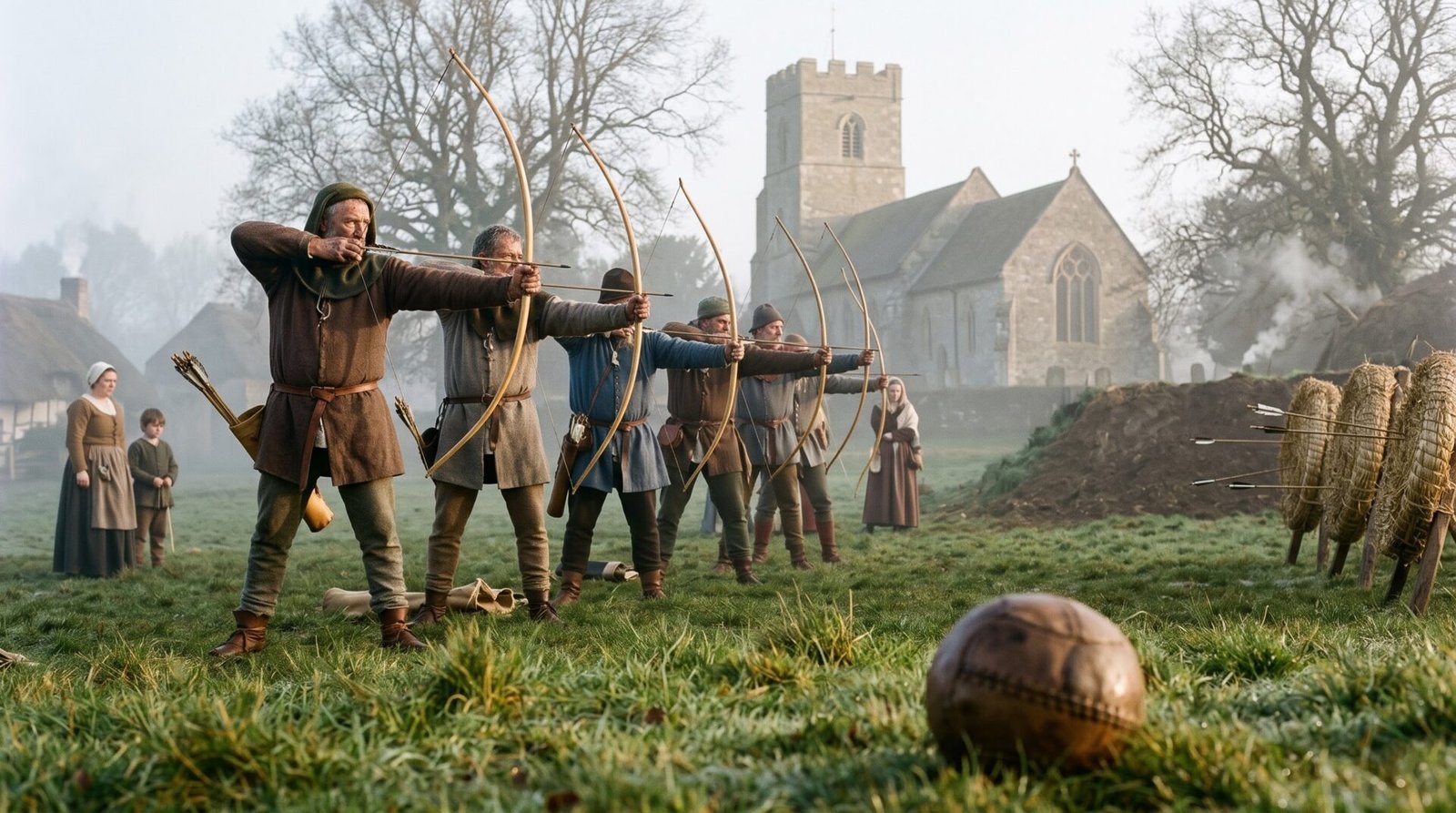
Picture a Sunday in a fourteenth-century English village. The church is over. This is normally when the lads would kick an inflated pig’s bladder around the green, or throw dice behind the alehouse, or settle an argument with a wrestling match. Then the sheriff turns up with a royal order, and from now on those free hours belong to the bow.
That was the deal Edward III handed his subjects in 1363. He spent most of his reign at war with France, and somewhere along the way he decided that his people’s hobbies were a defence problem. So he did something governments rarely try. He regulated fun.
The odd part is that it more or less worked. Not perfectly, and not because everyone obeyed. But the English longbow, the weapon people still bring up whenever Crécy or Agincourt comes round, was as much a product of Sunday afternoons as of anything that happened on a battlefield.

The Order of 1363
On 12 June 1363, Edward III sent a writ to the sheriffs. Every in a position-bodied man was to practise archery on Sundays and holidays, whenever he had spare time. The same writ listed what he should stop doing: handball, football, hurling, club ball, cockfighting, and any other “vain games of no value”.
Sheriffs were meant to make sure it happened.
Read it again, and the strategy is plain. Edward wasn’t suggesting a healthy hobby. He was taking over the only free time ordinary people had. A peasant spent six days working for his lord and his own strips of land. Sunday and feast days were what was left, and the Crown wanted them aimed at the butts, the earth banks where targets stood.
Why a King Cared About Sunday
In the 1300s, England was the smaller player in every contest with France. France had more people, more money, and far more knights in expensive steel. Matching them man for man was a losing plan.
Instead, England had a cheap weapon and plenty of ordinary men they could teach to use it. Raising a knight meant a lifetime of training and a small fortune in kit. A yeoman with a bow cost a fraction of that, and a few thousand of them shooting together could darken the sky. Crécy in 1346 and Poitiers in 1356 had already shown the result, with English and Welsh archers wrecking French armies that looked far more impressive on paper.
But a weapon like that only works if the men holding it are good. You can’t call up ten thousand skilled archers the month a campaign starts. Someone has to have been shooting for years already. Edward understood that, which is why he cared so much about what happened on a village green when no army was anywhere near.
A Weapon You Couldn’t Just Pick Up
In a museum case, the longbow looks simple: a long stave of yew and a string, done. In practice it was brutal. War bows ran to about six feet, and the ones recovered from the Mary Rose, Henry VIII’s warship that sank in 1545, point to draw weights somewhere between 100 and 150 pounds, sometimes more. Most modern shooters couldn’t manage one.
So you couldn’t hand a farm boy a bow and expect an archer. The strength came slowly, usually starting in the teens. And it left marks. Skeletons of archers from the Mary Rose show thickened bones in the shooting arm and twisted spines, a physical record of years spent hauling on that string.
A good archer could lose ten or twelve arrows a minute and reach targets 200 yards away or more. Put a few thousand of them in a line, and the volley was something an enemy could barely face. But all of it depended on practice, and practice meant time. Every Sunday at the butts was a small payment into a military account the king could draw on later.

The Games That Got Squeezed
Football is the best people remember. Edward wasn’t even the first to dislike it. London had already proclaimed against the game in 1314, complaining about the noise and the trouble. Mediaeval football wasn’t the tidy sport on television. Whole villages could be involved, with no fixed pitch and hardly any rules, and the afternoon often ended with smashed windows and bruises.
Edward’s problem was different. He didn’t mind the racket much. He minded that every hour spent chasing a ball was an hour not spent drawing a bow. A kingdom at war with its biggest neighbour couldn’t afford subjects who preferred playing to preparing.
The idea stuck around. In 1388, under Richard II, every other regulation instructed servants and labourers to keep bows and shoot on vacations, at the same time as forbidding video games including tennis, quoits, and dice. Henry IV renewed comparable rules in 1410. The wording shifted a bit on every occasion; however, the message held constant: archery was an obligation, and nearly everything else became a distraction.
From Crécy to Agincourt
Did it work? The battles suggest so, though historians are careful about handing the law all the credit.
By 1363 the bow had already proved itself. Crécy and Poitiers came first. What the order did was protect that edge and pass it to the next generation of villagers.
The famous payoff came at Agincourt in 1415. Henry V’s army was worn out, hungry, and ill with dysentery and badly outnumbered. The English force is commonly put at around 6,000 men, most of them archers, against a French army several times that size. The exact figures on both sides are still argued over.
What is observed is the tale every English schoolchild hears. French knights in heavy armour pushed ahead over a tender, churned-up floor, hemmed in with the aid of woods, even as arrows came down on them in sheets. Plenty were killed or captured. A win that looked impossible became real.
It would be too neat to say Agincourt was simply the harvest of Edward’s order. Mud, poor French decisions, and Henry’s own leadership all counted. Still, Henry had a deep pool of trained archers to draw on, and that pool existed because shooting had been part of English life for generations.
Did Anyone Actually Listen?
Not really, and that’s the part I like best. The kings kept repeating themselves.
If absolutely everyone had obeyed in 1363, no one could have needed the brand-new legal guidelines of 1388 and 1410, or those that came after. All the ones who repeat tell their own quiet funny story: human beings saved gambling.
Enforcement was patchy. It fell to local officials who knew everyone by name and didn’t want trouble. A sheriff could easily look the other way at a ball game if the lord of the manor was enjoying it from the sidelines.
Even so, archery took root. Parishes built butts, often close to the church. Towns ran shooting contests with prizes. It became something you did with your mates, half from duty and half from pride. In 1477 Edward IV went further and ordered every Englishman to own a bow as tall as himself.

Yew, Imports, and the Business of War
The Crown’s interest went well beyond Sunday habits. A bow needs wood, and England never grew enough good yew to meet demand.
A law of 1483, under Richard III, required merchants importing certain goods to bring in a fixed number of bowstaves for every tonne of cargo. It was a neat trick: make trade feed the armoury. Yew arrived from the Baltic, Italy, and Spain; prices climbed, and over time European supplies ran thin.
So the whole system had layers. The king demanded practice, controlled materials, and bent trade to his needs, all to keep a deadly but delicate advantage alive.
Henry VIII and the Last Big Push
By the early 1500s, the old model was creaking. Firearms kept getting better. Henry VIII still backed the bow, at least on paper.
An act of 1512 required men beneath sixty to coach archery and fathers to buy bows for their sons. In 1541, the Unlawful Games Act banned bowling, tennis, dice, and cards for operating humans, again tying a forbidden laugh to ignored shooting. It also made an exception for Christmas, when a little gambling was tolerated, which tells you how seriously anyone enforced it.
The world kept moving anyway. In 1595, the Privy Council formally recommended that firearms replace the bow. After more than two centuries, it ended with very little fuss.
From Battlefield to Olympic Field
Archery didn’t vanish when the longbow lost its job. It turned into a sport.
English archery societies appeared in the eighteenth century, and by Victorian times shooting had become a stylish lawn hobby instead of invasion insurance. Archery then featured on the Olympic Games in 1900, 1904, and 1908 in London and 1920, before dropping out for decades. It came again for the Olympics in Munich in 1972.
There’s a small irony in there. Something kings once forced on their subjects now draws volunteers from around the world, while the games they banned, football above all, grew into global obsessions.

What the Order of 1363 Still Tells Us
Edward’s decree is more than a curiosity. It shows how closely free time and power can be tangled together. A government that feared war looked at how ordinary people spent their spare hours and decided those hours were too important to ignore.
You may find that intrusive, and plenty of villagers did too. But the logic was steady: a country’s strength rests on what its people practise when nobody’s watching.
So next time you hear about the English longbow and the miracle of Agincourt, spare a thought for the quieter part of the story. The Sundays at the butts, the aching shoulders, and the grumbling villagers who would honestly have preferred a game of football.
History sometimes gets made on a battlefield. Sometimes it’s made on a Sunday afternoon in a village field, one arrow at a time.



+ There are no comments
Add yours