


In August 1900, a few dozen people turned up at a cycling track in Paris to watch two teams play cricket. Most of the players had no idea they were at the Olympics. Nobody wrote it down as a big moment. It was just a match, and then it was forgotten for 128 years.
Now cricket is coming back. Los Angeles will host it in 2028, and if you follow the sport, you probably have questions. How many teams? Which format? Where on earth will they play in California? I’ve pulled together what we know so far, along with a bit of history you can use to win an argument at your next family dinner.

The Strange Story of Cricket’s Only Olympic Match
Here’s the part that surprises people: cricket has already been an Olympic sport once. At the 1900 Paris Games, they played exactly one match over two days at the Vélodrome de Vincennes.
Great Britain was represented by a side drawn mostly from clubs in Devon and Somerset. France fielded a team that was, to put it kindly, heavily British. Both sides played with twelve men instead of eleven. Great Britain won by 158 runs, and the French never really got going.
The best detail is that several players reportedly didn’t realise they were playing in the Olympics at all. The 1900 Games dragged on for months alongside the Paris World’s Fair, and the whole thing was a bit of a mess. The IOC sorted it out later and counted the British players as gold medallists.
Cricket was supposed to return in 1904 at St. Louis, but that fell through. After that, the sport vanished from the Olympics for over a century. Several comeback attempts failed, partly because cricket’s own officials couldn’t agree the Games were worth the trouble.
How the Comeback Happened
The step forward arrived in October 2023. At an assembly in Mumbai, the IOC voted by a huge margin to feature cricket in the LA 2028 programme. Honestly, you couldn’t have picked a better metropolis for the announcement.
Three things helped. T20 gave cricket a short, TV-friendly product, and that mattered more than anything. South Asia’s enormous fan base promised the IOC a massive audience. And the host country had its own story to tell, because cricket has been growing in the United States for years.
There was also a dress rehearsal of sorts. The Commonwealth Games and the Asian Games had both put cricket back into multi-sport events, and I’ll come to those shortly.
The Format: T20, Short and Sharp
The Olympic tournament will use the Twenty20 format. Each facet bats for no more than 20 overs, so a complete suit lasts approximately three hours. It’s the same game you’d watch at a T20 World Cup, just fitted into a Games schedule.
The fundamentals, as they stand now: there can be two medal occasions, one for guys and one for ladies. Each has six teams, so twelve international locations overall. Squads are limited to fifteen players, and the tournament ends with medal matches after a round-robin stage.
Six teams is tiny by cricket standards. The men’s T20 World Cup has twenty. But a small field has its charms. Every game carries weight, and a single bad night can knock a big country out. That makes qualification a real scrap, and I suspect it’ll produce some heartbreak.
Schedules at a long-new Olympic recreation can shift, so check the official LA28 and ICC pages before you book whatever.

Where Will They Play?
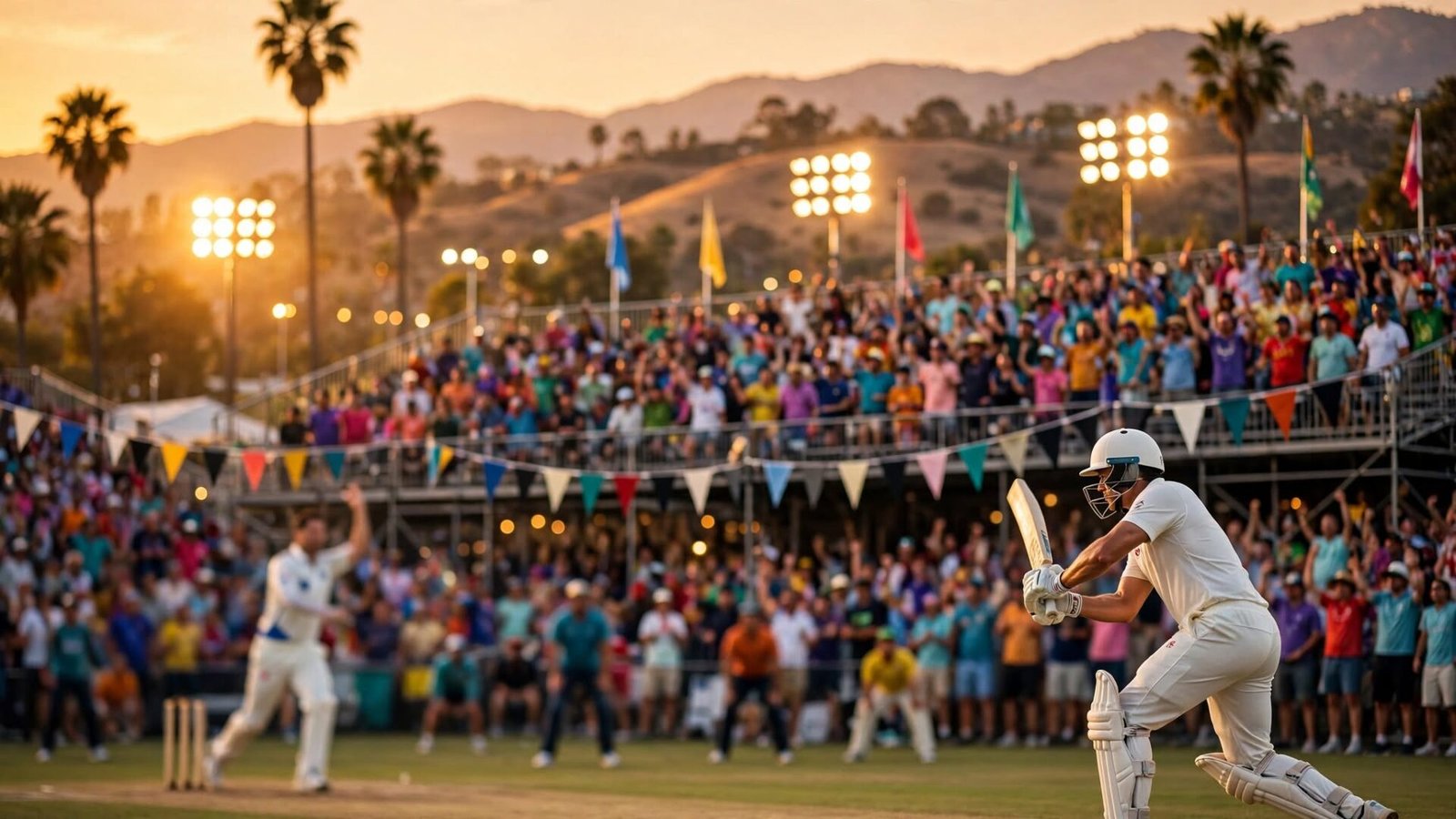
The matches are planned for the Fairgrounds in Pomona, kind of 30 miles east of downtown Los Angeles. There’s no massive cricket stadium within the area, so organisers will put up a transient one.
That might sound risky, but it’s been done. The 2024 T20 World Cup, co-hosted by the US and the West Indies, used a pop-up stadium in Nassau County, New York. It was built in a matter of months. People complained about the pitches, fairly, but the ground itself worked. The Pomona team has a chance to learn from those mistakes.
Cricket is scheduled for mid-July 2028, near the start of the Games, which means it won’t be buried at the tail end of the programme.
Who Will Be There?
Short answer: nobody knows yet. The full qualification route is still being worked out. The hosts, the USA, are expected to get a place. The ICC will decide the rest, probably using rankings and regional qualifiers.
On paper, the men’s favourites are easy to name. India, Australia, England and Pakistan have the depth. South Africa, New Zealand, the West Indies and Afghanistan can beat anybody on an amazing day. But with only six spots, some very huge names will be left out, and that feels abnormal for a sport where the giants commonly flip up everywhere.
The women’s side is a bit clearer. Australia are the team to beat, with India and England not far behind. New Zealand, South Africa and the West Indies can all push for a place.
The fun question is the outsider. If the USA or an Associate nation squeezes through, they could become the story of the tournament. Remember the USA beating Pakistan in a Super Over at the 2024 T20 World Cup? Upsets like that aren’t flukes anymore.
What the Commonwealth Games Taught Us
If you’ve read our piece on cricket at the Commonwealth Games, you already know cricket has records at these events. Men’s cricket was played in Kuala Lumpur in 1998, and South Africa took gold in a 50-over match.
The real turning point came at Birmingham in 2022, in which girls’ T20 cricket made its debut. It worked brilliantly. The crowds were big, the games were tight, and the final ended with Australia beating India by nine runs. I’d argue that tournament did more to win over Olympic officials than any presentation could.
It additionally proved a simple point: a T20 event can take a seat inside a multi-game programme and nevertheless feel like a headline act.

What the Asian Games Taught Us
Cricket also featured at the Asian Games in 2010 and 2014 before coming back in Hangzhou in 2023. Our post on cricket at the Asian Games covers it in detail, but the short version is that India sent a young, second-string squad and still won gold in both the men’s and women’s events.
That result mattered for a reason beyond the medals. India’s board has historically treated multi-sport events as an afterthought. Turning up to Hangzhou, even with a lighter squad, hinted that attitudes were changing. A proper Olympic push from India would shift everything.
Hangzhou also reminded everyone how competitive Asia is. Afghanistan, Sri Lanka, Bangladesh and Pakistan all showed up with real quality. If qualification rewards regional results, expect several Asian teams in the mix.
What to Watch For in 2028
A few things I’ll be keeping an eye on.
Brand-new viewers. Millions of people who’ve never sat through a cricket match will tune in just because it’s the Olympics. Broadcasters have a tricky job: explain the game without boring the people who already know it.
National pride. We’re so used to franchise leagues and club loyalties that we forget what it feels like to play for your country with a medal on the line. An anthem at a podium hits differently from a league trophy.
Player availability. Big stars have packed calendars and very lucrative league contracts. Will the best players actually show up? Boards will have some uncomfortable conversations over the next two years.
America afterwards. The long-term question is what happens when the Games leave town. If the USA invests in real grounds and a proper domestic pipeline, 2028 could be the start of something. If it doesn’t, the stadium goes back in a box.

Why It Matters
For years, cricket has complained that it’s huge in a few places and nearly invisible everywhere else. An Olympic medal gives governments in small cricket countries a reason to spend money on coaches, grounds and school programmes. That could change things in places where cricket was always an afterthought.
Women’s cricket has plenty to gain too. Olympic status usually brings more funding and a much bigger audience, and sharing a stage with the world’s biggest sports can only help.
Final Thoughts
It’s been a long road, from a muddled two-day match in Paris to a purpose-built stadium in California. The Commonwealth and Asian Games paved the way, and LA 2028 is where cricket finally gets to show itself to the whole world.
We still don’t have every answer. Qualification, squads and fixtures are all still taking shape. But the broad picture is clear: the format suits the Games, the timing is right, and a lot is riding on it. Put July 2028 in your diary. I think this one will be worth it.
Want the full background? Read our guides to cricket at the Commonwealth Games and cricket at the Asian Games.



+ There are no comments
Add yours