


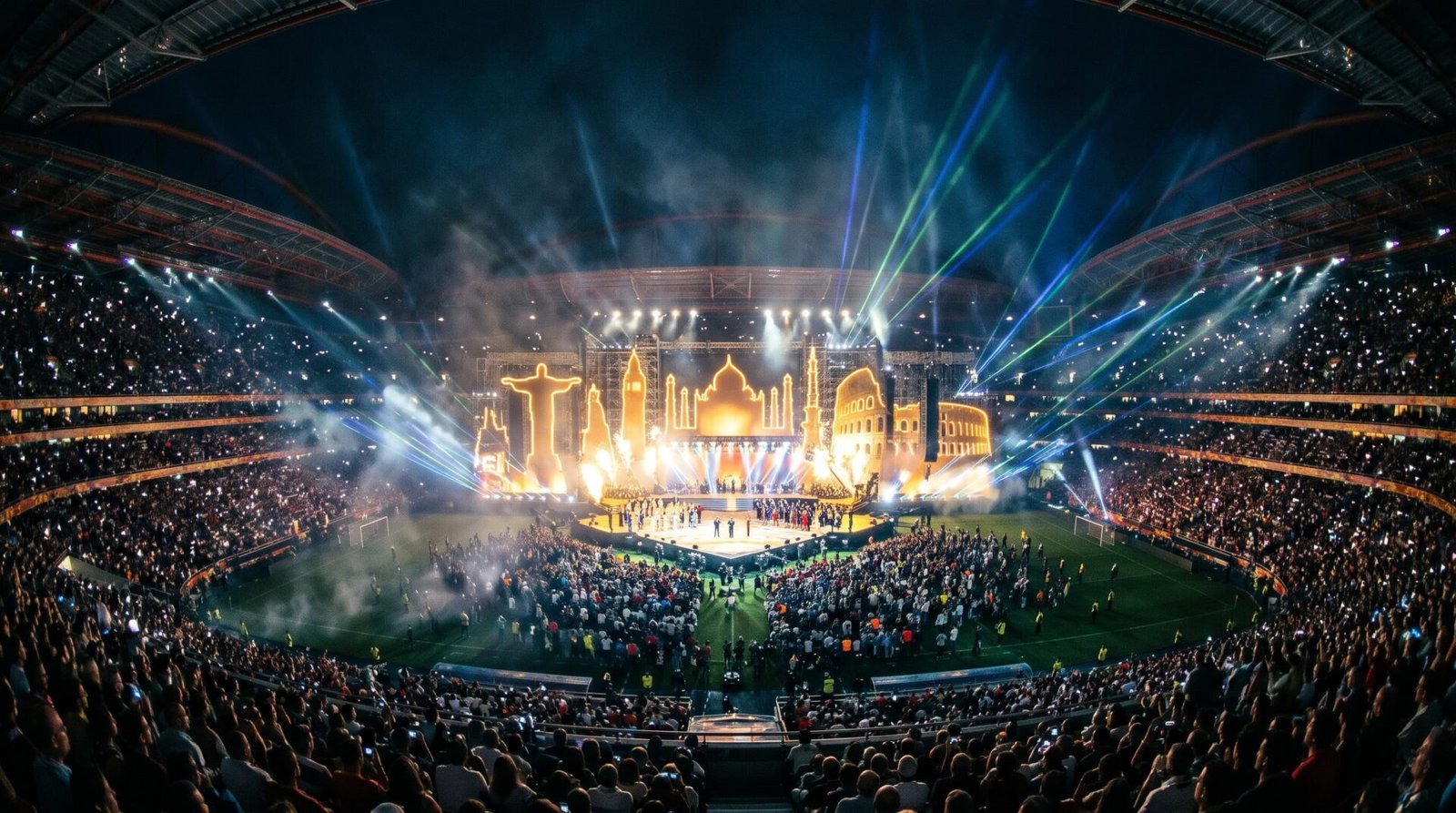
On 7 July 2007, Lisbon’s Estádio da Luz, a football stadium, hosted a match with no ball in sight. The prize was a title. The people in the stands, and millions more watching from home, were waiting to hear whether their favourite monument had made the cut.
Seven did. I’ll list them further down, but honestly, the winners are the least interesting part. What I’d rather dig into is the backstory: who convinced the world to vote, and why the “start date” changes depending on which website you open.

The Old List Was Mostly Rubble
Ask an ancient Greek traveller for sightseeing hints, and you’d get seven marvels: the Great Pyramid of Giza, the Hanging Gardens of Babylon, the statue of Zeus at Olympia, the Temple of Artemis at Ephesus, the Mausoleum at Halicarnassus, the Colossus of Rhodes and the Lighthouse of Alexandria.
Now try booking a ticket. Only the Pyramid is still standing. Earthquakes, fires, invaders and the sheer passage of time took care of the rest, so the classic list is really a catalogue of what we’ve lost.
That bothered Bernard Weber, a Swiss-born Canadian filmmaker, author and adventurer. The Greeks had chosen the wonders of their world, so why shouldn’t everyone get to choose the wonders of ours?
Borrowing From the Olympics
Weber has said he drew the proposal from Pierre de Coubertin, who revived the historical Olympic Games in their current shape in 1896. He desired to do the same with the wonders: take an old Greek idea and make it international.
The timing helped. By the late nineties, the internet had changed into thousands and thousands of houses, and mobile telephones were everywhere. For the first time you could ask one question on every continent and get answers back in days rather than years. A generation earlier, it simply wouldn’t have worked.
Weber describes it as a millennium task, a way to get humans thinking about the background collectively. Judge the result, however you like; it was an ambitious swing: a single poll about the places humans built and loved, open to anyone with a phone or a computer.
Setting Up the Foundation
To run something this big, Weber created the New7Wonders Foundation in Zurich. It was a private non-profit that took no public money. It lived on donations and on selling broadcast rights, and it promised to put roughly half its funds into restoring sites.

The first round was loose and a bit untidy. Anyone could nominate a monument. Reports from the time mention almost 200 nominations, while later accounts say 441, which probably comes down to which stage you’re counting.
Then the list shrank. A panel of architects led by Federico Mayor, a former head of UNESCO, narrowed 77 candidates down to 21 finalists in early 2006. The public voted again, online or by phone, until the final count.
The Seven Winners
These were announced at the Estádio da Luz on 7 July 2007:
- The Great Wall of China
- Petra, Jordan
- Christ the Redeemer, Brazil
- Machu Picchu, Peru
- Chichén Itzá, Mexico
- The Colosseum, Italy
- The Taj Mahal, India
The date was no accident. 07-07-07 was already a headline, and the organisers happily played it up. Actress Hilary Swank was at the ceremony, and she remarked that no global decision had ever involved so many people.
The foundation says more than 100 million votes were cast. I’d treat that number with caution. No exact breakdown was ever published, so most outsiders see it as an estimate instead of an audited matter.
So Where Are the Pyramids?
Read through the winners, and you’ll spot a gap. The Great Pyramid of Giza isn’t there, and that caused a minor diplomatic fuss.
Egyptian officials weren’t keen on seeing the Pyramid compete against newer monuments. It already had its place among the ancient wonders, they argued, and shouldn’t have to enter a popularity contest. Weber pulled it from the race and made it an honorary candidate.
I like the irony. The one wonder that survived thousands of years never had to ask anybody for a vote.

Why UNESCO Stepped Back
UNESCO offered some advice on nominees at the start, then withdrew. It’s clear to see why. UNESCO maintains the World Heritage List, which rests on professional evaluation, criminal protection, and medical requirements. A public vote plays by completely different rules.
A UNESCO spokesperson said at the time that a media campaign couldn’t be compared with the educational and scientific work behind World Heritage status. There was a practical snag too: UNESCO treats all sites as equal, so it couldn’t endorse a ranking that placed some above others.
Critics had their very own lawsuits. Countries with big populations, or slick national campaigns, should pile up votes and leave sites in smaller nations behind. And a popularity ballot tells you what humans like, not what maximum urgently desires protecting.
Supporters answered that the vote got millions of people thinking about heritage who would never open a conservation report. Both arguments hold up, honestly.
Fact-Check: When Did the Campaign Actually Start?
Search for the start date, and you’ll find several different answers, each stated with total confidence. Here’s what the sources say:
- September 1999: CyArk and a few other sources give this as the start.
- 1999: Al Jazeera, Swissinfo and NBC News all say Weber launched the campaign in 1999. One account adds that he bought his first computer that year and built the project’s first website.
- 2000: Weber’s own message on the foundation’s site says he decided in 1999 to revive the idea and began the New7Wonders project in 2000 as a millennium effort.
- 2001: The foundation was formally established in Zurich in 2001. Wikipedia lists 2001 as the start, and NBC reported that voting began that year.
So who’s right? Probably all of them, because each source is counting something different. The idea and the first website belong to 1999 and 2000. The foundation belongs to 2001. Public voting ran from 2001 to 2007.
If you need one smooth sentence for your own writing, try this: the idea took form in 1999, and the inspiration and voting formally started in 2001.
The lesson is straightforward. When two assets disagree, test what everyone is measuring before determining who’s incorrect.

Is There a 2026 List?
Plenty of people search for a “2026 list” expecting new winners. There aren’t any. The New 7 Wonders list is still the one announced in 2007, with the Great Pyramid sitting beside it as an honorary wonder.
What has changed is how people use it. Many travellers treat it as a bucket list, and tourism boards in the winning countries have put the title to work in their marketing. The foundation later ran other campaigns as well, one for natural wonders and another for cities.
Why This Story Still Matters
Whether you like the marketing campaign or find it a bit slick, it pulled off something unusual. For a while, human beings on each continent cared about the identical set of places. It also confirmed how far away an easy, shareable idea can travel once the generation catches up.
For everyone writing approximately records, there’s a small lesson buried in it. Neat dates and tidy lists regularly disguise a messier story. Sources disagree, reminiscences waft, and a single “begin” seems to be several smaller beginnings.
So the next time a person tells you exactly when the New 7 Wonders campaign started, smile and ask which element they imply.



+ There are no comments
Add yours