


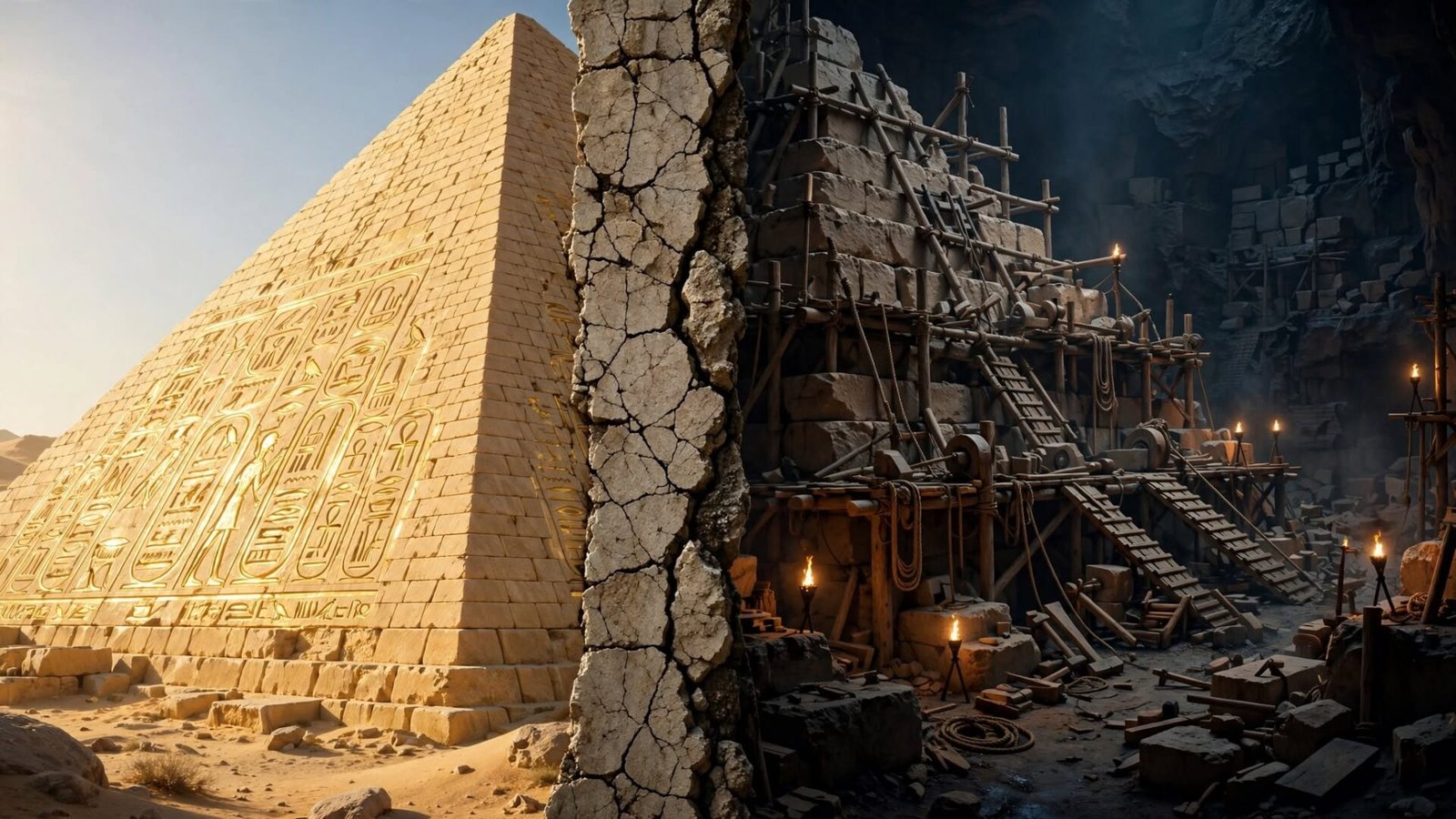
Here’s something your history teacher probably never said out loud: the stories we were taught about ancient civilisations were edited. Not necessarily wrong — just carefully trimmed. The uncomfortable parts got softened. The messy, brutal, deeply human parts got pushed to the margins or dropped entirely.
And the result is that most of us carry around a version of ancient history that’s about 60% accurate and 100% flattering to the civilisations being described.
So let’s talk about the other 40%.
Mesopotamia Invented Writing — But Not for the Reasons You’d Hope
Here’s a fun fact nobody puts on motivational posters: the world’s oldest surviving written texts are grocery lists for workers.
Not philosophy. Not poetry. Not the wisdom of kings. The earliest writing we’ve discovered — clay tablets from the ancient city of Uruk, going back to around 3,200 BCE — are ration records. How much barley did this worker get? How many days does that one still owe? Who’s fallen behind on their labour quota?

Humanity’s greatest intellectual invention was, in its earliest form, a spreadsheet.
The Mesopotamian temple economies ran on a system modern historians call “state dependency”. Workers weren’t quite slaves, but they weren’t free in any meaningful sense either. They were tied to temple institutions, receiving food and beer as payment, unable to simply quit and move on. And every transaction — every ration, every debt, every obligation — was carved into clay and stored permanently so nobody could later claim they’d been miscounted.
The world’s first bureaucracy wasn’t created to serve people. It was created to track them.
What’s genuinely unsettling about this isn’t just the history — it’s the familiarity. Substitute clay tablets for software and barley rations for direct deposit, and the structural logic isn’t entirely foreign. The powerful have always been very interested in keeping detailed records of what the less powerful are owed.
Egypt: The Pyramid Workforce Nobody Wants to Talk Honestly About
The “enslaved Israelites built the pyramids” story has been thoroughly debunked by archaeology, and good riddance to it. The actual story, though, requires a little more nuance than “the workers were paid and treated well, end of story” — which is roughly how most modern corrections frame it.
Yes, pyramid workers received food, shelter, and medical attention. Some even received beer rations, which feels like a reasonable workplace perk when you’re moving multi-tonne stone blocks through desert heat. Archaeologists at Giza found the remains of workers who had bones surgically amputated and survived — meaning someone was actually performing medical procedures and someone else was allowing them recovery time. By ancient standards, this was notable.
But conscripted is still conscripted.
These men didn’t volunteer. Egypt operated on a system of labour taxation — the state could require men to leave their families, their farms, and their entire lives and report for construction duty. The length of time varied, but the choice didn’t. You went because the alternative wasn’t pleasant to think about.
Dig into the records from Deir el-Medina—the village built specifically to house the craftsmen working on the Valley of the Kings—and you get a surprisingly intimate window into what this actually felt like. These workers kept their own records. They wrote about wages being delayed, about rations running short, and about what happened when the state failed to meet its end of the deal. Around 1170 BCE, when grain payments stopped coming, they did something that had probably never been done before: they walked off the job. They sat outside the tomb complex and refused to move until someone paid them.
History’s first recorded labour strike happened because the Egyptian government bounced its workers’ pay cheques.
Outside the pyramid construction sites, the broader Egyptian economy rested on millions of peasants farming land they would never own, surrendering a significant cut of every harvest to the state and to temple institutions. The people whose labour made everything else possible — the farming, the building, the feeding of entire cities — were also the people who saw the least return on that labour.
The monuments are still extraordinary. That’s just not the whole sentence.

Ancient Greece: Democracy, Fine Print Included
Athens gets its own chapter in every political science course, and honestly, some of that credit is deserved. The reforms introduced around 507 BCE gave citizens a genuine, direct voice in governance — real votes on real decisions, not just the symbolic consultation of a ruler’s court. For its moment in history, that was genuinely radical.
The footnote that usually gets glossed over is what “citizens” actually covered.
At Athens’ democratic peak, somewhere between 80,000 and 100,000 people in the city were enslaved — historians estimate roughly a third of the total population. This wasn’t an incidental feature of Athenian society. It was structural. The silver mines that generated Athens’ wealth were operated by enslaved workers in conditions that were, by multiple historical accounts, absolutely horrific. People went into those mines, and many didn’t come out. The households, the farms, the workshops — all of it ran on labour performed by people with no legal standing, no political representation, and in most circumstances, no realistic prospect of freedom.
Women, across every social class, had no political role whatsoever. Metics — foreign residents, some of whom had been born in Athens, raised families there, paid taxes there, and fought in Athens’ wars — couldn’t own property or participate in civic life regardless of how many generations their family had lived in the city.
If you work through those numbers, you end up with something like 10 to 15 per cent of Athens’ total population actually participating in this celebrated democracy. The rest of the population was either excluded by law or owned by someone.
The Athenian philosophers we still read and teach — Socrates, Plato, Aristotle — had the time to sit around discussing the nature of justice and the ideal state because enslaved people were doing the work that their leisure required. Aristotle, notably, wrote that certain human beings were slaves by nature and that this arrangement was both natural and just. It was a remarkably convenient philosophical conclusion for someone whose own life depended on the institution.
Again — the Parthenon is still magnificent. Greek philosophy still matters. These things can both be true.
Rome Turned Mass Violence Into a Ticketed Event
The phrase “bread and circuses” gets taught as a piece of Roman political cleverness — keep the masses fed and entertained, and they won’t cause trouble. It’s usually delivered with a little smirk, like we’re all in on a sophisticated joke about crowd management.
What that framing tends to skip past is what the circuses actually were.
Gladiatorial games weren’t an underground spectacle or a fringe entertainment for bloodthirsty crowds. They were a state-endorsed, commercially organised industry. Gladiators trained in professional schools — called ludi — owned by investors who contracted fighters out to politicians who needed to put on a good show before elections. The Colosseum, Rome’s most famous venue, seated somewhere between 50,000 and 80,000 people. These were not small events. They were the equivalent of a packed stadium on a Sunday, except the athletes could and did die.
The men fighting came from several sources. Condemned criminals with no legal options. Enslaved people with even fewer. And a surprising number of free volunteers who signed contracts because the money was real and the alternative — whatever low-wage grind they’d been doing before — apparently didn’t look much better.
But the arena is almost a symbol of a larger problem. Rome’s entire economic model required expansion to survive. Every military victory brought enslaved people, tribute, and looted wealth back into the system. The empire didn’t just happen to have enslaved people — it needed them. It was engineered around them. At Rome’s peak, historians estimate that Italy’s population may have been 35 per cent enslaved. The roads you’ve read about, the aqueducts, the administrative systems that influenced law for the next two thousand years — all of it was produced within and sustained by one of the most extensive slave economies the ancient world ever built.
When Rome stopped conquering new territory, the economic pressures became difficult to manage. Some historians argue this structural dependency was a contributing factor in the empire’s eventual unravelling. The system that made Rome great was also a liability it couldn’t escape.

The Maya: Where Genius and Brutality Shared the Same Calendar
It genuinely is remarkable what the Maya accomplished. Their astronomical observations were detailed enough to track Venus cycles with extraordinary precision. Their mathematical system included the concept of zero — something many cultures never developed independently. Their cities were planned and built without metal tools, wheels, or draft animals.
And their political system was held together, in part, by organised ritual violence.
This isn’t a secret — Maya human sacrifice is mentioned in most history curricula. But it tends to get one sentence before the class moves on, which misses something important about how central it actually was to Maya society.
Maya cosmology held that the gods had bled and died to create the world and humanity. That debt was not metaphorical. It had to be paid back, continuously, through sacrifice — both the elite’s own blood, drawn in ritual self-cutting ceremonies, and the lives of captured enemies. Warfare between Maya city-states wasn’t only about territory or resources. It was partly a procurement operation. High-status captives had a specific ceremonial value. Kings demonstrated their divine connection through their willingness to participate in these rituals publicly.
There was no separation between religious obligation and political authority in Classic Maya society. They were the same thing. The king’s legitimacy depended on his performance in ceremonies that included presiding over sacrifice. Violence wasn’t a dark feature of Maya culture that coexisted awkwardly with their achievements — it was woven into the fabric of how power worked.
The Maya collapse, spread across the 800s and 900s CE, adds a further dimension. The evidence increasingly points toward drought, yes — but also toward soil degradation from intensive farming, deforestation that may have disrupted local rainfall patterns, and the kind of violent political fragmentation that happens when resources get scarce and city-states start fighting over what’s left. It is at least possible that centuries of intensive land use contributed to making the drought’s effects worse than they might otherwise have been.
A civilisation that helped cause the conditions of its own collapse. That’s not an ancient problem.
The Great Wall of China Is Also the World’s Longest Graveyard
That’s not a provocative claim — it’s essentially what Chinese folklore has said for centuries. The Great Wall of China, the image we plaster on travel brochures and geography textbooks, was built largely by workers who had no more choice about being there than the stones they were cutting.
The major construction push under the Qin Dynasty, beginning around 221 BCE, moved hundreds of thousands of men to the northern frontier. Conscripted farmers. Convicted criminals serving labour sentences. Soldiers deployed to build what they would later be expected to defend. They worked in mountain terrain, in harsh weather, with inadequate supplies, far from home. Death rates were high enough that the belief that workers’ bodies were incorporated into the wall itself became a lasting part of the cultural memory surrounding it.
Qin Shi Huang — the emperor who launched this project — gets credit in most history texts as a brilliant unifier. He standardised writing, currency, weights, and measurements across a massive and previously fragmented territory. Those were real achievements with real lasting effects on Chinese civilisation.
He also had books burnt, ordered the execution of scholars who criticised him, and maintained power through a system of collective punishment so severe that an individual’s crime could result in their entire extended family being enslaved or killed. His standardisation of China happened through machinery that required absolute obedience and treated dissent as a capital offence.
Brilliant and terrible, simultaneously. Which turns out to be a fairly common combination in the history of powerful people.

So What Do We Actually Do With This?
None of this is an argument that ancient people were uniquely evil or that their achievements don’t count. People 3,000 years ago didn’t have our moral vocabulary, our accumulated history of rights movements, or our knowledge of long-term consequences. Judging them purely by modern standards without understanding their context isn’t honest history either.
But “they were products of their time” can’t mean “therefore we don’t look closely”.
The sanitised version of ancient history has always been useful for someone. It makes certain power structures easier to romanticise. It makes the idea that great achievements justify terrible costs easier to absorb without questioning. And it keeps the people who actually did most of the work — the farmers, the conscripts, the enslaved, the people whose names were never carved into stone — invisible.
History is more honest and more interesting when you include them.
The Egyptian worker who went on strike because his grain payment was late. The Athenian metic who paid taxes and couldn’t vote. The Maya captive who became a political symbol. The man who cut stone in the Chinese mountains and never came home. These weren’t background characters. In most cases, they were the numerical majority of the civilisations we’re talking about.
The textbook version of ancient history gave us the monuments. The complete version gives us the people — all of them, not just the ones with their names on the walls.
That version is harder to simplify. It’s also the one that’s actually true.



[…] handed the ancient world a rulebook for running an economy. No Harvard-trained economists. No central bank governors. No spreadsheets, no interest rate […]