


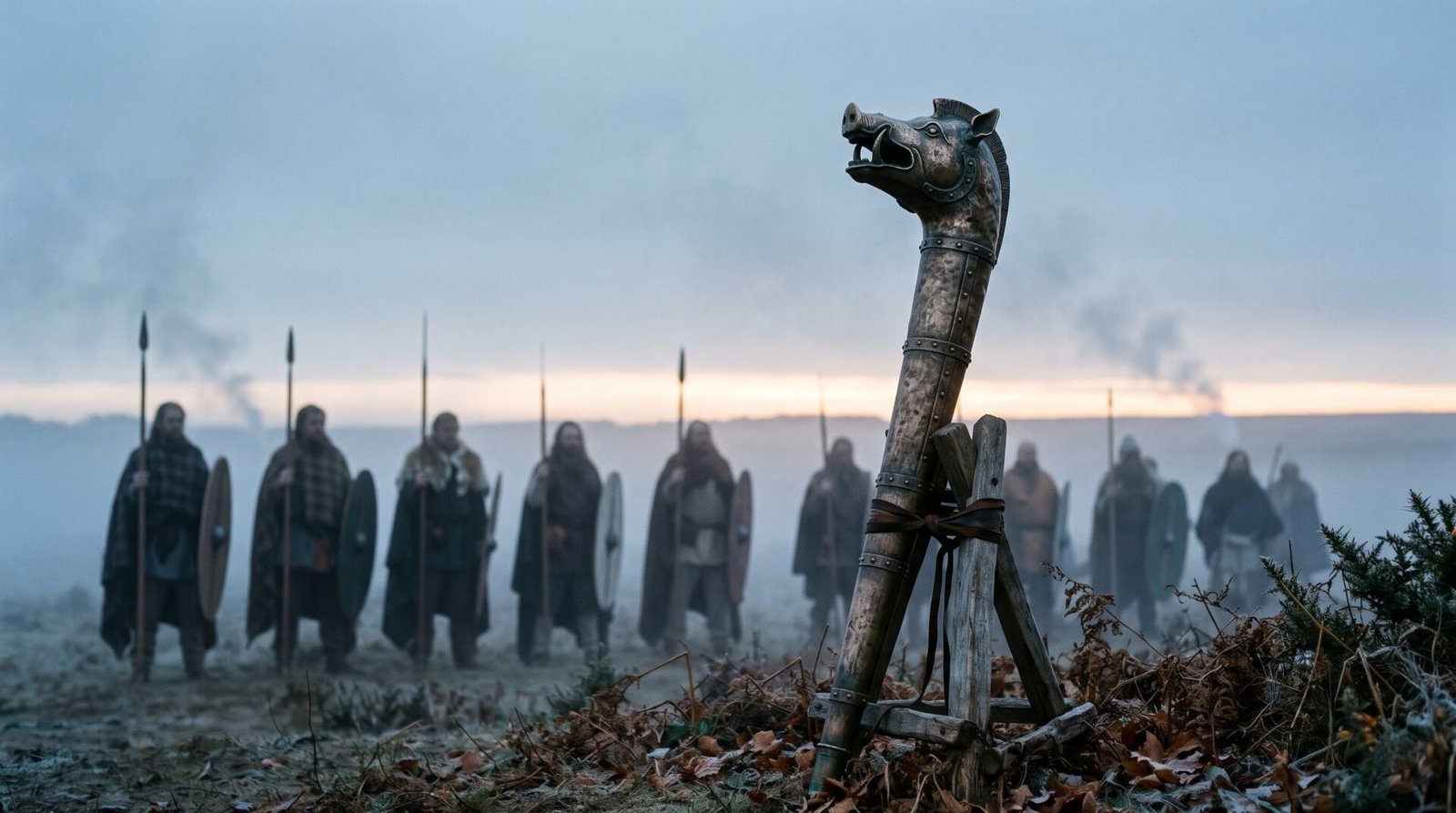
Before a battle commenced, there would have been a lot of activity. People shouted across lines of troops and shuffled their feet on the ground, and some may have even laughed too loudly. Over all this, there is an eerie sound, one that most people today have never heard before. A low blast that rises into a raspy buzzing. This sound would have come from an instrument known as:
The Carneyx! One of the most fascinating and difficult-to-understand artefacts from the Iron Age in Europe. We have fragments of metal, carvings on coinage and sculptures, and some ancient writings by people who never played the instrument. However, we do not have any recordings, instructions, or clear explanations.
A Carnyx has recently been discovered in Norfolk. This is an important area as it is in the centre of the land associated with the Iceni tribe. This tribe is strongly associated with Boudica’s uprising against Rome around AD 60/61. So it is almost impossible NOT to associate this with Boudica.
Although it may be almost impossible not to make that connection, the truth is actually that no Roman writers mention the Carthaginian being part of Boudica’s army. This Carneyx has no connection to Boudica or any named battle. However, the find is exciting in its own right, and we can learn more by not making assumptions.

What exactly was a Carneyx?
A tall instrument made of bronze. The tubing would be stood upright with a flaring bell at the top. This bell would usually be shaped like an open-mouthed animal.
There are many variations in surviving examples and ancient illustrations. Some have ears, some have teeth, and some appear to have a tongue sticking out. The Deskford carnyx discovered in Scotland in the 19th century had a boar-like head with a movable jaw. Reconstructions suggest that this jaw could be made to move whilst playing. In Tintignac, France, archaeologists found fragments of multiple carniças. This helped to show how the pieces fitted together.
This shows that the carnyx varied. They were not a standard piece of military equipment. As they were made locally by local craftsmen, there could have been many variations. This could be due to different traditions, clients, or just personal taste.
Carnyx can be traced back to ancient references. They are associated with many Iron Age tribes across Europe. Whilst ‘Celtic’ is not a nation, it is a good term to use to refer to a large group of related cultures. Not all communities would have used them in the same way.
The skill behind the sound
Bronze is not an easy material to work with. Alloying, sheet metal, and joining techniques would have been needed to create this large instrument. This was not a quick fix for a warrior to make the night before going on a raid. It was a serious instrument made by specialist craftsmen.
This means that if carnyces were rare and expensive to make, the person playing the instrument may have been a specific individual. Perhaps a musician, perhaps someone with a religious role, or maybe they were a status symbol. Historians have argued all three possibilities; however, we do not have any evidence to confirm.
What we can be sure of is that they were meant to be eye-catching. You wouldn’t make a tall, animal-headed bronze trumpet to blend in.
What did it actually sound like?
Unfortunately, we do not know.
However, we can get an idea from reconstructions. If you play it with a constant flow of air, it produces a loud buzzing noise. It can be made to sound quite grizzly. It is not a musical instrument and sounds more like a foghorn than a bugle. It is very loud.
However, this is an experiment. Ancient instruments are often not complete. The alloy used in the replica may not be the same as the original. The mouthpiece is extremely important to the sound and is often missing or unclear, so people will guess. Also, the airflow, technique, and space will vary.
So whilst we may have inferred that they made a terrifying booming sound from the fragments, artwork, and comments of ancient writers, it may be close to the truth but has not been confirmed.

Why make so much noise?
Ancient warfare was noisy, and everyone involved would expect this. It was useful to send messages over long distances, help people move together, and drown out any fearful noises. It also had an effect on people. It can be unsettling to hear an unfamiliar sound. They may have been prepared for swords and spears but not for a booming animal-mouthed instrument.
In the first century BC, Diodorus Siculus wrote about the harsh and disturbing noise made by the trumpets of the Northern Europeans. Although he wasn’t present at the battles, he was writing for people in the Mediterranean who enjoyed being excited by stories of the wild north. This tells us how they were viewed by outsiders and also shows how writers like to portray their subject.
Ancient warfare was very much about the noise and spectacle. The booming of the trumpets, the war cries, coloured shields, and sheer number of soldiers would all have an effect on your imagination. The carnyx could have been part of this spectacle and also used as a signalling tool. It may have been used for both.
Whilst it may be tempting to say that it was used for X reason, realistically it was likely to have had multiple uses, like most objects in complex societies.
The Norfolk discovery
This carnyx is important, as very few have been found in Britain. This has been reported as one of only three known in Britain. However, I would recommend looking at the official archaeological report to confirm this. Numbers can change depending on whether complete instruments, significant fragments, or just small pieces that may have once been part of a carnyx are counted.
This find has been associated with an Iron Age hoard in Norfolk. Hoards are very important. How they are arranged, what they are buried with, and whether they have been deliberately damaged or folded all mean something. Some appear to be safekeeping, some look like offerings, and some look like they were hastily buried during dangerous times. Some may not have any meaning we can discover.
This is part of what makes archaeology exciting. Just because something has been found in a hoard does not mean it was a trophy from a battlefield. Just because a coin has been found in a field does not mean it proves a certain trade route.
However, it is the correct place to talk about. Norfolk is at the centre of the land associated with the Iceni. There are some of the richest Iron Age finds in Britain, including coins, settlements, and metalwork. To find a rare instrument here shows that the east of Britain had access to high-quality craftsmanship and money.
Who were the Iceni?
The Iceni lived in what is now roughly Norfolk and Suffolk. They had influence over surrounding areas and produced their own coins. This shows they had an organised political authority. They were a structured and wealthy society that had to negotiate with a much bigger power.
Britain was invaded by Rome in AD 43 by Emperor Claudius. However, they did not take over all local rulers. Many areas were run using clientage. The local kings stayed in their position but had to be loyal and cooperative. This saved Rome the cost and effort of ruling everything.
The Iceni were part of this system. Boudica’s husband, Prasutagus, was a client of the king. However, his death (usually dated to around AD 60/61) is what started the whole story.

Tacitus, our most detailed source, says that Prasutagus left his kingdom to his daughters and the emperor in the hope that it would protect his family. However, Roman officials ignored this and stole property. He goes on to say that the royal family was treated cruelly. Boudica was whipped, and her daughters were abused.
This is a serious accusation. However, it was written by a Roman senator, so we know it is from the Roman perspective. Whilst it is some of our best evidence, Tacitus had his own agenda, and neither he nor Cassius Dio had access to an Iceni perspective. We will never know what the Iceni said their reason for rising was.
The revolt
The revolt was not just by the Iceni. The Trinovantes, whose land included Camulodunum, joined in. The revolt began with an attack on Camulodunum (modern-day Colchester). This was a Roman colony full of retired soldiers and had a huge temple to deified Claudius. There is lots of record of this place being destroyed.
The rebellion continued to go south. Londinium (London) and Verulamium (St Albans) were both attacked. All 3 were burnt; this can be seen by layers of fire marks found by archaeologists. When the governor, Suetonius Paulinus, heard of the rebellion, he was fighting on Mona (modern-day Anglesey). He withdrew from the attack.
Finally, Tacitus and Cassius Dio talk of a decisive battle for the Romans. With massive numbers of deaths for the rebels. However, this is very rhetorical, and ancient historians often exaggerated numbers. We must be cautious. We also do not know where the battle took place. It is traditionally thought to have been on Watling Street.
We do not know what happened to Boudica. Tacitus talks of her becoming ill and dying with an extravagant burial. Whereas Dio says she drank poison. Both can be used by the authors to help their story along.
So did a carnyx sound for Boudica?
This is the question everyone wants to know! Unfortunately, we do not know.
However, we do know that these instruments were present in Iron Age Europe. They have been found in Norfolk (in the centre of Iceni lands). They were regarded as remarkable by Roman writers and sometimes depicted by Roman artists. This means it is likely that they were used in Britain in the first century AD.
We do not know whether they were used by the Iceni in Boudica’s rebellion. Even if we knew they had them, we would not know where they were used.
As with most archaeological finds, you will rarely ever find anything with a note saying who owned it and when it was last used. You will have questions to answer and try to get as much information from the evidence.

What the Romans made of it
Sometimes the animal-headed trumpets are depicted in Roman art as a feature of the defeated northern enemies. This shows how unique they were and how they became a symbol of the foreign warrior. Artists included them as they would be recognised.
However, Roman monuments are propaganda. We know how Rome wanted to portray their enemies and what they wanted people to recognise. We cannot be certain that all the instruments in Britain were captured, carried, and depicted.
However, the fact they were included shows they left an impression. For something to be a symbol, it needs to have an impact on people’s imaginations.
Why this find deserves attention
This carnyx has a lot of interesting stories to go along with it. The skill involved in making the bronze, the music and drama, the warfare, and the interesting history of an area that shocked Rome greatly.
It also reminds us that the Iceni were much more than the rebellion. Although Boudica’s rebellion only lasted a few months, the Iceni had been around for generations and continued for some time after. Their coins, settlements, and metalwork show they had their own political system, craftsmen, and ways of displaying their power. The animal-headed trumpet is part of their wider culture.
If we were to picture the carnyx being used, the safest image would be a peaceful and unusual scene. A crowd had gathered for a reason we cannot now discover, and suddenly there is a primal and animalistic sound. This would have been made by a highly skilled blacksmith spending many hours creating the instrument. Finally, it was buried by someone for their own reasons.
This is where the mystery really comes in. Why would you bury a trumpet?
The bronze remains, but the answer doesn’t.



+ There are no comments
Add yours