


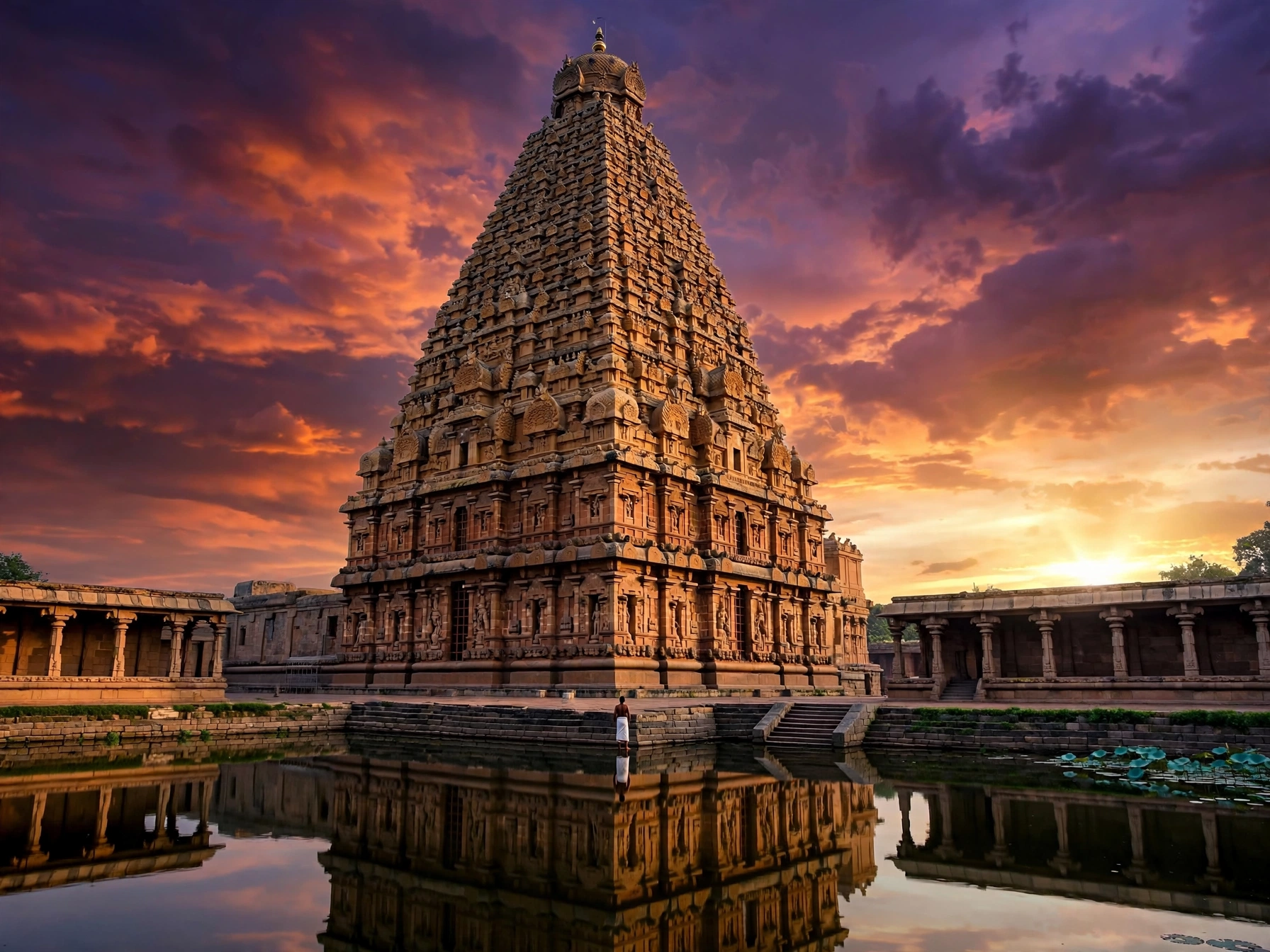
Let me tell you something strange before we get into the list.
There is a temple in Tamil Nadu where a tower standing 216 feet tall throws no shadow on the ground at noon. Not a smaller shadow. Not a faint one. Nothing. Engineers have walked around it. Architects have run calculations. And after all of that, nobody has come back with a completely satisfying answer.
This temple was built in 1010 AD.
India has over two million temples. A good number of them are ancient. Many of them are genuinely beautiful. But the ten on this list are operating in a different category altogether. These are not simply places of worship. They are riddles that have been sitting in stone for centuries, and we are still not close to solving all of them.
You do not need to be religious to feel something when you are standing inside them. You just need to be present and paying attention.

1. Brihadeeswarar Temple, Tamil Nadu — The Tower That Casts No Shadow
Go to the Brihadeeswarar Temple in Thanjavur at noon on any day of the year. Walk slowly around the main tower. Look at the ground around you.
You will not find the tower’s shadow anywhere on it.
This is not an optical illusion or a seasonal quirk. The gopuram stands 216 ft tall and was constructed using an anticipated 130,000 tonnes of granite. Here is the part that makes production engineers virtually uncomfortable: there’s no major granite source within 60 kilometres of the site. How that stone was transported, how it was cut with the tools available in 1010 AD, and how the pieces were assembled with the kind of precision you can still see today — none of that has been explained in a way that everyone agrees on.
Raja Raja Chola I commissioned the whole project. It was finished in seven years. The capstone sitting at the very top — one single block of granite, weighing 80 tonnes — was somehow raised 216 feet into the air. The method used to do that is still being debated.
UNESCO gave it World Heritage status. That feels like putting a small sticker on something that probably does not need our recognition.
Best time to visit: November to February

2. Vittala Temple, Hampi — The Pillars That Actually Sing
In the ruins of Hampi in Karnataka, there is a temple where the pillars make music.
Not metaphorically. Literally.
The Vittala Temple has 56 pillars arranged in a deliberate pattern. Tap one lightly with your knuckle, and it produces a distinct musical note. Different pillars produce sounds that correspond to different classical instruments – the mridangam, the veena, and the flute. Play them in the right sequence, and you can reproduce ragas.
During British colonial rule, engineers were so convinced there had to be a hidden mechanical explanation that they actually cut two of the pillars open. They found hollow chambers inside. That explained the acoustics in a technical sense. What it did not explain is how craftsmen working in the 15th century, under the Vijayanagara Empire, understood acoustic engineering well enough to design this intentionally.
In the same complex, the Stone Chariot deserves its own mention. A massive granite structure built to look like a wooden temple chariot — wheels, details, the whole thing. The wheels rotate. It is carved from stone.
Best time to visit: October to February

3. Lepakshi Temple, Andhra Pradesh — The Pillar Hanging in Mid-Air
Seventy pillars support the Lepakshi Temple in Andhra Pradesh. Sixty-nine of them rest on the floor. One does not.
This pillar — and it genuinely hangs from the ceiling with a visible gap between its base and the ground beneath it — has been examined by engineers and architects for years. Nobody has reached an agreement on how it stays where it is or why it was built this way in the first place. Visitors slide cloth and paper under it from every angle to check that the gap is real. It always passes through.
The temple itself is from the sixteenth-century Vijayanagara period. The artwork painted directly onto the stone ceiling is one of the best from that period — and it has barely faded in five centuries. Nobody has completely cracked the method behind the ones pigments or the method that made them last this long.
Sitting outside the temple is the most important Nandi bull sculpture inside the temple. Carved from a single rock. 4.5 metres tall. Eight metres long. The detail on it consists of the veins seen beneath the stone skin.
Best time to visit: October to March

4. Konark Sun Temple, Odisha — A Stone Sundial That Actually Works
From a distance, this temple looks like a chariot. That is the point.
King Narasimhadeva I built the Konark Sun Temple in the 13th century as the chariot of Surya, the Sun God — complete with 24 carved stone wheels and seven stone horses pulling it in the direction of the rising sun. The horses face east. The whole structure faces east.
But the wheels are not there just for appearance. Each one works as a precise sundial. The spokes and the shadows they cast can tell you the time of day, accurate to the minute.
Sailors crossing the Bay of Bengal used this temple as a navigation landmark for centuries. They called it the Black Pagoda — partly for the colour of the stone, and partly because the original structure had a massive lodestone at its peak that was said to interfere with compass readings on passing ships.
Every December, the Konark Dance Festival takes place in front of the ruins. Classical Indian dance forms are performed against the backdrop of a 750-year-old stone chariot. There are not many settings in the world that compete with that.
Best time to visit: December, to coincide with the dance festival

5. Meenakshi Amman Temple, Madurai — A City That Grew Around a Goddess
Most temples are places you go to see. This one is a place you can genuinely get lost in.
Fourteen gopurams. Thirty-three thousand sculptures. Fourteen acres of complex sitting right in the heart of Madurai. The entire old city was laid out around this temple — roads spreading outward from it in all directions. That arrangement has been in place for over 2,500 years.
Each gopuram is covered from ground to tip in painted sculptures. Thousands of them. Every twelve years, a team of painters repaints the entire thing by hand. The project takes years to complete.
The temple has its own elephant named Lakshmi. She indicates up at the entrance every morning and gets her ritual bathtub and her prayers, after which she stands on the gate and blesses devotees with a touch of her trunk. She has been doing this for many years and appears to know the timetable better than all and sundry on staff.
Every single night, a ceremonial procession carries a statue of Shiva from his shrine throughout to Meenakshi’s chamber, in which the 2 deities rest together until morning. This ritual has not been interrupted in centuries.
Best time to visit: April to May for the Meenakshi Tirukalyanam festival

6. Padmanabhaswamy Temple, Kerala — The Wealthiest Place on Earth
In 2011, the Supreme Court ordered an inventory of the vaults beneath this temple in Thiruvananthapuram. What the team found made international headlines within days.
Gold statues. Diamonds. Rubies and emeralds. Ancient coins. Solid gold ceremonial objects. The estimated value of what turned up in just five of the six vaults: somewhere between 22 and 25 billion US dollars. By most calculations, that makes this temple complex the single wealthiest location on the planet.
Vault B has never been opened.
Ancient texts describe it as protected by forces that go beyond what any lock or mechanism can explain. The Supreme Court has repeatedly deferred the decision. The lock itself reportedly does not match any standard mechanism, and attempts to open it without damaging the door have not succeeded. Believe the supernatural explanation or do not — the outcome is the same either way. The vault stays shut.
Non-Hindus are not permitted inside the temple, which means the vast majority of visitors to India never see the interior.
Best time to visit: November to February

7. Dilwara Temples, Mount Abu — Marble That Has No Business Looking Like This
Mount Abu is the only hill station in Rajasthan. At the top of it sit five Jain temples known collectively as the Dilwara Temples, built between the 11th and 13th centuries.
The marble work inside these temples is unlike anything else you will encounter anywhere in the world. That is not enthusiasm talking — it is just an accurate description.
The ceilings are carved into patterns that look like lace. Stone pendants hang from them, some carved down to 2 or 3 millimetres at their finest points. Individual ceiling panels contain more than a thousand carved figures, and no two of them are the same.
There is a story about how the craftsmen were paid — by the weight of marble dust they produced each day; the reasoning being that finer carving creates more dust. True or not, it makes a certain kind of sense when you look at the work they left behind.
No mortar was used anywhere in the construction. Every stone holds in place purely because of how precisely it was cut to fit against the one beside it.
Best time to visit: October to March

8. Somnath Temple, Gujarat — Rebuilt After Every Destruction
Some places have long histories. Somnath has something beyond that.
This temple on the Gujarat coast has been attacked, looted, and torn down seventeen times across recorded history. Mahmud of Ghazni. Alauddin Khilji. Aurangzeb. Others. Seventeen times across different centuries and different rulers. And seventeen times, it was rebuilt — by different communities, different generations, different rulers who had nothing in common except the decision to put it back up.
The contemporary structure was rebuilt after Indian independence. Sardar Vallabhbhai Patel individually oversaw the reconstruction, describing it as a statement about India’s refusal to be permanently erased. The temple was inaugurated in 1951.
Near the temple, there is a pillar with an inscription pointing due south. It notes that the first landmass in that direction, throughout lots of miles of open ocean, is Antarctica. The people who built this temple apparently already knew that.
The evening aarti with the Arabian Sea directly behind it is one of the more striking temple experiences you will find in this country.
Best time to visit: November to February

9. Khajuraho Temples, Madhya Pradesh — More Than What You Have Heard About
Everyone arrives at Khajuraho knowing about the erotic sculptures. Here is what most people do not realise before they get there.
Those sculptures make up roughly ten per cent of the total artwork on the exterior walls. The other ninety per cent shows everyday life — farmers at work, musicians playing, teachers with students, children, animals, hunting scenes, celestial figures, and gods sitting in meditation. Taken together, it reads more like a visual record of an entire civilisation than anything narrowly religious.
The Chandela dynasty built these temples between 950 and 1050 AD. There were originally 85 of them. Twenty-five are still standing.
The erotic sculptures were not about celebration for its own sake. They reflect the concept of Kama — one of the four recognised goals of human life in Hindu philosophy, alongside Dharma, Artha, and Moksha. The position these temples were taking is that the full range of human experience, including desire, belongs on the walls of a sacred place. That is a more considered theological position than most modern religious institutions manage to hold.
Best time to visit: October to March, or February for the Khajuraho Dance Festival

10. Kedarnath Temple, Uttarakhand — Still Standing After Everything
In June 2013, the Kedarnath Valley was hit by flash floods and landslides of a scale that has not been seen in the Himalayas in living memory. Entire villages were buried. The death toll ran into the hundreds. The destruction left people without words for what they were looking at.
The Kedarnath Temple, constructed in the 8th century at 3,583 metres above sea level, came through it without harm.
A large boulder came down from the mountain at some point during the flood and lodged itself immediately at the back of the temple. The water and debris split around both sides of the building. Call it engineering, or geography, or something you do not have a name for — the temple stood while everything around it did not.
It was constructed with large interlocking stone slabs, with no mortar involved. That construction has held through Himalayan winters for over 1,200 years, including six months of snow each year that cut off all access until the temple reopens in May.
The trek to attain it is miles – 22 kilometres from Gaurikund. When that stone temple sooner or later appears through the cloud and snow at the end of the walk, most humans move pretty quietly.
Best time to visit: May to June, or September to October
These Temples Were Built by Human Hands
You do not have to be a believer to sit with what is on this list.
A tower with no shadow. Pillars that produce music. A vault holding billions that nobody can get open. A temple that was destroyed seventeen times and rebuilt every single time. A stone structure that sent floodwater around it.
No power tools. No computers. No engineering software. What these builders understood about stone, sound, mathematics, and weight — they figured it out themselves, and the evidence of what they figured out is still standing there for anyone who wants to look.
That is worth a moment.
Which of these temples is already on your list?
If this changed the way you reflect on or consider India’s historic past, bypass it to someone who believes they already realise the whole thing about this United States of America. And when you have been inside any of those temples yourself, say something in the feedback about what it felt like while you were truly there.
Quick Reference Table
| Temple | State | Period | What Makes It Remarkable |
|---|---|---|---|
| Brihadeeswarar | Tamil Nadu | 1010 AD | Zero shadow at noon, 80-tonne capstone |
| Vittala Temple | Karnataka | 15th Century | Musical pillars, rotating stone chariot wheels |
| Lepakshi Temple | Andhra Pradesh | 16th Century | Pillar hanging from ceiling, world’s largest Nandi |
| Konark Sun Temple | Odisha | 13th Century | Wheels that tell time, sailors’ landmark |
| Meenakshi Amman | Tamil Nadu | 2500+ years | 33,000 sculptures, centuries-old nightly ritual |
| Padmanabhaswamy | Kerala | 8th Century | Unopened vault, $22 billion in five open vaults |
| Dilwara Temples | Rajasthan | 11th–13th Century | Lace marble carvings, zero mortar |
| Somnath Temple | Gujarat | Ancient | Rebuilt 17 times: Antarctica inscription |
| Khajuraho | Madhya Pradesh | 950–1050 AD | Complete record of human life in stone |
| Kedarnath | Uttarakhand | 8th Century | In the 2013 floods, the temple was untouched |



+ There are no comments
Add yours