


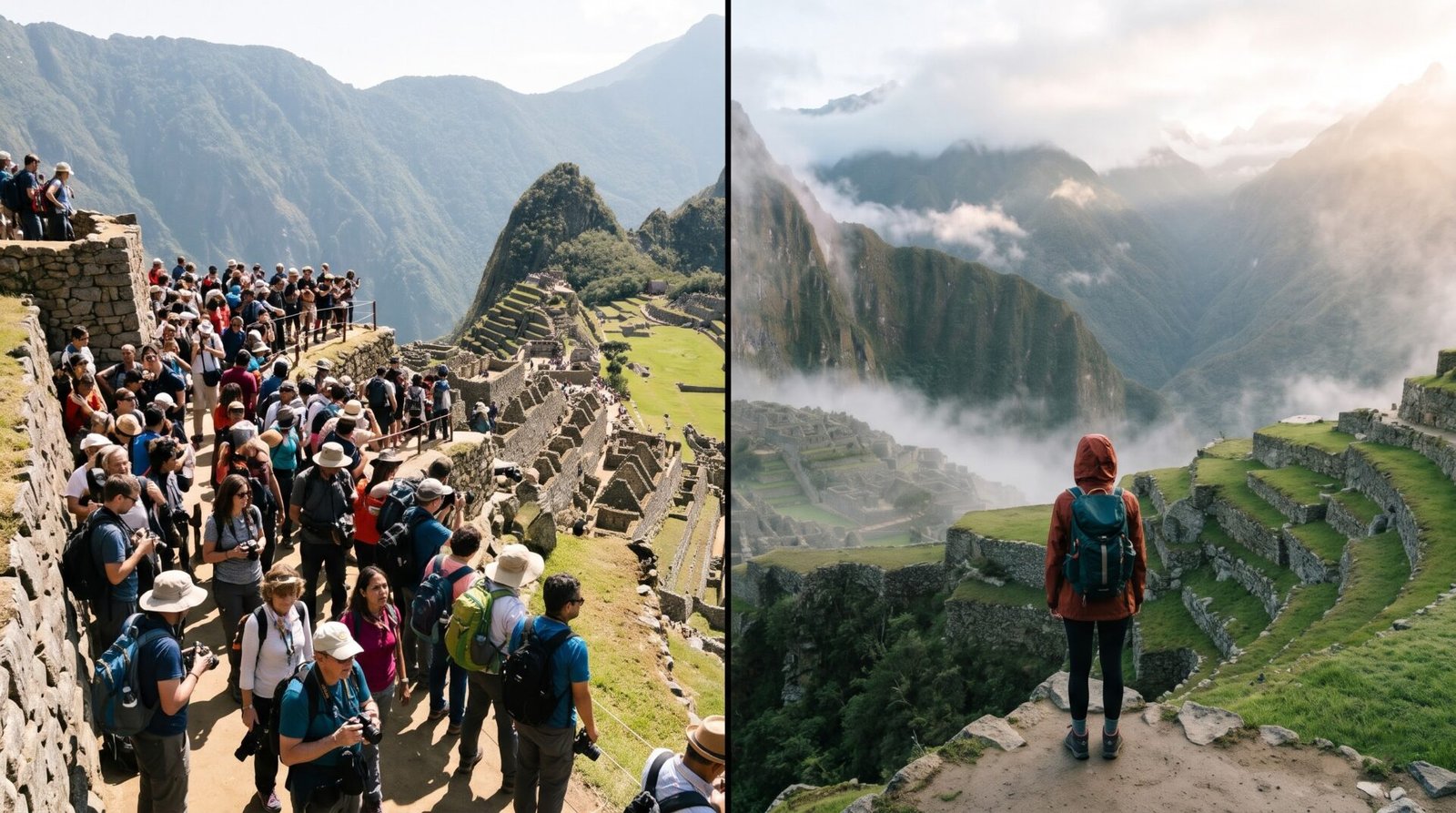
Picture the classic travel photo. You, grinning, in front of some world-famous wonder. Behind you, maybe four hundred other people grinning in front of the same wonder.
Nobody talks about that part when they post it.
The famous places are famous for a reason, and I’m not going to pretend otherwise. But somewhere between the timed-entry tickets, the selfie sticks, and the hotel prices that triple in July, a lot of people have started wondering whether there’s a smarter way to do this. There it is, and the internet has given it a name: the destination dupe. It’s a quieter twin of a famous spot, similar in scenery or history or mood, but without the queue.
Below are three proper pairs (Machu Picchu, Ha Long Bay, and Croatia’s Dalmatian coast), plus three smaller swaps. If you’re sorting through alternatives to overcrowded destinations or sketching a list of hidden gems for 2027, start here. I’ve also tried to say what each swap costs you, because none of them is free.

The Cheat Sheet
| Famous hotspot | Quieter twin | What you get | What you give up |
|---|---|---|---|
| Machu Picchu, Peru | Choquequirao, Peru | Inca ruins, huge mountain views, very few people | A multi-day hike |
| Ha Long Bay, Vietnam | Lan Ha Bay, Vietnam | Same limestone towers, fewer boats | Slightly longer trip, and it’s getting busier |
| Dubrovnik and Split, Croatia | Vis Island, Croatia | Stone harbors, local wine, clear water | Nightlife, easy transport |
| Kyoto, Japan | Kanazawa, Japan | Gardens, old teahouse lanes, geisha quarter | Fewer big-name temples |
| Santorini, Greece | Folegandros, Greece | Cliff-top village, sea views | Limited flights and ferries |
| Venice, Italy | Chioggia, Italy | Canals, lagoon life, great seafood | The grand palaces |
Choquequirao: The Inca Site You’ll Probably Have to Yourself
Let’s be clear about Machu Picchu. It’s astonishing. It’s also a place where your visit is scheduled to the hour, your route is marked with arrows, and the best viewpoint has a line.
Choquequirao has none of that. It sits on a ridge above the Apurímac canyon, a good way southwest of Cusco, and it’s often described as Machu Picchu’s sister. The terraces roll down the hillside like green steps. Look closely at the lower ones, and you’ll spot llamas, formed in white stone against the dark wall. It’s a lovely, odd detail, and most travellers never see it.
The numbers tell the story. Peruvian reports say the site gets up to about 9,000 visitors a year. Machu Picchu can handle that in a couple of days. So when people say Choquequirao feels empty, they’re not being poetic. They mean it.
There’s a reason for that, of course. You can’t take a bus. The usual route starts in the village of Cachora and takes around two days on foot to reach the ruins, and most people do it as a four-day return trek that plunges into the canyon and then hauls you right back up. The altitude doesn’t help. If you’ve never done a multi-day hike, go on some long training walks first, and think seriously about a guide and a mule for the heavy bags.
Timing is worth thinking about too. Peru has been planning a cable car that would shrink the journey to roughly 15 minutes and move around 400 people an hour. So far it’s a plan, not a ride. Some hikers dread it. Others say the area needs the earnings. Either way, in case you need the quiet version of Choquequirao, the window might not stay open all the time. The site reopened to site visitors in April 2026, so test the contemporary access rules before you book flights.

Lan Ha Bay: Same Rocks, Fewer Boats
Anyone who’s looked at photos of Ha Long Bay knows the scene. Limestone towers rising out of green water, a junk boat with red sails drifting through. What the photos leave out is the traffic. On a busy day, there can be so many boats that the bay looks like a floating car park.
Lan Ha Bay is the next bay over, curled around Cat Ba Island to the south and east. It has over 400 islands and basically the same kind of scenery, with the same sharp, jungle-covered karsts. One comparison puts it at roughly 100 cruise boats against more than 1,000 in Ha Long, which sounds about right when you see the difference on the water. Many travellers also say the water is cleaner, and you’ll find real sandy beaches rather than floating platforms.
Most people base themselves in Cat Ba town. From there, a day of kayaking through lagoons, with a guide, lunch, and boat transfer, typically costs somewhere between 500,000 and 1,000,000 VND. You can also lease a motorbike, wander through the countrywide park, or live in a homestay in a small village.
I’d be doing you a disservice if I sold it as a secret, though. It isn’t one anymore. A few operators report that Lan Ha has grown busier, with bigger cruise ships pushing groups through the handful of sights still open. And as of mid-2026, cruise guests can simply kayak in a restricted location near Cat Ba, due to the fact that paddling at some of the higher-recognised spots has become restricted. The fix is straightforward: pick a smaller boat or a homestay-style ride, and keep away from the massive floating resorts.
Also, don’t expect a quick day trip from Hanoi. You’ll want a night or two on Cat Ba. In a way, that’s the filter that keeps it calmer.
Vis: Croatia Without the Cruise-Ship Crush
Dubrovnik is lovely, with its limestone streets and its great walls above the sea. It’s also the poster child for overtourism in Europe, and on a summer day when two or three cruise ships dock, walking the Old Town can feel like a slow-moving festival. Split isn’t far behind.
Vis is where you go when you’ve had enough of that.
It’s the furthest inhabited island from the Croatian mainland, and for decades it was a military base that outsiders weren’t allowed to enter. That odd history did the island a favour. Development stayed low, and the villages saved their stone houses and fishing boats. Today you get quiet harbours, family-run konobas and some of the clearest swimming water in the Adriatic.
Most visitors split their time between Vis Town and Komiža, a fishing village on the other side with a stunning little waterfront. From Komiža you could hop a boat to Biševo and the Blue Cave, a famous sight that does draw organisations, so go early in the morning. The island additionally makes its own wine, and the niceness of it tends to be poured in small circles of relatives’ cellars, now and again via the same individual who grew the grapes.
Getting there takes some planning. The Jadrolinija car ferry (line 602) from Split takes about a hundred and forty minutes, and there’s a quicker passenger catamaran on some days. A foot-passenger ticket is often below €10 on the standard ferry, even though expenses shift with season and direction. Watch the schedules, because a few sailings fit locals commuting to Split better than tourists making plans for a time out. Treat Vis as a stay of 3 or 4 nights, no longer a brief hop.
There’s no big nightlife scene and no long list of have-to-see monuments. If that’s what you want from Croatia, stick with the mainland. If your idea of a super day is a swim, a protracted lunch and a nap, Vis wins.

Three Smaller Swaps
Not every pair needs a full chapter.
Kanazawa instead of Kyoto. Kyoto in cherry blossom or maple season can feel like an amusement park with temples. Kanazawa, on the west coast, has the Kenrokuen lawn, a properly preserved geisha district, vintage samurai streets, and an excellent fish market, and you may cover most of it on foot. The bullet train from Tokyo takes about a half hour.
Folegandros instead of Santorini. You get the cliff-face village, the whitewashed alleys and the big sea perspectives, however, with fewer than 1000 residents and no cruise-ship tide. The price is logistics: fewer flights and ferries that don’t always run when you’d like them to.
Chioggia instead of Venice. People call it “Little Venice”, and the nickname isn’t far off. It sits on the southern end of the same lagoon, with canals, working fishing boats, and a proper fish market. You won’t find Venice’s grand palaces here. You will find restaurants where the menu depends on what came in that morning.
Choosing Your Dupe
Before you change whatever, ask what you virtually desired from the unique. People frequently bypass that step.
If it became the surroundings, fit the geography. Lan Ha for limestone seascapes, Folegandros for cliffs. If it became the records, search for a domain with actual depth, like Choquequirao or Kanazawa. If it was the feeling of the place, the slow pace and the sound of water, then Vis or Chioggia will probably suit you better than a copy of the famous view.
And be realistic about effort. Every pick here asks for something: a longer trip, a harder walk, or a tourism setup that’s a bit rougher around the edges. That’s the trade. A quieter trip rarely comes with a shortcut.
A Few Habits That Help
Go in shoulder season on every occasion you may. Even a lovable quiet location gets busy at peak time, and spring and early autumn generally tend to be in shape in the Mediterranean and northern Vietnam.
Book small. A one-off family guesthouse, a local market, or a boat that consists of ten people rather than a hundred keeps extra money in the community and fewer feet on the path.
Check modern-day rules a few weeks earlier than you leave. Ferry timetables, kayak zones, and sites get right of entry to all alternate, on occasion with little caution.
Stay on marked paths, take your trash with you, and ask before you picture human beings.
One more thing: go easy on the geotags. If a place feels peaceful, you don’t need to point every follower to the exact spot. That’s how hidden places stop being hidden.

The Catch With “Hidden”
Here’s the uncomfortable bit. Once a place becomes a well-known dupe, it begins to lose what made it one. Lan Ha is already feeling it. Choquequirao might be next if the cable car arrives.
That’s not a reason to skip them. It’s a reason to visit with some care. Stay longer than a night. Eat where locals eat. Spend your money in the village, not on the big operator’s package. A dupe stays good when visitors act like guests rather than ticking off a checklist.
Where to Start
You don’t have to give up the famous names. Machu Picchu, Ha Long Bay and Dubrovnik have earned their reputations, and if you’re set on seeing them, book early and cross during the shoulder season.
But if what you actually need is that second of walking as much as something dazzling and having it, broadly speaking, to yourself, there are actual alternatives—an Inca terrace within the morning mist. A kayak sliding between limestone partitions without an engine noise—a long lunch on a Vis quayside where the simplest hurry is the tide coming in.
Pick one pair from this listing. Check the cutting-edge conditions. Then start planning for 2027, and maybe keep the best spot off your Instagram.



+ There are no comments
Add yours