


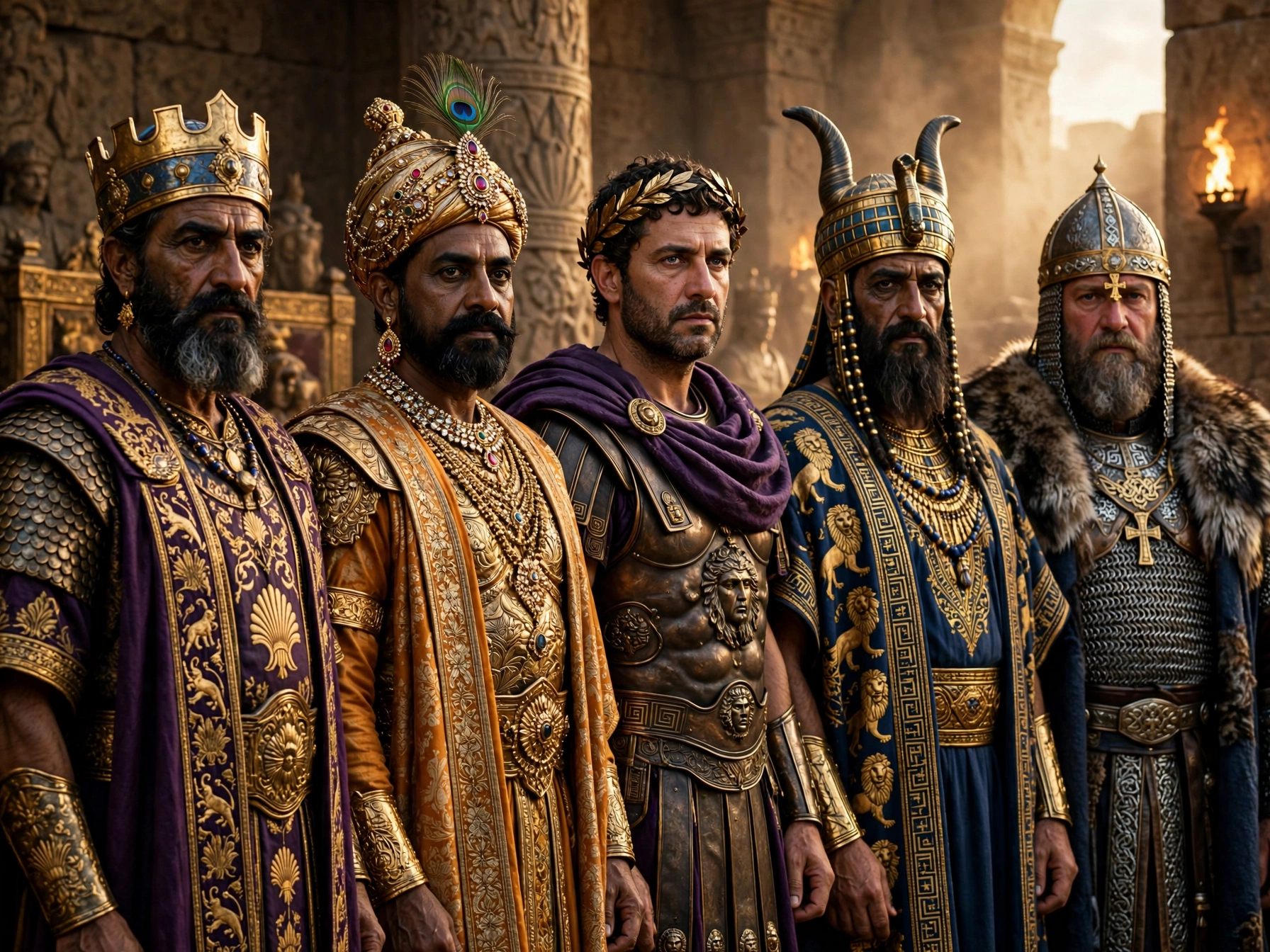
Most kings are forgotten within a generation or two. Even the ones who conquered half a continent in their lifetime — chances are you couldn’t name them if I asked. History is crowded with rulers who did exactly what was expected of them: collect taxes, win a few wars, pass the crown down, and disappear into the footnotes.
Then there are this small handful who refused to play by that script.
They didn’t just sit on a throne. They picked up the whole board and flipped it, changing how justice worked, how empires were run, how conquered people were treated, and sometimes how an entire nation saw itself. Centuries later, we’re still living with the aftershocks of what they did.
Here are five of them.

1. Cyrus the Great — The Conqueror Who Let His Enemies Go Home
Picture this. It’s 539 BCE. You’ve just flattened one of the most powerful empires on earth. Babylon is yours. Every rulebook of ancient warfare says what happens next — slaughter, slavery, forced worship of your gods, maybe a city burnt to the ground just to send a message.
Cyrus did none of that.
Instead, he freed the Jewish population that had been held captive in Babylon for decades and told them they could go home and rebuild their temple in Jerusalem. He let conquered peoples across his empire keep their own gods, their own languages, their own way of life. Nobody was forced to become Persian.
Was this pure kindness? Probably not entirely. It was smart politics too – a ruler who understood something most conquerors never figure out: an empire held together by fear crumbles the second that fear weakens, but one built on trust can survive for generations. And his did. The Achaemenid Empire he founded eventually stretched from Egypt all the way to India, and it held together for well over two hundred years.
There’s a clay artefact called the Cyrus Cylinder — you can go look it up — that historians consider one of the earliest recorded examples of a ruler formally respecting the rights of the people he’d just defeated. Some go as far as calling it the first human rights document in history. Maybe that’s a slight stretch. But the core idea behind it? That was genuinely new for its time.
2. Ashoka the Great — The King Who Won a War and Hated Himself for It
This one’s basically a redemption arc, except it’s real.
Ashoka came up exactly the way you’d expect a Mauryan prince to — ambitious, aggressive, and hungry for more territory. Then came the Kalinga War around 261 BCE. It was brutal. Estimates put the death toll above 100,000, with countless more displaced and lives wrecked. Ashoka won.

And then, instead of celebrating, he looked at what he’d done and couldn’t stomach it.
He converted to Buddhism and made a decision almost no king in his position had ever made: he stopped fighting. Not because he had to. He had all the power in the world at that point. He simply chose not to use it that way anymore. He called it “conquest by dharma” — spreading values instead of sending armies.
What followed was strange for a man who’d just won a brutal war. Hospitals for people, hospitals for animals. Wells and shade trees planted along roads for travellers. Edicts carved into rocks and stone pillars in plain language so ordinary citizens — not just scholars — could read about tolerance and non-violence. One of those pillars, the Lion Capital, is now the national emblem of India. You’ve probably seen it without knowing where it came from.
Very few rulers in history have had that much power and voluntarily put it down. One war changed how an entire civilisation thought about leadership for centuries afterward.
3. Alexander the Great — The King Who Shrunk the World
He inherited the throne of Macedon at twenty. He was dead by thirty-two. In between, he built an empire running from Greece to Egypt to the edge of India — and somehow never lost a major battle doing it.
But honestly? The conquest itself isn’t the interesting part. Plenty of kings before him grabbed territory. What made Alexander different was what he did once he had it.
He founded more than twenty cities, most of them called Alexandria, and turned many of them into genuine melting pots — Greek ideas mixing with Egyptian, Persian, and Indian ones. He pushed his soldiers to marry local women. He started wearing Persian clothes and adopting Persian court customs, which honestly annoyed a lot of his own Macedonian generals to no end.
That fusion of cultures gave rise to what we now call the Hellenistic Age — a stretch of history where Greek philosophy, art, and science spread across three continents and blended with whatever was already there. The great Library of Alexandria, arguably the single greatest hub of knowledge in the ancient world, exists because of the world Alexander’s conquests created.
He wasn’t just redrawing maps. He was moving ideas around, faster than they’d ever moved before. Trade opened up. Knowledge travelled. For maybe the first time, the ancient world started feeling connected instead of scattered pockets that barely knew each other existed.
4. Hammurabi — The King Who Wrote the Rules Down for Everyone to See
Around 1754 BCE, in Babylon, a king did something that sounds almost boring by today’s standards but was genuinely radical back then. He wrote the laws down. In public. Where anyone could see them.

Before that, justice was basically whatever the local ruler felt like that day. No consistency. There was no way to know in advance what would happen if you broke a rule or what protection you had if someone wronged you. It depended entirely on the mood of whoever happened to be in charge.
Hammurabi changed that with 282 laws carved into a massive stone stele and placed somewhere the public could actually read it. The code covered trade disputes, marriage, theft, property damage, criminal punishment — basically the full spread of everyday life. It’s where we get the famous idea of proportional justice, the “an eye for an eye” principle — punishment that actually matches the crime instead of whatever cruelty someone decides to hand out.
It wasn’t perfect. Punishments still varied depending on your social class, which feels genuinely unjust by modern standards. But the underlying principle — that laws should be public, consistent, and known ahead of time rather than made up on the spot — was the real breakthrough. That single idea, that even a king answers to written law, ended up as a foundation stone for legal systems all the way down to the courtroom near you today.
5. Peter the Great — The Tsar Who Dragged His Country Into a New Era
Late 1600s Russia was, by Western European standards, cut off. Behind on technology. Behind militarily. Behind culturally. Peter the Great looked at that gap between his country and the rest of Europe and decided it simply wasn’t acceptable.
Here’s the part that always gets me about Peter — he didn’t just issue orders from a palace and expect things to change. He actually travelled through Europe under a fake identity, worked in Dutch shipyards with his own hands, learned carpentry and shipbuilding himself, and studied Western military strategy and medicine firsthand. Then he brought all of it back to Russia and forced modernisation onto the country through sheer stubbornness — building a navy from nothing, reforming the army, overhauling the entire bureaucracy, and even changing the calendar.
He built a brand new capital, St Petersburg, out of literal swampland, meant to be Russia’s window looking out onto Europe. He pushed education reform, opened schools for maths and navigation, and brought in foreign experts to train Russians in modern trades. Not all of it was gentle — a lot of his reforms came at real human cost, and calling him harsh would be an understatement in places. But the transformation was undeniable. Within a few decades, Russia went from being on the outer edge of European relevance to being one of its major powers.
Peter didn’t inherit a great empire. He basically forced one into existence through refusal — refusal to accept that his country had to stay behind everyone else.

What Actually Connects These Five
Cyrus ruled through tolerance. Ashoka, through giving up violence. Alexander through blending cultures. Hammurabi through law. Peter through pure, stubborn modernisation. On the surface, they don’t have much in common at all — different eras, different values, different parts of the world.
But look closer, and there’s a thread. None of them were satisfied with just holding power. Every single one of them used it to reshape something bigger than themselves — how people were governed, how cultures collided and mixed, how justice functioned, how a whole nation saw its place in the world. Their crowns are gone. Their bodies turned to dust centuries ago. But the systems and ideas they built? Still standing. Still shaping things.
That’s really the difference between a king who rules and one who rewrites history. One gets remembered for how long he kept the throne warm. The other gets remembered for what was still standing long after he wasn’t.



[…] the dates of major wars, dissecting the dense clauses of peace treaties, tracing the lineages of kings and queens, and sketching the broad strokes of the Industrial Revolution. And while all of that is […]