


Cusco, Peru. 1650.
An earthquake tears through the city with the kind of violence that the Andes delivers without warning or apology. Churches collapse. Spanish colonial palaces — built with all the confidence of a conquering civilisation — crumble into rubble. The Church of Santo Domingo, one of the grandest buildings the Spanish had erected after seizing the city a century earlier, comes apart at its foundations.
Underneath it, holding up what is left, stands an Inca wall.
Curved, mortar-free, assembled from stones fitted so precisely that not a single one had shifted. The Spanish would rebuild their church on top of that wall. Then another earthquake hit in 1950 — again, the colonial construction above gave way. Again, the Inca wall beneath it held.
That wall is still there today.
At some point, after the second earthquake, you have to stop calling it luck and start asking a harder question: what did the Inca actually know that we do not?

Start with What They Did Not Have
The list is almost insulting, from a modern engineering standpoint.
No iron tools. The Inca worked with bronze chisels, stone hammers, and abrasive sand. Their cutting instruments were softer than the granite and andesite they were cutting. No written language — not a single blueprint, no annotated plan, no engineering specification committed to paper or clay or any other surface that survives. No wheel, which in a civilisation doing large-scale construction across brutally steep mountain terrain means no wheelbarrows, no pulley systems, and no wheeled transport of any kind. No large draft animals — no horses, no oxen, nothing that could pull or haul the way European construction relied on.
They had llamas, which max out at about 75 kilograms of cargo each. They had human muscle. They had rope made from plant fibre. They had wooden levers and, on flat ground, log rollers.
With those tools, they moved stones at Sacsayhuamán — the great fortress overlooking Cusco — that weigh between 100 and 200 tonnes each. The largest single block historians have confirmed weighs approximately 125 tonnes. The nearest quarry is several kilometres away, across valleys and up slopes that challenge modern heavy equipment.
They moved those stones. They fitted them together without mortar. And they built something that has survived six centuries of Andean seismicity without significant structural failure.
The question of how tells us something profound about the difference between technological sophistication and engineering intelligence.
The Earthquake Problem Nobody Talks About Honestly
Peru sits, without delay, at the Pacific Ring of Fire. The country averages more than 2,000 earthquakes per year. This isn’t always an exaggeration or a dramatic figure — it’s far from the geological fact of a landmass sitting at the collision point of the Nazca and South American tectonic plates.
The Inca did not choose to construct in a seismically lively location, no matter knowing the dangers. They were born into those mountains. They had watched structures fail in earthquakes for generations before the great building projects of the 15th century began under the emperor Pachacuti. Seismic risk was not an obstacle they worked around. It was the central engineering problem they had to solve before anything else.
And here is what makes their solution so elegant — so genuinely, technically impressive — it was not to build stronger. It was to build looser.
Every engineering instinct shaped by modern construction says that a wall should be rigid. Rigid is strong. Rigid holds. Rigid resists. So we blend cement, pour concrete, support with steel rebar, and bind the whole thing right into a unique locked shape.
When an earthquake hits a rigid structure, the energy has nowhere to go. The floor moves, the foundation acts, and the inflexible wall should flow with it or break. This is why modern masonry buildings — even well-engineered ones — are vulnerable in major earthquakes. The energy enters the structure, and the structure resists until it cannot resist anymore.
The Inca built walls that do not resist. They absorb.
How the Stones Actually Work
The technique is called ashlar masonry, though the Inca version of it is more sophisticated than the term usually implies.

Each stone was individually cut and shaped to fit its exact position in the wall — not to a standard size or modular format, but to the specific neighbouring stones it would sit against. The contact faces were ground until they interlocked, three-dimensionally, like puzzle pieces that can only fit each other. No mortar. No adhesive. Just geometry and gravity holding everything together.
The stones are cut so precisely that they fit together like 3-dimensional jigsaw puzzle pieces, held in place with the aid of gravity and their perfectly matched interfaces. During seismic events, the stones can shift slightly without the brittle mortar that would crack and fail in traditional construction.
When an earthquake moves the ground beneath an Inca wall, each stone shifts microscopically — slides a fraction of a millimetre in the direction of the seismic wave — and then settles back into its position when the wave passes. The energy moves through the wall rather than into it. No stone cracks because no stone is rigidly locked. The wall flexes, microscopically, and holds.
This is the principle modern seismic engineers call “base isolation” — designing a structure so that its foundation can move independently of its superstructure, absorbing seismic energy before it can travel upward into the building. It is a technique considered cutting-edge in earthquake-resistant construction. Major buildings in Tokyo, San Francisco, and Istanbul are designed on versions of this principle. The Inca were doing it in the 15th century with interlocking stone and no mortar.
The decision to build without mortar, which looks like a limitation, turned out to be the reason these structures survived centuries of earthquakes that brought down everything built on top of them.
There is a specific irony in that sentence worth sitting with. The thing that looks like a weakness — no mortar, nothing holding the stones together — is precisely what makes the wall strong. Spanish builders, looking at Inca construction, assumed the absence of mortar was a primitive oversight they should correct. So they built with mortar. Their buildings fell.
The Geometry of Survival
Mortar-free construction is only part of it. The Inca embedded seismic engineering into every geometric choice they made.
Look at a doorway in any Inca building – the temples at Machu Picchu, the palaces in Cusco’s historic centre, the chambers inside Sacsayhuamán. Every single one is trapezoidal. Wider at the bottom than at the top. Not because it looks impressive, though it does. Because a trapezoidal opening distributes load downward into the bottom of the wall in place of outward into the surrounding stones. During an earthquake, while forces circulate through the wall laterally, the trapezoidal form means the opening no longer puts stress at its corners the way a rectangular opening could.
The walls themselves lean inward slightly — battered walls, engineers call them. The outer face of an Inca wall tilts toward the building rather than standing perfectly vertical. This lowers the wall’s centre of gravity, making it inherently more resistant to being toppled by horizontal seismic forces. Modern retaining walls are built with the same principle. The Inca applied it to every wall, every building, across an entire empire, without ever writing down why.
Every layout desire, from trapezoidal doorways to walls that lean slightly inward, served a useful purpose in one of the most earthquake-prone areas on Earth. The result became a construction tradition that treated stone not as a static cloth but as something supposed to transport.
Stone meant to move. That is not a primitive understanding of materials. That is a sophisticated one.
Sacsayhuamán: The Problem That Should Have Been Impossible
Above Cusco, on a steep hillside with a commanding view of the valley, sits the fortress of Sacsayhuamán — and it represents perhaps the most difficult engineering problem the Inca ever solved.
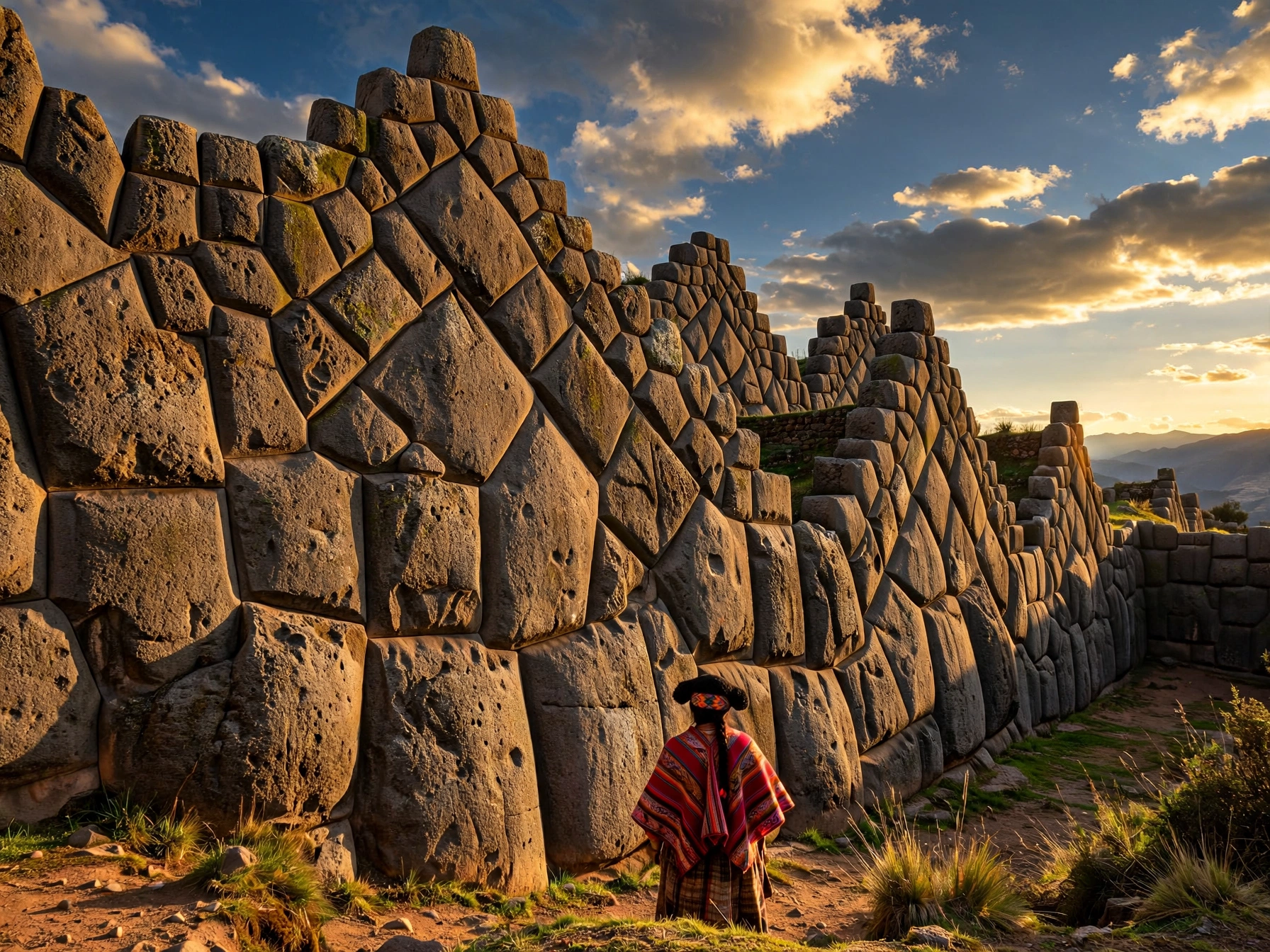
The zigzagging walls are built in three massive terraces, each wall rising as high as nine metres. The stones are the largest the Inca ever used anywhere — some of the blocks in the lower courses weigh more than 100 tonnes. Researchers consider that 1,800 men were required to pull the sort of huge block using wheeled planks, thick ropes, gravity and muscle energy, and that they probably used wet clay or gravel to lessen friction.

Think about what that means logistically. You are moving 100-tonne blocks of andesite across several kilometres of mountainous terrain, uphill, with 1,800 people pulling on plant-fibre ropes over ground prepared with wet clay to reduce friction. You are doing this with no blueprint — just the mental model held by the master masons directing the work. You are doing this without a single written file, coordinating lots of employees throughout a creation undertaking that took decades, using a system of knotted strings called ‘quipu’ to track materials, employees, and development.
The precision of Sacsayhuamán reflects the Inca’s state-of-the-art mathematical knowledge, particularly their knowledge of geometry and spatial relationships. The complex angles and curves of each stone required careful calculation to ensure proper fit with neighbouring blocks.
The polygonal masonry at Sacsayhuamán — where stones are not rectangular but cut into irregular, multi-sided shapes that interlock like a three-dimensional jigsaw — is particularly striking. One famous polygonal stone at the royal Inca capital of Cusco boasts 12 sides. Every one of those twelve faces had to be ground to fit perfectly against the twelve corresponding faces of the surrounding stones. Without a single power tool. Without measurement instruments beyond what the masons could make themselves.
Modern stonemasons with diamond-tipped angle grinders and digital callipers have attempted to replicate this work. Most of them report it is harder than it looks, even with contemporary equipment.
The Mit’a: When Social Architecture Enables Physical Architecture
One thing often missing from conversations about Inca engineering is the social system that made it possible.
The Inca relied on a system called ‘mit’a’, in which its citizens were required to provide some form of labour to the government each year in exchange for the government’s care and protection – a kind of tax in the absence of currency. Men aged 15 to 50 were required to donate a portion of their time to the empire’s various construction projects.
Crucially – and this is a point modern accounts consistently underemphasise – the Inca did not practise slavery in the way many ancient civilisations did. The workforce that built Sacsayhuamán and Machu Picchu was not coerced labour in the traditional sense. Workers were fed, clothed, and cared for by the state. The mit’a was a civic obligation, not forced servitude. In a society with no currency and no market economy, it was how collective projects got funded — with time rather than money.
This matters architecturally because it means the workforce was not resentful, not malnourished, not driven by fear. The organisational model produced workers who were invested in the quality of what they built. That investment shows up, quite literally, in the walls.
What Happened When Spain Arrived
When Francisco Pizarro’s forces entered Cusco in 1533, they encountered stonework they couldn’t recognise and couldn’t easily destroy.
When Spanish conquerors arrived in the 16th century, they were each awed and pissed off by the Inca stonework. They often tore down Inca temples to construct their own churches but observed the native walls were not possible to smash or repurpose without a fantastic attempt.
Many Spanish colonial buildings in Cusco were simply built on top of existing Inca foundations — not because the Spanish admired the Inca, but because demolishing those foundations was more work than building on them. The irony that followed across the next four centuries is precise and almost theatrical: earthquake after earthquake, the Spanish structures above collapsed, and the Inca structures below survived.
Today, many colonial buildings in Cusco rest on Inca bases, a silent testament to which civilisation truly mastered the art of endurance.
Walk through the historic centre of Cusco today, and you can see exactly where one civilisation’s work ends and the other’s begins. The lower courses of stone — perfectly fitted, slightly tilted inward, mortar-free — are Inca. Everything built above that line, in the centuries since the conquest, sits on a foundation it could not have built itself.

The Lesson That Engineers Keep Relearning
There is a pattern in the history of engineering in which a technique is abandoned, forgotten, or dismissed as primitive — and then modern analysis reveals it was optimal.
Roman concrete that strengthens over the years instead of weakening. Inca mortar-loose masonry that absorbs seismic electricity in place of resisting it. These aren’t satisfied injuries stumbled upon by humans too unsophisticated to recognise better ones, are they? They are solutions arrived at through generations of empirical commentary, trial, failure, and refinement in the precise environments in which the problems without a doubt existed.
The Inca built in earthquake country. Every structure that failed taught the next generation of builders something. Every technique that survived multiple earthquakes got passed down, refined, and incorporated deeper into practice. Over centuries, what emerged was not a textbook of structural engineering — it was something more durable than a textbook. It was a living tradition of knowing, held in the hands and eyes and judgement of master masons who understood stone the way a surgeon understands anatomy.
We replaced that kind of knowledge with software and specification sheets. The software is faster. The specifications are reproducible. But they do not always produce walls that last six hundred years through two hundred earthquakes.
The Inca walls do.
One Last Thing About That Wall in Cusco
The Church of Santo Domingo was rebuilt after the 1950 earthquake. It stands these days over the same Inca foundation that has held up through each seismic event the Andes have thrown at it since the 15th century.
Tourists visit to see the church. But the thing worth looking at is what the church is standing on – those lower courses of perfectly fitted, slightly tilted, mortar-free stone, assembled by people with bronze chisels, plant-fibre rope, and an understanding of how the earth moves that our most sophisticated engineering is still, quietly, trying to match.
They had no wheel. No iron. No written language.
What they had was something harder to manufacture than any of those things: an intimate, earned, embodied understanding of stone, gravity, and the particular way this piece of the earth shakes when the plates beneath it disagree.
That understanding is still holding up the church.



+ There are no comments
Add yours