


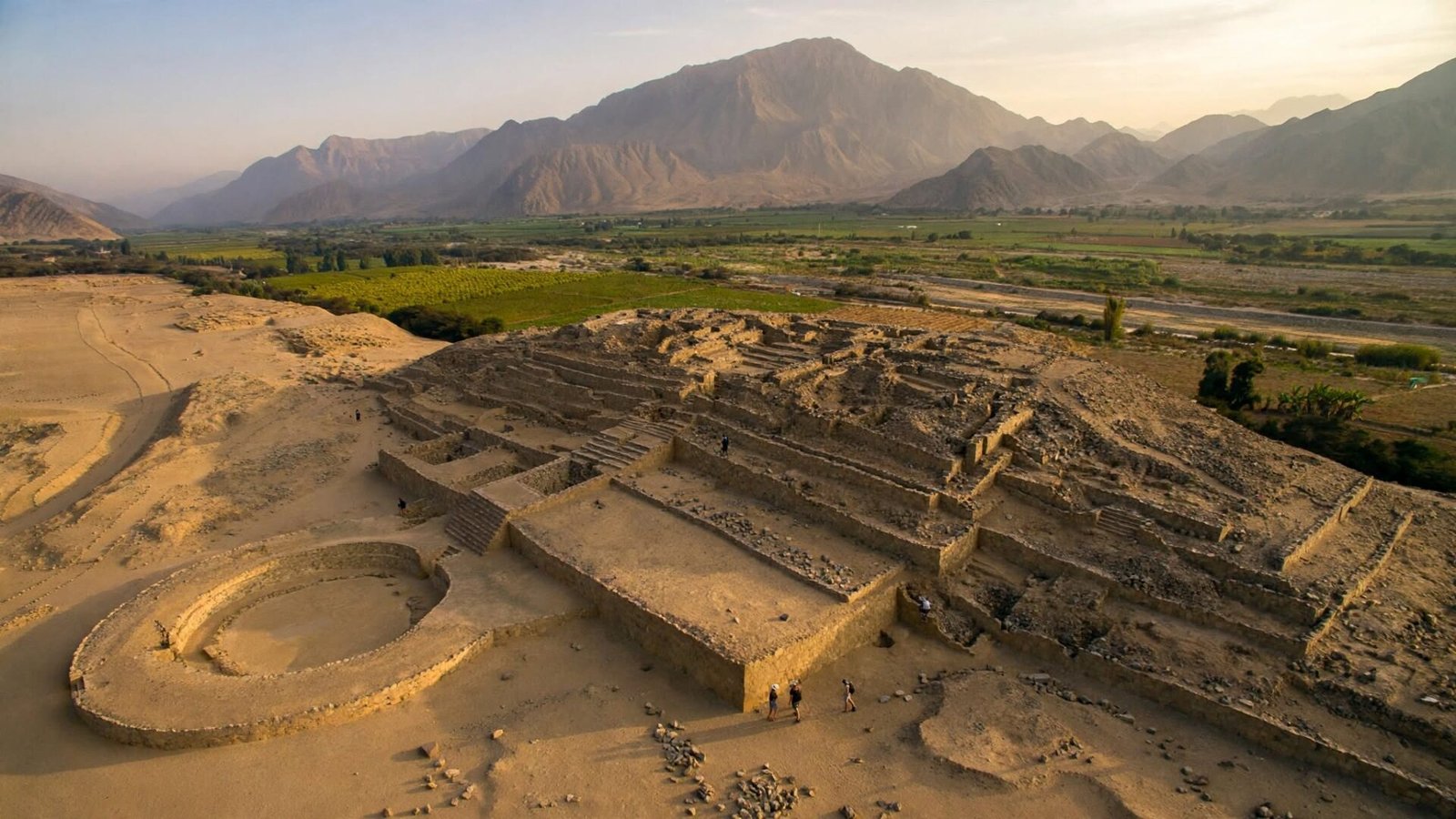
The first thing that surprises people about Caral is how everyday it appears from the road. You depart Lima, follow the coast north, then head inland through naked, sandy hills. Nothing special. Then the land drops into a thin green valley, and on the dry ground above it sit several huge stone platforms that you’d swear were natural hills. They aren’t. They’re pyramids, raised at the same time as Egypt’s, by way of folks who had no pottery, no metal, and, as far as everyone can tell, no navy.
That’s Caral, the exceptionally well-known site of the Caral-Supe civilisation and one of the oldest towns within the Americas. Below, I’ll go through what was found there, how its age was worked out, and what the famous “no weapons” idea really holds up to.
Caral in Brief
- Where: Supe Valley, roughly 200 km north of Lima, Peru
- Main period: About 2600 to 2000 BCE (the wider region was occupied from around 3000 to 1800 BCE)
- Area: Around 66 hectares (160 acres)
- Key features: Six large platform mounds, a sunken circular plaza, residential areas
- Population: A few thousand people, by most estimates
- First noticed: 1948; serious excavation began in 1994
- Lead archaeologist: Ruth Shady Solís
- UNESCO World Heritage Site: Listed in 2009

The City That Hid in Plain Sight
Nobody had to “discover” Caral in the way people imagine. It had been sitting there all along. In 1948, the American archaeologist Paul Kosok walked the Supe Valley and saw the mounds, but he wasn’t inspired. Back then, people anticipated an ancient civilisation to leave behind gold, painted pots, and wealthy tombs. Caral offered none of those, so the mounds were filed away as modest ruins.
That changed when Ruth Shady, a Peruvian archaeologist, started digging in 1994. As sand and rubble came away, it became clear these were not hills at all. They were planned buildings with staircases, terraces and open plazas. The largest, called the Pyramid Mayor, covers a base of roughly 160 by 150 metres and rises about 18 metres.
Then the radiocarbon results came back, and things got a lot more interesting.
How Old Is It?
In 2001, Shady and her colleagues reported their dates in the journal Science. They’d tested organic material, including reed fibres from the stone-filled bags used in construction. The main building phase landed between roughly 2600 and 2000 BCE.
For comparison:
- Egypt’s Great Pyramid went up around 2560 BCE.
- The first Indus Valley cities were growing at about the same time.
- Mesopotamia already had cities, though nobody in Peru knew that.
No one in the Andes was borrowing ideas from overseas. Caral is one of the few cases where urban life appears to have been invented from scratch, which is why scholars often list it beside Mesopotamia, Egypt, the Indus Valley and China.
It may not even be the oldest. Sechín Bajo, in the Casma Valley, has been dated by some researchers to before 3000 BCE. The timeline for Peru’s earliest monument builders keeps moving backward.
Pyramids Before Pottery
Archaeologists call this the Late Archaic, or pre-ceramic, period. In plain terms, these people built giant monuments before they’d started making clay pots. They had no metal tools and no wheel.
What they did have was a clever trick called the shicra. A shisha is a net bag woven from reeds. Workers packed thousands of them with stones and stacked them to form the inner core of a platform. It sounds almost too basic, but it’s brilliant for an earthquake country, and Peru has plenty of that. The stone-filled bags flex and absorb shaking rather than cracking apart. Many of Caral’s buildings are still standing after about five thousand years of tremors, and engineers today study the method with real respect.
There’s another habit worth noting. The builders often buried older temples on purpose, filling them with rubble and constructing a bigger one on top, like a hard-and-fast set of nesting dolls. Archaeologists suppose these rebuilds may additionally have marked ceremonial cycles or modifications in management. In some spots, old staircases and fire pits had been carefully preserved inside the new shape, nearly like a time tablet.

Daily Life in the Valley
Caral sat in dry country, but the Supe River gave the settlement water. The people dug irrigation channels and grew cotton, squash, beans, sweet potatoes, peppers, and guava. What’s missing is just as telling: no maize at first, and none of the grain farming that powered many other early cities.
The food trail gets even better. Excavators found large amounts of anchovy and sardine bones at Caral, though the sea is about 20 kilometres away. So fishing communities on the coast were sending their catch inland. In exchange, valley farmers supplied cotton, which the fishermen turned into nets, along with vegetables.
It’s basically an ancient supply chain. Fish moved one direction, and cotton and crops the other. And it points to a reason early cities formed that has nothing to do with conquest: people needed each other.
Society was layered. Larger, better-built houses stood near the central plazas, likely home to leaders and priests, while simpler dwellings stretched out toward the edges for ordinary workers. There was a pecking order for sure. But the evidence suggests it rested more on ritual and organising authority than on force.
Flutes, Knots and Sacred Fire
A few of the best finds at Caral are tiny.
Flutes. Archaeologists recovered about 32 flutes made from pelican and other animal bones, many carved with birds and monkeys. Music clearly mattered in ceremonies, and these people weren’t only builders.
Knotted cords. In 2005, a team reported a bundle of knotted strings in a reed bag at Caral, which they identified as a quipu. The Inca used quipus thousands of years later to keep records. If that identification is right, it would push the idea back by millennia. But researchers still argue about what the knots meant or whether or not that is a true quipu at all, so it’s better dealt with as an intriguing trace than a settled fact.
The sacred fire. Several homes include an imperative hearth, sometimes referred to as the Altar of the Sacred Fire. Ash and burnt services suggest ceremonial use. Some fire pits were connected to underground ducts that may have fed air to the flames, which is a surprisingly clever bit of design.
The circular plaza. In front of 1 pyramid lies a sunken circular area, in all likelihood used for gatherings, performances, and rituals. It suggestions at big public occasions that certain communities gathered collectively.
Did Caral Really Have No Weapons?
This is the claim that grabs headlines, so let’s be careful with it.
The facts are striking. Excavations at Caral haven’t turned up shielding partitions, fortresses, or stockpiles of clubs, spears, or slings. There aren’t any mass graves, no skeletons with war wounds, and no artwork celebrating battle or captives. In many ancient societies, violence is easy to spot in the ground. Here it mostly isn’t.
That’s where the “peaceful city” label comes from. But a few caveats are worth keeping in mind:
- No evidence isn’t proof. Only a portion of Caral has been dug. New excavations could change the story.
- Weapons can rot. Wooden clubs or simple slings wouldn’t necessarily last five thousand years.
- The region varied. Not every nearby site looks equally calm, and later Andean cultures definitely fought wars.
So here’s the fair version. Caral shows remarkably little sign of warfare, and its growth seems to have relied on organisation, ritual and trade instead of armies. That alone is a big deal. It challenges the old assumption that early cities needed conquest to get started.

One City in a Bigger Network
Caral was the largest site in its valley, but it wasn’t alone. Researchers have identified around 30 settlements throughout the Supe, Pativilca, and Fortaleza valleys with similar architecture, such as platform mounds and sunken circular plazas. Coastal sites, which include Áspero, at the mouth of the Supe, possibly served as fishing centres tied to Caral.
So picture an internet of cities linked by way of shared ideals, change, and building styles, with Caral at the coronary heart. That’s why scholars generally say “Caral-Supe civilisation” in place of just “the metropolis of Caral”.
Why Did They Leave?
Around 1800 BCE, the people of Caral moved away. There’s no sign of burning or battle. The city seems to have been closed down in an orderly fashion, with some buildings carefully covered in sand and stone, as if the residents hoped to return or simply wanted to protect their work.
Nobody knows the exact cause, but climate is the top suspect. This coast is prone to violent El Niño floods and long droughts. A shift could have dried up the river or wrecked the fishing that fed the trade network. Earthquakes may have played a role too.
After that, cultural electricity moved to different valleys, and later Andean societies, including the Chavín, carried ahead ideas of temple building and formality. Caral sits at the beginning of an extended tradition that sooner or later led to the Inca.
Why It Matters
Three reasons stand out for me.
First, Caral proves that civilisation didn’t have to look like Egypt or Mesopotamia. It grew without pottery, without grain-based farming at the start, and apparently without much fighting. That broadens our sense of how people can organise themselves.
Second, it’s a story about cooperation. Building a pyramid out of stone-filled luggage takes thousands of coordinated painting hours. Someone had to plan it, feed the crews, and persuade everybody it was profitable. Whatever held Caral together, it wasn’t just brute force.
Third, it shows how much remains unknown. A site ignored for decades turned out to be among the oldest cities in the Americas. What else is under the sand?
Visiting Caral
You can see Caral on a day ride from Lima. The force takes more or less three to 4 hours each way, so start early. Local publications lead you via the pyramids, the circular plaza, and the residential areas. Bring a hat, water, and sunscreen, due to the fact that shade is scarce and the wasteland sun is fierce.
From the pinnacle of the Pyramid Mayor, with the vast valley spread out beneath, you could see why people picked this spot. You can also feel how old it is.

Quick Answers
Where is Caral?
In Peru’s Supe Valley, about 200 kilometers north of Lima and roughly 20 kilometers from the Pacific.
How old is it?
Its main construction dates to about 2600 to 2000 BCE, so around 4,600 to 5,000 years old.
Is it the oldest city in the Americas?
It’s widely called one of the oldest, and often the oldest known urban center, though some nearby sites may be older. A lot depends on how you define “city.”
Did it really have no weapons?
Excavations haven’t found fortifications, weapon stockpiles or clear signs of warfare. But only part of the site has been excavated, so researchers stay cautious.
Why was it abandoned?
Unknown. Climate change, drought, floods and earthquakes are the leading explanations.
Is it a UNESCO site?
Yes, since 2009.
Last Thoughts
Caral has no gold masks and no dramatic battle scenes. What it offers is quieter and, honestly, more impressive: proof that thousands of people once built a city together, traded fish for cotton, played bone flutes at their ceremonies, and then moved on when the world shifted around them.
Five thousand years later, the stones are still standing. That’s a pretty good tribute to the people who put them there.



+ There are no comments
Add yours