


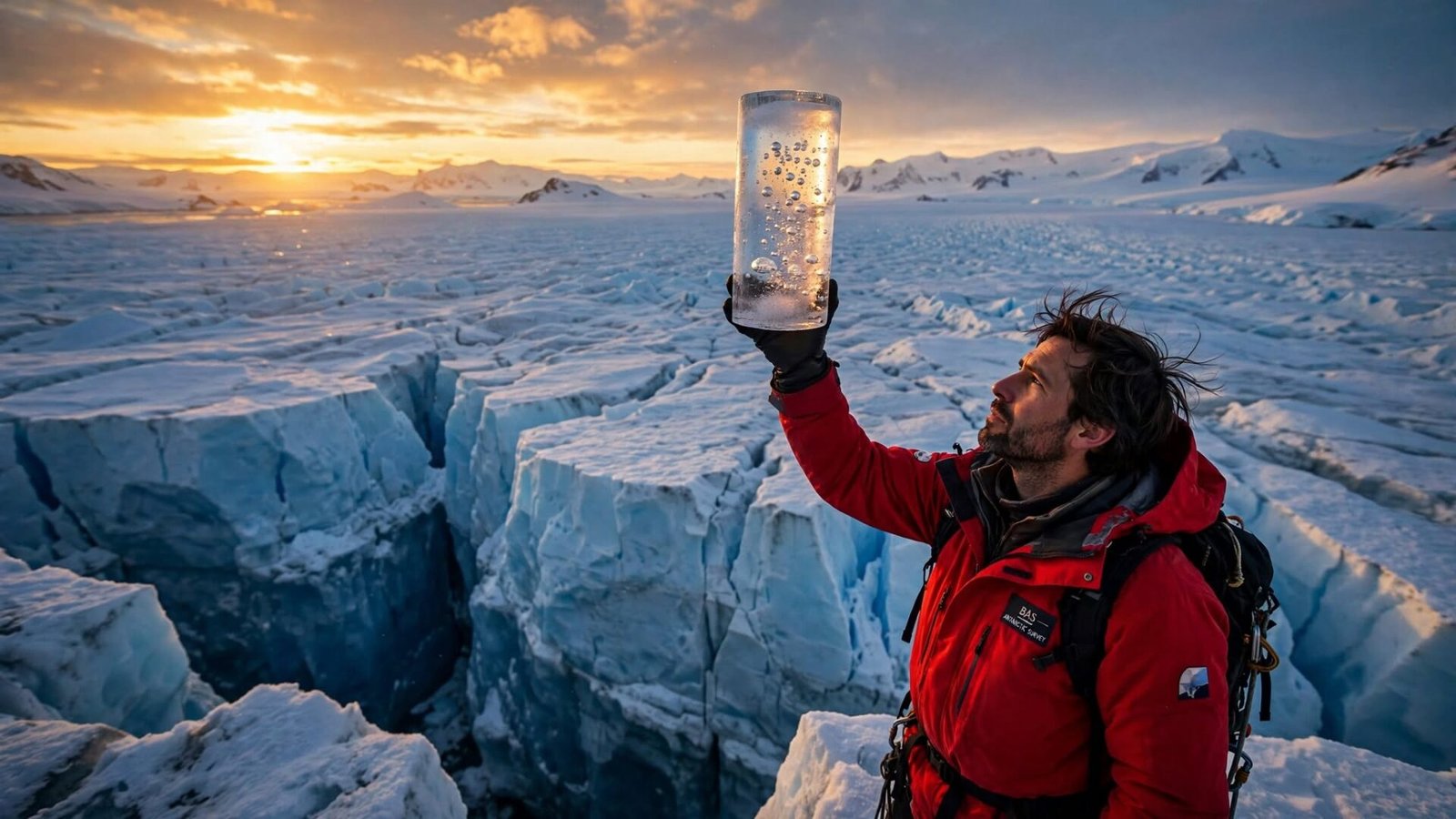
There’s a place in Antarctica where you can hold a piece of air that was trapped before humans figured out how to make fire. Not a sample, not a replica — actual air, locked inside a bubble of ice for 800,000 years, preserved with the same quiet indifference that glaciers have always shown toward the world happening above them.
That’s the thing about glaciers. While civilisations rose and crumbled, while species went extinct and new ones figured out how to survive, these slow rivers of ice just kept doing their job — compressing snow, year after year, layer by layer, trapping everything the atmosphere threw at them. Pollen. Dust. Volcanic ash. Ancient microbes. Even the faint chemical fingerprints of wildfires that burnt whilst woolly mammoths were still walking the Earth.
Nobody asked them to. They just did.
The Accidental Archivists
Scientists didn’t realise what they had for a long time. Early polar explorers noticed glaciers as obstacles — matters to navigate around, not through. But sometime within the mid-20th century, researchers started noticing something abnormal: the deeper you drilled into an ice sheet, the older the ice got. And the older the ice, the more it had to say.

The concept behind ice cores is almost embarrassingly simple. Each winter, snow falls and accumulates. Summer brings a slightly different kind of snow — sometimes a thin melt layer forms on the surface. Over decades, the weight of new snow compresses older snow into firn and eventually into glacial ice. What you’re left with is a layered record — like rings in a tree, but far more detailed and stretching back far longer than any tree has ever lived.
When scientists drill into an ice sheet and pull out a cylinder of ice — an ice core — they may be essentially pulling out a timeline. A physical, tangible, hold-it-in-your-hands timeline of Earth’s atmospheric records.
The longest ice core ever retrieved came from Antarctica’s Dome C, pulled out throughout the European Project for Ice Coring in Antarctica, also known as EPICA. It reached ice that was approximately 800,000 years old. That’s not a typo. Eight hundred thousand years of unbroken atmospheric record, sitting quietly below the East Antarctic Ice Sheet, waiting for a person to return and ask questions.
What’s Actually Inside
Here’s where it gets remarkable. Ice is not just frozen water. Every layer of a glacier carries tiny air bubbles – literal samples of an ancient environment, sealed off from the whole thing that came after. When researchers crack open an ice core in a lab, they can extract those bubbles and examine the internal gas composition. They can let you know exactly how a good deal of carbon dioxide changed inside the ecosystem 400,000 years ago. Or 600,000 years ago. Or any point in between.
This is how we know, with confidence, that CO₂ levels today are higher than at any point in the past 800,000 years — and climbing faster than anything the ice record has ever recorded.
But the story doesn’t stop at greenhouse gases. Glaciers are remarkably promiscuous collectors of atmospheric material. Consider what else turns up in ice cores:
Volcanic eruptions leave awesome layers of sulphuric acid and ash. When researchers locate these layers, they can cross-reference them with historic records of eruptions — and in doing so, they’ve been capable of exactly dating ice layers going back thousands of years. The eruption of Tambora in 1815, the one that induced “the year without a summer”, is without a doubt seen in ice cores from Greenland and Antarctica. So is Krakatoa. So are dozens of ancient eruptions that records books in no way recorded because there has been no one around to jot them down.
Pollen grains show up, carried by wind from continents thousands of miles away. By figuring out which plant species the pollen came from, researchers can reconstruct what the plant life looked like in distant areas at particular points in time. This tells them about climate – what temperatures had been, how a great deal of one-of-a-kind rainfall regions were obtained, and when ice, for a while, tightened its grip and then loosened it.
Dust is another messenger. The amount and composition of dust trapped in ice varies with climate conditions. During cold, dry periods — glacial maxima, when ice sheets spread across continents — dust levels spike dramatically. The ice remembers every sandstorm, every drought, every era when the winds were strong and the land was bare.

Lead and other industrial pollutants appear in ice cores from the past few centuries, giving researchers an unintentional but precise record of human industrial activity. You can see the Roman Empire’s smelting operations in Greenland’s ice. You can see the Industrial Revolution beginning and accelerating. You can see leaded gasoline entering widespread use in the mid-20th century and then disappearing after it was phased out in the 1970s and 80s. The ice, noticed. It recorded everything without being asked.
Reading the Temperature Record
Perhaps the most effective device hidden in ice cores is something known as ‘stable isotope analysis’ — mainly, the ratio of oxygen-18 to oxygen-sixteen, two barely distinct versions of oxygen atoms that show up in water molecules.
Here’s the logic: when temperatures are hotter, heavier water molecules (those containing oxygen-18) evaporate more readily and travel farther before falling as snow. When temperatures are chillier, lighter molecules dominate. By measuring the isotope ratios at exceptional depths in an ice core, scientists can reconstruct temperatures with surprising precision.
This is how we constructed the targeted photo we have of ice age cycles — the long, rhythmic swings between glacial and interglacial durations that have characterised Earth’s weather for millions of years. The EPICA core showed eight whole glacial cycles, every one following a rough pattern: a sluggish, grinding descent into cold over tens of thousands of years, then an exceedingly fast warming again to interglacial conditions. The warmth in no way lasted long. Then the cold came back.
We’re currently in an interglacial period – the Holocene, which began about 11,700 years ago. Based on the patterns in the ice, it might have been expected to gradually give way to another glacial period over the coming thousands of years. The ice record makes clear, however, that something unprecedented is happening. The rate of warming we’re observing right now has no parallel in those 800,000 years of data.
The Human Fingerprint
Ice cores aren’t just ancient history. Some of their most startling revelations involve the recent past — the last few centuries, when human activity started leaving marks that the ice couldn’t ignore.
Researchers can pick out the beginning of the Industrial Revolution in ice cores now, not just from CO₂, but from a surprising shift in the carbon isotope ratio of that CO₂. Fossil fuels incorporate carbon with a distinct isotopic signature, different from carbon in the natural carbon cycle. When that signature starts evolving within the ice record, around 1850, it’s as clear as a timestamp.
Similarly, nuclear bombs checking out in the 1950s and 60s left a layer of radioactive fallout that shows up in ice cores globally. Scientists now use this layer — sometimes called the “bomb horizon” — as a convenient date marker when analysing ice from that era.
The ice is keeping receipts, in other words. It doesn’t editorialise. It doesn’t have an agenda. It just records.
The Race Against Melting
There’s an uncomfortable urgency to all of this that researchers don’t usually foreground, but it is always there: the archive is at risk.

As global temperatures rise, glaciers are retreating. Surface ice is melting. In some mountain glaciers — the Himalayas, the Alps, and the Andes — the ice that holds centuries or millennia of climate data is disappearing at rates that alarm everyone studying it. When that ice melts into rivers and oceans, the record it contains is gone. Not damaged — gone. Irrecoverable.
This is why there’s been a push, in recent years, to create ice core archives — to drill and preserve cores from at-risk glaciers before the ice vanishes. The Ice Memory Foundation has been doing exactly this, collecting cores from glaciers like Mont Blanc in France and Illimani in Bolivia, then storing them in Antarctica at temperatures cold enough to preserve them for future researchers who may have analytical tools we haven’t invented yet.
It’s a kind of scientific race against time — trying to preserve the archive before the archive destroys itself.
Why This Matters Beyond Science
There’s something philosophically unsettling about ice cores if you let yourself sit with it. These columns of frozen history didn’t know they were being created. The glacier wasn’t trying to remember anything. It was just being a glacier – doing what glaciers do, accumulating and compressing and slowly creeping downhill under its own weight.
And yet, inside that indifferent, mindless process, a record formed that no human institution could have created intentionally. No library, no archive, no oral tradition kept continuous records across 800,000 years of climate history. Only ice did that. Only a substance that didn’t care, that couldn’t care, managed to outlast every civilisation and every catastrophe and every extinction event, faithfully recording the chemistry of the sky above it.
When scientists drill into a glacier and pull out a core, they’re doing something that would have seemed like magic to anyone who came before them – they’re reading the world’s oldest diary, written in a language of isotopes and bubbles and dust, by an author who never knew it was writing anything at all.
The question it leaves open, the one the ice record makes uncomfortably sharp, is whether the current authors of Earth’s story – us – are writing something worth reading.



+ There are no comments
Add yours