


Ask anyone what they know about ancient France, and you’ll likely hear about Julius Caesar, Roman baths, or maybe that Asterix cartoon with the magic potion. Fair enough. Rome left its fingerprints all over the country—the roads, the arches, and the legal frameworks that still quietly shape French law today. But here’s the thing: Rome showed up relatively late to this particular party. By the time Caesar’s legions crossed into Gaul in 58 BC, this land had already been home to human beings for roughly 450,000 years. The stones had already been raised. The caves had already been painted. Entire civilizations had already risen, flourished, and slipped quietly out of memory.
What came before Rome in France is not a footnote. It is the real story—and it is far stranger than most people realize.

The Land That Remembers Everything
France does not look like a country sitting on top of deep time. You drive through sunlit vineyards, past stone farmhouses, along rivers that seem to have been there forever—and honestly, the rivers have. The Seine has been flowing for around 30 million years. Humans have been walking its banks for hundreds of thousands. Most of what those early people did, said, or believed is gone beyond recovery. But not all of it.
Some things survived because they were painted on rock deep underground, where daylight and weather never reach. Some survived because they were too heavy to destroy—thousands of tonnes of granite arranged with a deliberateness that still makes engineers uncomfortable. And some things survived as fragments of oral tradition, remembered by the wrong people in the wrong language, which is to say by Roman writers who usually had very little interest in accuracy when describing cultures they were busy conquering.
Piecing it all together is slow, incomplete work. But what archaeologists have found is enough to completely overturn the old picture of prehistoric France as a land of mud-smeared cave dwellers just getting by. These people were not struggling to survive. They were building things that have lasted six thousand years. They were making art that professional painters in the 20th century called humbling. They had ideas about the universe that were, by any honest measure, sophisticated.
A Cave Full of Impossible Questions
Sometime around September 1940, 4 teenage boys from a village inside the Dordogne region went seeking out a rumored underground passage. What they discovered, rather, at the bottom of a slender shaft in a hillside near Montignac, turned into a cave system whose walls were blanketed in animals.
Not crude scratches. Not smeared handprints. Real paintings—horses caught mid-stride, bulls going through each different one with their heads reduced, and stags with their necks stretched out as if crossing a river. Done in purple, yellow, black, and brown, the use of mineral pigments is ground to powder, mixed, and carried out with brushes or blown through hollow bones. In some chambers the ceiling is painted too, which means whoever did this either worked with mendacity on their backs or constructed some form of raised platform to reach it. Archaeologists found proof of the latter. These were not human beings dashing off brief sketches. This became deliberate, organized, technically demanding work.
The Lascaux cave contains around six hundred painted figures and nearly 1,500 engravings. The paintings date to somewhere between 17,000 and 15,000 years ago—the height of the ultimate Ice Age, whilst glaciers covered a good deal of northern Europe and woolly mammoths, nonetheless, walked. And right here, in this hidden chamber in what is now southwestern France, humans have been making art that the 20th century discovered was clearly dazzling.

The question that nobody has satisfactorily answered is, ‘Why this cave?’ There is no sign that anyone ever lived there. No hearths, no food scraps, no sleeping areas. People came, painted, and left. They came back, painted more, and left again. For what purpose? Some researchers lean toward ritual—a gathering space for hunter-gatherer groups who met periodically and marked the occasion on the walls. Others think it was connected to hunting practices, to shamanic trances, and to teaching young people about the natural world.
Then there is the Shaft Scene. Down a vertical drop at the back of the cave, in a section that requires genuine effort to access, is one of the most discussed images in the history of art. A bird-headed man lies on his back. Next to him is a bison, clearly wounded, with its intestines hanging out. Between them is a broken spear. Nearby stands a small pole topped with a bird figure. It is the only narrative scene in the entire cave, and nobody knows what it means. A myth? A memory? A vision? An actual event? The debate has been going on for 80 years and shows no sign of settling.
Lascaux is famous; however, it isn’t precise. The Dordogne region as a whole has more adorned Paleolithic caves than anywhere else in Western Europe. These have no longer been isolated incidents of individual creativity. They have been a part of something giant, coordinated, and significant to the people who made them. What that something changed into, we virtually do not understand now.
Six Thousand Years of Standing Stones
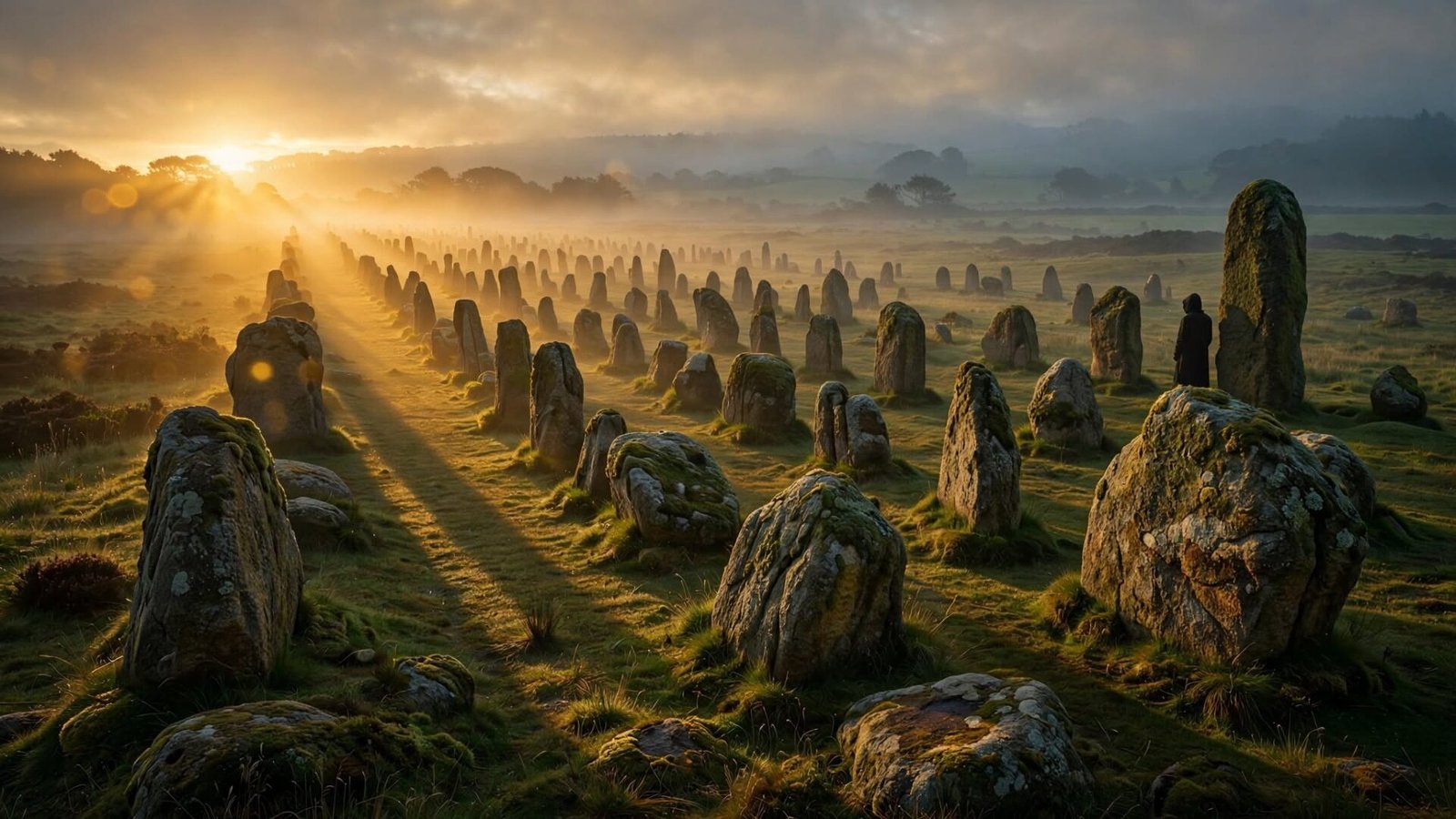
Take a train west from Paris to the coast of Brittany, then go all the way down to the small town of Carnac. Get out of the car and go searching. Then keep looking, because what you are looking at goes on for a very long time.
More than 3,000 standing stones stretch across the landscape for over ten kilometers, arranged in parallel rows so precise that they have, over the centuries, generated more crackpot theories than almost any site in Europe. Alien architects. Atlantean refugees. Ley lines. The Bretons themselves have a more entertaining explanation: a Roman army, turned to stone by the wizard Merlin, still standing at attention for eternity. At least that one has narrative flair.
The mundane truth is in some ways more extraordinary than any of those theories. In 2025, a team of French and Swedish archaeologists published the results of a rescue excavation at a previously unknown part of the Carnac complex called Le Plasker. Using radiocarbon dating on nearly fifty samples, they established that at least one section of these alignments was built between 4,600 and 4,300 BC. That is more than six thousand years ago. It makes Carnac not just old but possibly the oldest megalithic monument complex in the whole of Europe—older than Stonehenge by over a thousand years, older than the Egyptian pyramids, and older than most things people think of when they think of ancient history.
The researchers also found cooking pits alongside the stone foundations. Charcoal analysis ruled out grain processing. What they found instead pointed to communal feasting—people gathering, eating together, and sharing food as these enormous stones went up around them. That detail somehow makes the whole thing feel more real. Less monument, more event. Less of an ancient construction project, more something people actually celebrated.

Who organised it? Nobody knows. Moving stones of this size—some weigh several tonnes—across a landscape without wheels, without metal tools, and without draught animals capable of that kind of load requires coordinated effort on a scale that implies genuine social structure. Someone had authority. Someone drew plans, or at least held them in their head. Someone decided where each stone went and why the tallest ones stand at the western end while smaller ones trail off to the east. That decision was deliberate. The reasoning behind it has not survived.
Carnac was inscribed on the UNESCO World Heritage List in 2025; that is long past due for a website of this importance. Even now, with drones mapping previously buried stones underneath the soil, archaeologists admit the website online is way larger than all of us formerly understood. What else is down there is anybody’s guess.
The People Who Remembered Everything (And Then Forgot)
By the last few centuries before Rome arrived, France was Gaul—a patchwork of Celtic tribes with their own cities, trade routes, coinage, and art. At the top of that society sat a class of priestly scholars who held the entire civilization’s knowledge inside their own heads.
The Druids. People have been romanticising or mocking them for two thousand years, which makes getting at the actual truth difficult. Everything we know comes filtered through Roman writers who were, at the time, in the middle of destroying them. Caesar noted that Druid training took up to twenty years. Young Gaulish nobles memorized vast bodies of law, history, cosmology, and natural science through oral recitation—deliberately, as a matter of principle. Writing was available to them; they chose not to use it, because written knowledge made memory lazy.
When Rome dismantled Druidic culture, the knowledge simply ended. No library to burn. Everything held in human minds died with the people who carried it. We recognize they valued mistletoe and oak, amassed in sacred forest clearings near what’s now Chartres believed in something corresponding to reincarnation. We recognize they served concurrently as judges, doctors, astronomers, and political advisors. Beyond that, the record goes quiet.
A British writer named Graham Robb spent years cycling across France, mapping old Gaulish roads, and argued that the Gauls had orientated their entire territorial organization along solar geometry—alignments with the solstice sun stretching across hundreds of kilometers. Whether that specific thesis survives full scrutiny or not, the wider point is worth sitting with: we have constantly underestimated those humans, and the Romans had every incentive to inspire that underestimation.

What the Soil Still Keeps
Below modern France—beneath mediaeval cellars and Roman foundations—some things haven’t been properly excavated or understood. Burgundy and the Loire Valley have underground galleries, a few herbal and some virtually formed by human hands, with functions still long debated.
At Alesia, where the Gaulish chieftain Vercingetorix made his final stand in opposition to Caesar in 52 BC, the archaeological layers pass deeper than the famous siege. Beneath the Gallic walls, beneath the Roman fortifications, there are traces of occupation that predate both. France has been lived in for so long that its soil is less ground and more compressed time.
Archaeology here keeps producing surprises. A cave is redated and turns out to be older than thought. Drone surveys at Carnac in 2026 found buried stones that nobody knew were there. A hill opens up to reveal a structure that changes the assumed sequence of occupation. Each discovery nudges the story further back and makes the familiar version—Rome arrived, and then history began—feel more like a convenience than a truth.
France before Rome was not a blank page waiting to be written on. It was already full. Most of what was written there we cannot read yet. Some of it, if archaeology keeps moving at the pace it has been, we still might find.
Somewhere within the French geographical region, likely inside a few kilometers of wherever you show up to be standing, the floor holds something antique. Something placed, painted, or built by those who had their own sense of what mattered and why. We have not figured out how to hear them clearly yet. But they are still down there, still waiting.



+ There are no comments
Add yours