


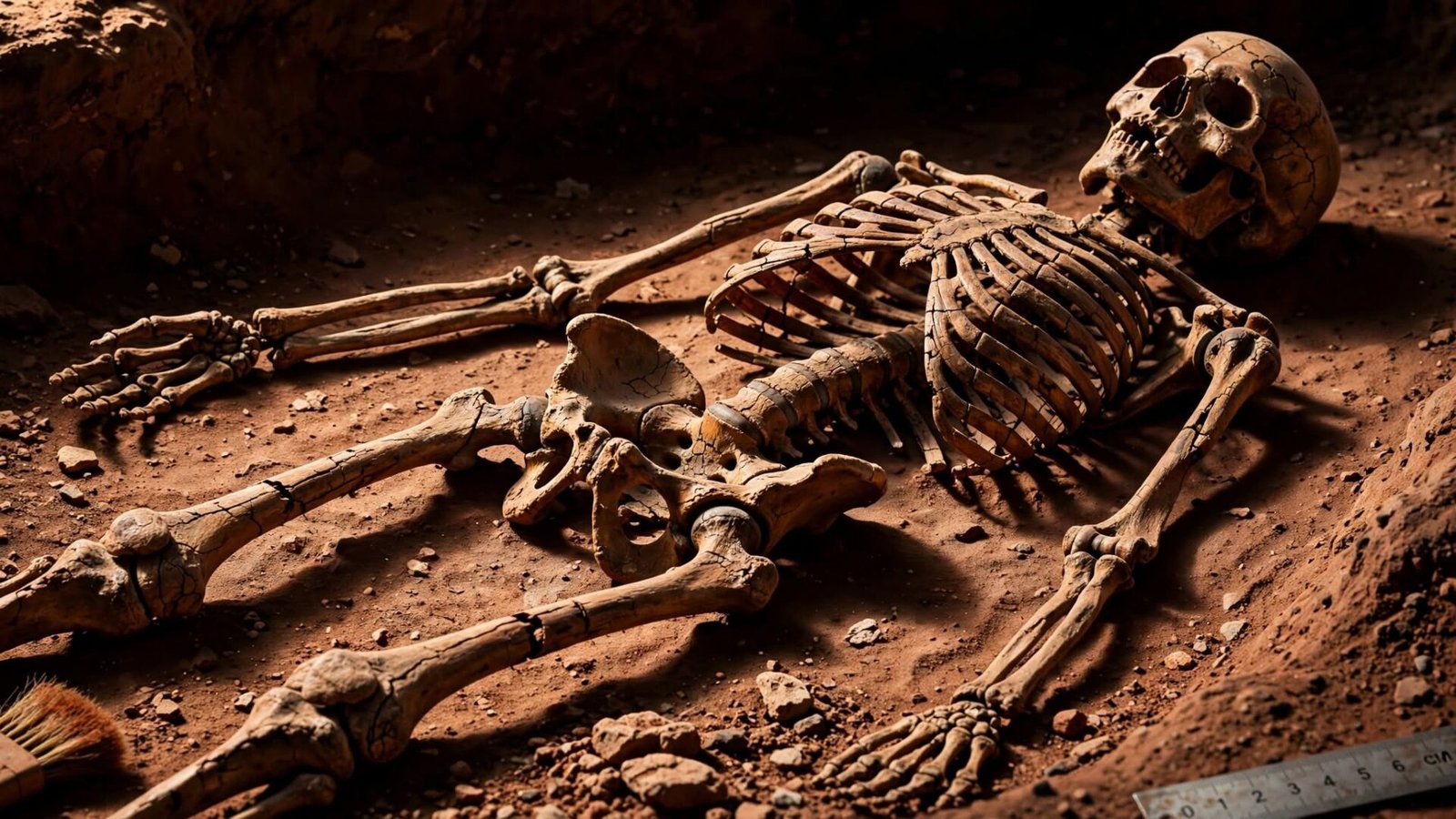
There’s a version of ancient history that a lot of people carry around in their heads — mostly unconscious, probably absorbed from films and documentaries. Strong, lean people moving through clean landscapes. Hunting, gathering, sitting around fires. Hard, yes, but also free. Uncluttered. Almost romantic in a rugged sort of way.
The bones disagree.
When forensic anthropologists and bioarchaeologists actually pull ancient human remains out of the ground and spend weeks examining them under proper conditions — studying the density, the wear patterns, the healed fractures, the diseases written permanently into calcium and collagen — what they find is something considerably less cinematic. Ancient life, 10,000 years ago and in the millennia immediately surrounding it, was a sustained physical ordeal that most modern humans would struggle to last a month inside.
This is what the bones actually say.

The Body Keeps the Score—Even Across Ten Millennia
Bones are not just structural. They’re a record. Every significant thing that happens to a body — every injury, every period of starvation, every chronic infection, every repetitive physical stress — leaves a mark that persists long after the flesh is gone. Bioarchaeologists have spent decades learning to read these marks, and the field has produced some findings that are genuinely arresting.
Start with something as basic as height. Skeletal remains from early Neolithic populations — roughly 10,000 to 7,000 years ago, when humans were transitioning from nomadic foraging to settled agriculture — consistently show a reduction in average stature compared to their hunter-gatherer predecessors. Men who had previously averaged around 5 feet 9 inches dropped toward 5 feet 5 inches. Women shrank proportionally. This wasn’t genetics. It was nutrition. Specifically, it was the consequence of relying on a narrower range of crops — primarily grains — that provided calories but lacked the protein diversity of a varied foraging diet.
The bones show this in another way, too: Harris lines. These are thin bands of denser bone visible on X-ray, formed when growth temporarily stops during periods of illness or malnutrition and then restarts. Finding one Harris line in a child’s skeleton means one serious illness or food shortage. Finding multiple means a childhood defined by recurring crisis. They are extremely common in ancient remains. Not rare. Common.
What the Joints Say About Daily Labour
In 2025, archaeologists in the Czech Republic published findings from a Neolithic flint mine — specifically the skeletal remains of two women, likely sisters, buried together in one of the mine shafts where they had worked. Both were between 30 and 40 years old. Their bones told a story that made the research team’s report notably careful and clinical, the way academic language gets when the underlying reality is uncomfortable.
Worn vertebrae. Herniated discs. Early-onset arthritis throughout the joints. A partially healed fracture in the older sister’s forearm — the kind of injury that happens once from acute force, not from gradual wear. And crucially, the fracture showed signs of healing, meaning she had continued working through it. Not after recovery. Through it.
This is not unusual in ancient skeletal records. It’s the norm. Research reviewing remains from the British Isles found an extremely high prevalence of osteoarthritis in Romano-British and Saxon burials, suggesting that whatever genetic factors may have existed, there was an extraordinarily high level of sustained physical activity. The same pattern holds far earlier. Joint degeneration found in skeletons from 10,000 years ago looks, in many cases, like what a modern orthopaedic surgeon would expect to find in a 70-year-old manual labourer — except the skeleton belonged to someone in their early thirties.

Analysis of 10,000-year-old hunter-gatherer remains in Brazil found that initial examination of the bones indicated individuals involved in strenuous physical activities, evidenced by bone marks showing load-bearing stress and extensive muscular development. These weren’t people who occasionally worked hard. These were bodies that had never stopped working from the time they were old enough to carry something.
Violence Was Not Occasional. It Was Structural.
The romantic version of ancient life tends to treat violence as episodic — the dramatic hunt, the rare raid, the exceptional conflict. The skeletal record suggests something different: that violence, both interpersonal and between groups, was woven into the fabric of daily existence in ways that left permanent marks on a significant proportion of any given population.
At Nataruk in Kenya’s Turkana Basin, researchers found the skeletons of 27 people who died approximately 10,000 years ago bearing marks of blunt force trauma and projectile wounds. The victims included men, women, and children. “That scale of death can’t be an individual murder or homicide amongst families,” said study co-author Robert Foley of the University of Cambridge. “It was a result of some intergroup conflict.”
This site is not an anomaly. Skeletal remains from Jebel Sahaba in Sudan, at least 13,400 years old, show evidence of both healed and fatal trauma, with researchers suggesting the violence stemmed from territorial disputes arising from environmental pressures and climatic instability.
What’s particularly striking is the healed trauma — the wounds that didn’t kill. At a Late Neolithic site in Spain, systematic examination of 338 individuals identified 65 unhealed and 89 healed traumatic injuries consistent with aggression, affecting nearly a quarter of the total population. Among adult males, almost 45% showed evidence of violent injury.
Nearly half the men. Let that settle for a moment. Nearly half of the adult male population at this site had, at some point in their lives, sustained an injury consistent with being attacked. This was not an extraordinary community. Evidence like this appears repeatedly, across continents, across time periods.
Childhood Was the Most Dangerous Part
One of the more quietly devastating things that ancient remains reveal is how many people never made it to adulthood — and how hard the early years were for those who did.
Infant and child mortality in pre-agricultural and early agricultural populations was staggering by modern standards. Estimates vary by site and period, but researchers consistently find that between 30 and 50 per cent of individuals in ancient burial populations were under the age of 15. Many died in infancy. The causes written into tiny bones include malnutrition, infection, and the compounding effects of both together — a sick child who can’t eat properly becomes sicker, in a cycle that ancient medicine had essentially no tools to interrupt.
At Poulnabrone on the west coast of Ireland, archaeologists found the skeleton of a baby with Down syndrome who died nearly 4,000 years ago — the oldest confirmed case of the condition. In prehistoric Vietnam, signs of malnutrition in the bones of people buried near a disabled individual suggested famine was a constant threat to the entire community.
Disease didn’t wait for children to grow up, either. Examination of 71 individuals from a 7,000-year-old Neolithic site in Hungary revealed numerous cases of infections, non-specific stress indicators in both juveniles and adults, metabolic diseases in juveniles, and evidence of trauma and mechanical changes in adults. Tuberculosis has been confirmed in remains this old through ancient DNA analysis. Parasitic infections — pinworms, intestinal worms, and flukes — have been identified through soil samples taken from around skeletal remains, including a 7,000-year-old female skeleton found beneath a street in Tehran.
These weren’t exotic diseases of the ancient world. They were routine. Background noise in a life already running at a deficit.
They Operated on Each Other—Without Anaesthesia
Perhaps the most startling finding that comes out of the bioarchaeological record is how sophisticated — and how brutal — ancient surgical practice was, born of sheer necessity.
The prevailing view has been that the emergence of settled agricultural societies around 10,000 years ago gave rise to health problems that stimulated the first major innovations in prehistoric medical practices, including the development of more advanced surgical procedures.
Trepanation — drilling or scraping holes into a living person’s skull — has been documented at Neolithic sites across France, and some of the oldest examples, from Morocco, date to around 11,000–12,000 years ago. Signs that skull wounds were healing indicate that a fair proportion of patients actually survived the operation. Think about what that means for a moment. No anaesthesia beyond whatever plant medicines they had access to. No sterile environment. No understanding of infection in any modern sense. And yet people survived it — which means the alternative (whatever was happening inside the skull) was worse.
Limb amputations have been confirmed from the Neolithic period. A 31,000-year-old skeleton found in Borneo showed a surgically amputated lower leg that had subsequently healed — meaning the individual lived for years after losing the limb. These weren’t accidental removals. They were deliberate procedures performed by people who had developed real surgical knowledge through painful trial and error on patients who had no choice but to endure whatever came next.

What the Bones Don’t Tell You
There’s a limit to what skeletal remains reveal, and it matters to acknowledge it. Bones can’t show grief. They can’t show humour, or love, or the particular texture of belonging to a small group of people in a large and indifferent landscape. They can’t show the warmth of a fire or what it felt like to successfully bring down something large enough to feed everyone for three days.
What they can show — and what they show consistently, across site after site, continent after continent, millennium after millennium — is that the bodies of ancient people were under sustained, serious, unrelenting stress. Physical stress. Nutritional stress. The stress of violence, of disease, of work that never stopped.
And yet archaeologist Lorna Tilley, who developed what she calls the “bioarchaeology of care”, has found that even in these brutally stressed communities, disabled individuals were supported and kept alive by others. “That tells us people mattered,” she says. “They were valued.”
That might be the most important thing the bones say. Not just that life was hard — we already suspected that. But that even inside that hardness, even when resources were desperately thin, and survival was genuinely uncertain, people took care of each other anyway.
The difficulty was real. So was the humanity.
The field of bioarchaeology continues to expand rapidly as ancient DNA analysis and isotopic testing give researchers tools their predecessors didn’t have. Sites currently under excavation in East Africa, the Levant, and South Asia are expected to significantly update our picture of early human health and daily struggle over the next decade.



+ There are no comments
Add yours