


Nobody was looking for a tomb that morning.
A crew of workers had shown up before sunrise to cut a drainage trench through the hard soil outside a neighbourhood in Oaxaca. Boring work. The kind where you move dirt for hours and think about lunch. Somewhere around mid-morning, a shovel cracked against something solid — a flat stone slab that didn’t belong there. One of the workers crouched down. Pushed soil aside. And peered into a gap of darkness that had been sealed shut for roughly fourteen hundred years.
Archaeologists got the call. And then everything changed.
A Civilization Most People Have Never Heard Of
Here’s something that also irritates me on every occasion I reflect on consideration of it: you can stroll into most bookshops, pull a book about historical civilisations off the shelf, and discover a slightly paragraph at the Zapotec. Maybe an image of Monte Albán tucked among chapters on the Maya and the Aztec. Maybe nothing at all.
And yet the Zapotec were extraordinary.
They built Monte Albán — one of the earliest proper cities anywhere in the Americas — around 500 BCE. Let that date sink in. This became more or less a thousand years before the Aztec Empire existed. Five centuries earlier than the upward push of Teotihuacan. The Zapotec had a functioning town with formal structure, a writing system, a 365-day calendar, and a political structure sophisticated enough to preserve together for centuries, all at the same time as Europe changed into itself, nevertheless figuring itself out.
At their peak—somewhere between one hundred CE and seven-hundred CE—Monte Albán had a population expected at somewhere between 15,000 and 25,000 human beings. That’s not a village. That’s an urban centre with neighbourhoods, craft specialists, priests, administrators, markets, and presumably all the petty social dramas that come with living that close to other people.

They traded across vast distances. They built astronomical alignments into their architecture. They maintained a rich religious life that we are still, only now, beginning to properly decode.
So why do people know more about the Aztec, who came much later, than the Zapotec, who built the foundation those later cultures stood on?
Partly it’s the Spanish conquest — the conquistadors wrote obsessively about the Aztec, since that’s who they destroyed most visibly. Partly it’s that Monte Albán, for all its grandeur, sits tucked away in the Oaxacan hills, less accessible than Teotihuacan outside Mexico City. And partly, honestly, it’s just the randomness of which cultures get champions — scholars, writers, documentarians — willing to shout about them.
The Owl Lord’s tomb is one of those moments where the Zapotec finally get to shout for themselves.
What Was Inside the Chamber
The burial dates to approximately 600–700 CE. That’s late in the Zapotec story — Monte Albán was already past its peak population, entering a long, slow decline that wouldn’t fully resolve for another century or two. But it was still the beating heart of the Oaxaca Valley. Still the place where power lived.
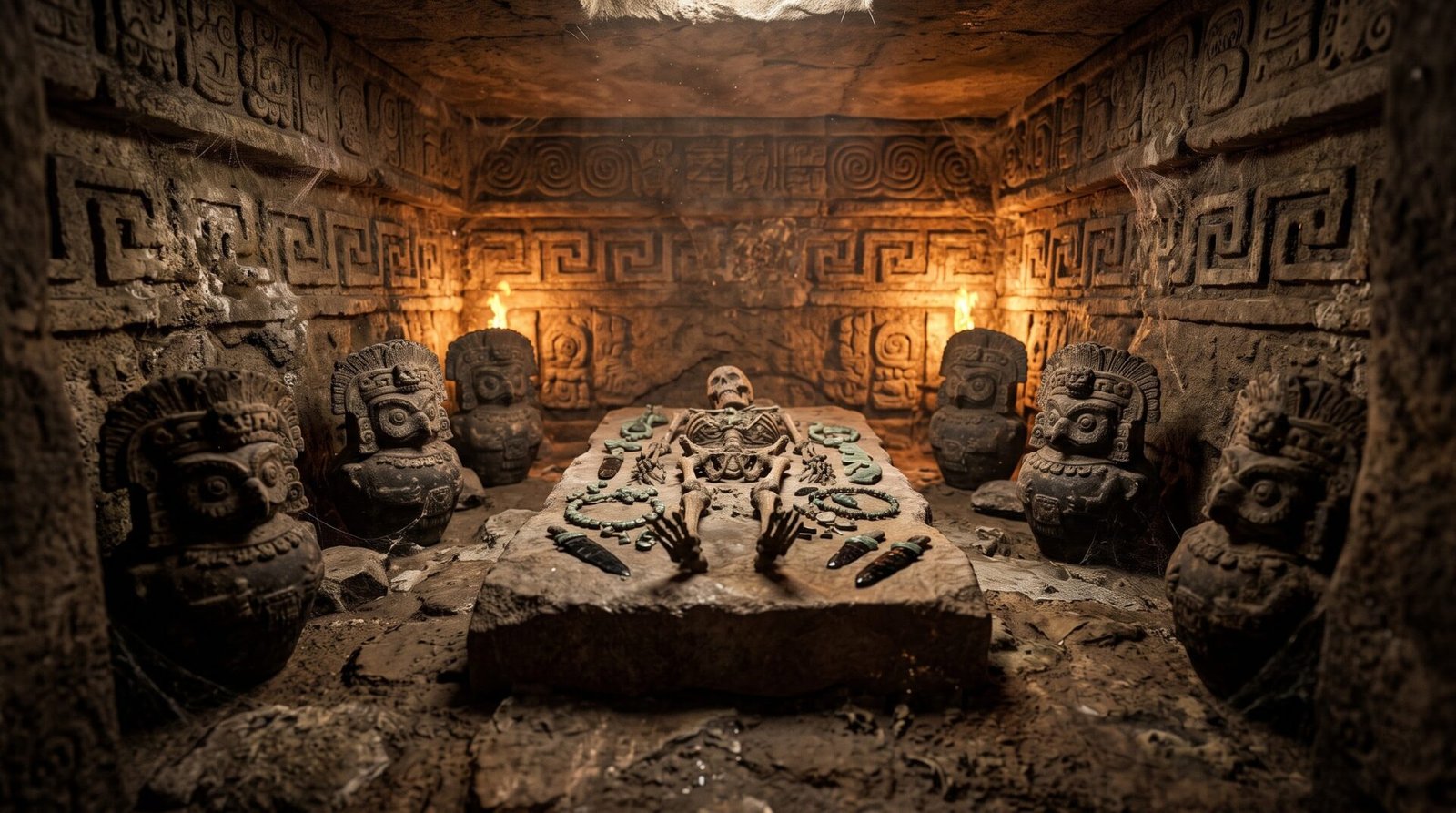
The tomb itself was a stone-lined chamber. Not a pit, not a simple hole in the ground. A constructed room with cut-stone walls, built to last — because the Zapotec fully intended it to be used more than once. We’ll come back to that.
Inside, archaeologists documented:
A primary male burial. A man, probably somewhere in his forties or fifties. His age wasn’t recorded anywhere on a piece of paper — it was written in his teeth, worn flat by decades of food that wasn’t especially soft, and in his bones, which had begun showing the density changes that come with a longer life. He was laid on his back, arms straight at his sides, face orientated directly toward the tomb’s entrance. Deliberate. Intentional.
Around him: large ceramic urns, multiple of them, all decorated with owl imagery. Not painted on casually. Sculpted, detailed, careful — the faces of owls staring out from clay with wide circular eyes and stylised feathers. These weren’t decorative. They were a theological statement.
Scattered through the burial: obsidian blades. Some of them still held an edge sharp enough that researchers handling them without care got cut. The obsidian came from somewhere far north — volcanic deposits that required significant trade connections to access. Alongside those, jade ornaments. The jade came from Guatemala. That’s not a short trip. The presence of these materials isn’t coincidental. It tells you something specific about who this man was.
Then there were the secondary burials.
The Part That Rewrites How We Think About This
Most people hear “burial” and picture something linear. A person dies and goes in the ground; that’s it.
The Zapotec elite had a completely different relationship with their dead. For them, a stone tomb wasn’t an ending — it was more like a room in the family home that happened to be underground. They built these chambers with the explicit expectation of coming back. The entrance was designed to be reopened. The interior had enough space to accommodate more arrivals over time.
Secondary burials — where bones from an earlier interment are moved aside, rearranged, and sometimes bundled together to free up space — appear consistently in elite Zapotec tombs. The Owl Lord’s chamber showed exactly this. Remains of at least one other individual had been added after the primary burial, with the original bones carefully repositioned rather than simply pushed out of the way.
The family came back. They brought offerings. They may have spoken to their dead, or performed rituals, or simply sat in the dark with their ancestors during particular ceremonial dates. The dead weren’t gone. They were present in a different way — relocated, not lost.

If you’ve spent any time reading about ancient burial customs (and if you’ve seen our piece on what ancient skeletons tell us about how our ancestors really lived, you’ll know this theme runs through cultures separated by thousands of miles and years) — this pattern keeps appearing. The Neolithic people who built megalithic tombs in western Europe did something similar. Certain cultures in Southeast Asia maintained this relationship with ancestral remains for generations. It’s not bizarre. It’s actually a very human response to loss: the refusal to make it permanent.
So why the Owls?
The owl imagery in Zapotec burial culture isn’t symbolic shorthand for “this person died”. It’s more specific than that.
In Zapotec religion, owls were associated with Pitao Pezalao — a deity governing death, the underworld, and the movement of souls from one state to another. The owl wasn’t a mascot for death in general; it represented the moment of crossing. The threshold. The liminal space between living and not-living.
Finding multiple large urns with owl faces inside a single tomb is significant. It suggests that the person buried there had more than a passing relationship with this deity. He was someone whose identity — in life, in death, in memory — was entangled with the ritual management of that crossing.
Was he a priest? A shaman? Some kind of death-specialist whose role was to manage the boundary between the living and the dead on behalf of his community?
We don’t know for certain. But the excavation team, half-jokingly at first and then with genuine conviction, started calling him the Owl Lord. It stuck. Because it’s probably right in some essential way.
Researchers have noted similar patterns in Maya elite burials, where certain high-status individuals were buried with consistent jaguar imagery — what scholars call “jaguar lords” — suggesting their public identity in life was bound to a particular animal’s symbolism. The logic runs across Mesoamerica: powerful animals carried divine attributes, and powerful people could claim those attributes as their own. The Owl Lord claimed death itself. Which is either a grim choice or the ultimate power move, depending on your perspective.
Monte Albán and the Science Built Into Stone
I want to stop here and say something about Monte Albán itself that rarely gets enough attention.
The site wasn’t placed on that mountaintop because it was convenient. It was obviously inconvenient — the Zapotec had to completely rework the natural topography of the hill, flattening the summit artificially to create the massive open plaza that still exists there today. They hauled enormous quantities of stone and fill up a steep slope to do it. That’s not pragmatic city planning. That’s a deliberate, costly, symbolic choice.
From that mountaintop, they could see three separate valleys converging below. They could see for enormous distances in every direction. And — critically — they built their structures in alignment with specific astronomical events. The rising of certain stars that signalled agricultural seasons. The positions of Venus. Buildings that cast shadows in precise patterns on particular days of the year.
This was a city that functioned as a scientific instrument.
It’s worth placing that alongside something I wrote about previously when discussing the ancient city of Caral in Peru. Caral, which dates to around 2600 BCE — making it the oldest regarded city inside the Americas — also emerged without contact with Old World civilisations. Also constructed an enormous structure. Also confirmed evidence of sophisticated social organisation and lengthy-distance alternate, some distance in advance than mainstream textbooks had assumed, became viable in the vicinity.
The parallel is uncomfortable for those who like their records neat. Both Caral and Monte Albán challenge the assumption that genuine urban sophistication could only emerge in certain parts of the world, on a certain timeline. The Zapotec, like the Norte Chico people of Caral before them, built something remarkable entirely on their own terms — and both have been persistently underrepresented in the histories we teach.

Reading Power Through Grave Goods
Here’s a thought experiment: imagine a historian a thousand years from now excavating a modern cemetery and trying to figure out social class from what people were buried with.
That’s basically what archaeologists do with ancient burials. And elite tombs like this one are especially legible.
The jade in the Owl Lord’s chamber came from Guatemala. The obsidian came from distant volcanic deposits. Both required trade relationships, political connections, and real economic muscle to acquire. These weren’t things an ordinary Zapotec family could go purchase. They were the kind of goods that flowed through elite networks — gifted, traded, accumulated as markers of status over a lifetime.
The ceramic urns required skilled labor. Someone had to spend significant time crafting objects that would be placed in a tomb and sealed away. The community mobilized real resources — time, materials, specialized skills — to put this man into the ground correctly.
That might reflect genuine love and reverence. It might reflect political calculation — someone in power staging a spectacular burial to consolidate influence. It might be both. These things usually are.
What it definitely reflects is that this man was not on the margins of Zapotec society. He was somewhere near its center.
Why This Still Matters, Right Now
The Oaxacan hills are still giving things up.
Excavations have accelerated across the region in recent years, and with every new season of fieldwork, the picture of Zapotec civilization gets more detailed, more specific, more human. We’re moving away from the abstract (“they had a calendar, they built pyramids”) toward the granular (“this specific man, with this specific status, was buried by people who came back to visit him for generations”).
The Owl Lord’s tomb isn’t the most visually dramatic discovery ever made in Mexico. It won’t make the cover of every magazine the way a pharaoh’s death mask does. But in some ways, that’s the point. It’s not the king. It’s not the poorest person in the valley. It’s someone in the complicated middle of a real society — managing power, performing ritual, maintaining the intricate social contracts that keep a civilization running.
Those are the people history usually forgets. The ones who weren’t quite important enough to be commemorated in official records, but too important to be buried without ceremony.
Researchers are now trying to determine, through ancient DNA analysis, whether the secondary burials in the Owl Lord’s chamber were biological family members or ritual associates — priests, perhaps, or individuals who were meant to accompany him for religious reasons. The answer will change how we interpret the whole chamber.
Until then, the bones sit carefully catalogued. Every layer of soil mapped. Every fragment of ceramic measured and photographed.

One Last Thing
Fourteen hundred years is a long time.
Long enough for empires to rise and collapse. For languages to die. For the people who built Monte Albán to be conquered, converted, dispersed, and folded into a history that barely remembered them.
And yet there is something almost stubborn about this tomb. It was sealed, and it waited. The darkness inside it held — for longer than most nations have existed — the evidence of a life that mattered to someone. A man who was powerful enough to be buried with objects from two countries. He was associated, in some ritual or priestly way, with the Zapotec concept of death itself. He was placed in a room his family could return to, and probably did, for as long as the civilization held together.
Death wasn’t an ending for the Zapotec. It was, as I said earlier, a renegotiation. The Owl Lord moved into a different kind of presence.
The drainage workers cracked open that slab, and he stepped back into ours.
There are more tombs under those red hills. More people waiting to be remembered. Archaeology is slow, painstaking work — nothing like what movies suggest — but every season in Oaxaca brings the Zapotec a little closer to the place in history they always deserved.
We’re only just beginning to listen.



+ There are no comments
Add yours