


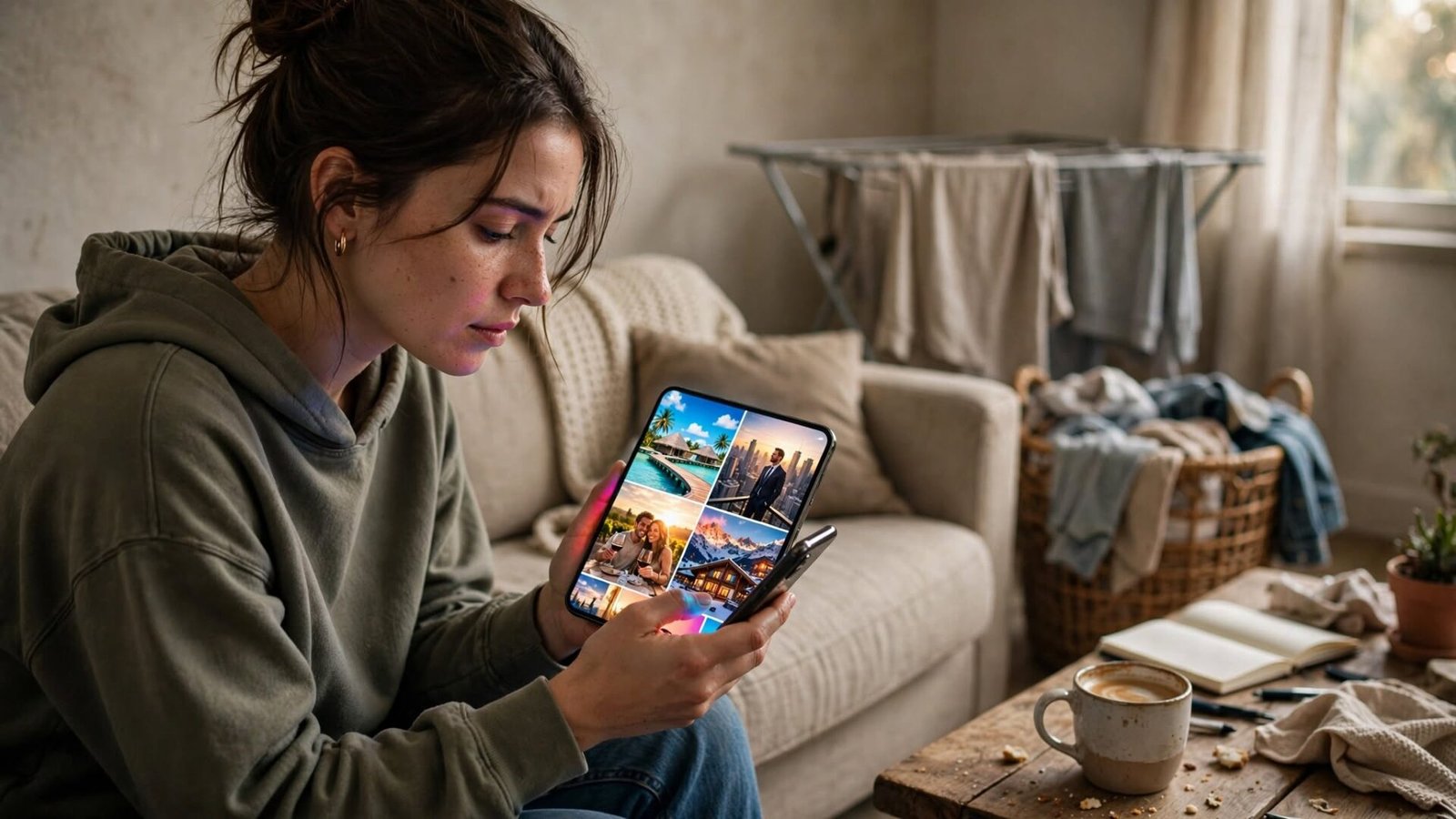
There’s a specific kind of bad feeling that hits at around 11 pm on a Tuesday.
You’re lying in bed; there’s nothing particularly wrong with your day. You had lunch. You did some work. You watched something forgettable. And then, for reasons you couldn’t fully explain even if someone asked, you picked up your phone and spent twenty minutes scrolling through the life of someone you went to college with, or used to work with, or don’t even really know — just a face attached to a name attached to a series of photos that all seem to have been taken in places you’ve never been, wearing things you don’t own, next to people who look genuinely delighted to exist.
And now you feel worse. Not dramatically worse. Just that quiet, grey, slightly hollow feeling. Like something fine an hour ago has been quietly reclassified as not enough.
You didn’t do anything wrong, exactly. You just looked. But looking, in this particular way, has a way of doing something strange to the mind — making your ordinary life feel thinner than it actually is, measured against someone else’s curated collection of best moments.
This is what social comparison does when it goes wrong. And it almost always goes wrong, because it’s structurally rigged against you from the start.

The Game Was Never Fair
Here’s what nobody says plainly enough: you are comparing everything you know about yourself against everything someone else has chosen to show.
You know your 3 am doubts. You know the argument you had last week that you still feel bad about. You know the ambitions you’ve quietly shelved, the days where getting off the couch felt like a genuine achievement, the version of yourself that exists when no one’s watching. You know all of it — the whole unedited footage.
And you’re measuring that against a stranger’s highlight reel. Their wedding photos but not the months of tension that preceded them. Their promotion announcement but not the three years of quiet professional misery that preceded that. Their vacation pictures but not the credit card statement that followed. Their smiling family portrait but not the drive home afterward when everyone was tired and irritable and someone cried over something small.
The comparison is structurally false from the first frame. You’d have to be deliberately irrational to look at your blooper reel and someone else’s showreel and conclude you’re losing.
And yet we do it constantly. Because the brain wasn’t built to understand curated media. It was built to read social information as real. When it sees someone thriving, it files that under “this person has something you don’t”. It doesn’t add a footnote that says “based on two photos and a caption”.
Why You Can’t Just Think Your Way Out of It
The first thing most people try is to reason their way out of comparison. To remind themselves that social media is fake, that everyone’s struggling, and that nobody’s life is actually like that.
All true. Also largely useless, at least in the moment it’s needed most.
The problem isn’t information. You already know their life isn’t perfect. Knowing that doesn’t make the feeling go away, the same way knowing intellectually that you shouldn’t be afraid of something doesn’t stop your pulse from jumping. These aren’t rational responses. They’re not waiting around to be corrected by facts.
What actually moves the needle isn’t better arguments. It’s different inputs.

The Comparison Isn’t Really About Them
Something worth sitting with: the thing you feel when you look at someone else’s apparent success is rarely really about them.
What it’s actually about is the gap between where you are and where you thought you’d be by now. The other person’s Instagram just happened to be the mirror you picked up. You could’ve picked up a different one — a different person’s feed, a different moment of someone else’s life — and landed on the same feeling, because the feeling was already there, waiting.
What’s uncomfortable about comparison isn’t the other person. It’s the question they accidentally trigger: am I on track? Am I doing enough? Am I becoming the person I wanted to become?
Those are real questions. They deserve real attention. But looking at someone else’s carefully assembled public persona is one of the least useful ways to try to answer them. It’s like trying to figure out if your house is structurally sound by looking at your neighbour’s paint job.
What Helps—Actually Helps
Redirect the comparison inward.
The instinct to compare isn’t itself the problem. Comparison is how humans calibrate — it’s ancient and mostly useful. What wrecks it is the direction. Sideways comparison, measuring yourself against someone else, is mostly noise. Backward comparison — measuring yourself against where you were a year ago, two years ago, or five years ago — is actually a signal.
A year ago, were you handling a particular kind of situation as well as you handle it now? Have you built anything, learnt anything, or let go of anything that was holding you back? Even incremental growth looks significant when the baseline is your past self rather than someone else’s present.
This is slower and less dramatic than scrolling through someone’s life. It requires actually remembering where you started, which takes effort. But it’s orientated toward something real rather than something performed.
Get off the phone before you know why you picked it up.
Most comparison spirals start not with intent but with boredom. The phone goes up, the thumb starts moving, and the mind follows wherever the feed takes it — which is almost always toward the people having the most visually striking time.
The intervention that works isn’t willpower after you’re already scrolling. It’s building a tiny gap between the impulse and the action. When your hand reaches for the phone without a specific reason, notice that. Ask what you actually want — information? Entertainment? Connection? Then go get that thing directly, rather than letting the algorithm decide what version of the world you’re about to look at.
It sounds minor. It changes the texture of an evening considerably.
Spend more time with people who let you see the full picture.
One of the things that makes social media comparison so corrosive is that it doesn’t look like anything real people experience. It’s all peaks, no valleys. And when that’s your primary diet of other people’s lives, ordinary life — the in-between stuff, the Tuesday afternoons, the quietly fine days — starts to feel like failure by contrast.

The antidote to curated peaks is actual relationships. Talking to a friend long enough that the conversation gets real. Hearing someone describe their week in a way that includes the boring parts, the frustrated parts, and the parts where they weren’t sure they were doing anything right. That’s calibrating information. That’s the full picture.
It doesn’t make your life better on paper. But it makes it feel less like you’re the only person living in the non-highlight version of existence.
When comparison shows up, get curious about what it’s pointing at.
Instead of fighting the feeling or trying to shame yourself out of it, try treating it like an indicator light rather than a verdict. When you notice the comparison spiral starting — when you feel that particular grey deflation looking at someone else’s life — pause and ask: what specifically is bothering me here? What do I actually want that I think they have?
Sometimes it’s something genuinely meaningful. You want more connection. You want work that feels purposeful. You want to feel at home in your body. These are worth knowing. They’re data.
Sometimes it’s something that, once you look at it directly, dissolves almost immediately. You didn’t really want their life. You wanted to feel like your life was moving. Those are different problems with different solutions.
Either way, getting specific takes the power out of the vague, uncomfortable feeling. It stops being a fog that makes everything look bad and becomes an actual question you can think about.
The Harder Admission
Here’s the part that’s a little uncomfortable to say, but I think it matters.
Sometimes the comparison feels bad not because your life is lacking, but because you’ve been coasting in ways you know about. You haven’t made the call. You’ve been putting off the thing. You’ve been comfortable in a way that’s started to feel less like contentment and more like avoidance.
When that’s true, looking at someone else’s apparent momentum doesn’t just trigger insecurity. It triggers something more honest — a recognition that you’ve been a little asleep and that you’d prefer to be more awake.
That feeling is not pleasant. It’s also not the enemy. Used right, it’s the most useful discomfort available. Not because you should want their life or measure yours against theirs, but because the feeling briefly turns up the volume on something your own life has been trying to say quietly.
The solution, in that case, isn’t to spend less time on Instagram. It’s to move on from the thing you’ve been sitting on.

Your Life Isn’t a Draft
There’s a version of this problem that doesn’t get talked about enough — the sense that your real life is the rough draft and that somewhere out there, other people are already living the final version.
They’re not. Nobody is.
Everyone is figuring it out mid-flight. Everyone has a Tuesday night that looks nothing like their Instagram. The person whose life looks most finished from the outside is, in private, probably navigating something they haven’t posted about. Not performing struggle — genuinely living it.
Your life as it is right now, the specific shape of it, the half-built parts and the quiet parts and the parts that haven’t resolved yet — this isn’t the waiting room. This is the thing.
You don’t get a do-over where you start fresh from a better baseline. You get this now, and you do it with it. That’s both less dramatic and considerably more urgent than the highlight reel comparison ever let you believe.
The goal was never to match someone else’s visible moments. It was to actually be present for your own.
Put the phone down. Go do that.
The life you keep comparing to other people’s is the only one you’re ever going to get. Make it worth looking at — not for them, but for you.



[…] 7 seconds ago […]