


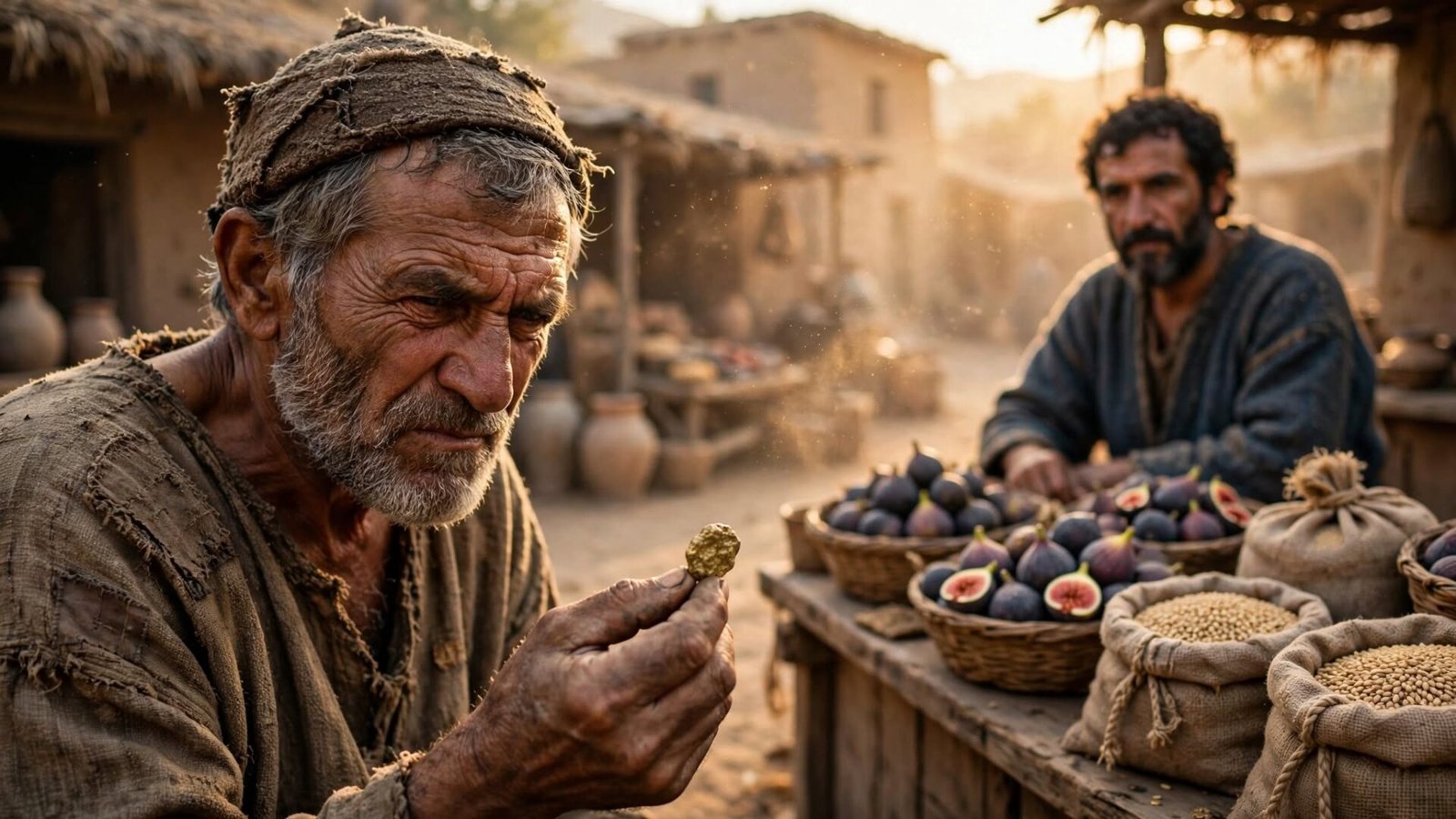
Imagine a farmer in western Anatolia, somewhere around 600 BCE. He’s at the market with a basket of figs and a sack of barley, the same as his father and grandfather before him. Then a stranger at the next stall holds out a small, lumpy bit of pale metal with a lion’s head stamped on it. “Figs for this,” he says.
Would you take it?
Most of us assume the farmer grabbed it with both hands. That’s what school taught us: barter was a headache, coins were the cure, and everyone happily moved on. It makes for a tidy story. It also happens to be mostly wrong. When coins first showed up, plenty of ordinary people squinted at them, bit them, argued about them, and went home unconvinced.

The Story We All Learned in School
The textbook version goes back to Adam Smith. In 1776, he argued that trade began with swapping and that money was invented to fix the problems of swapping. His example is easy to picture. You’ve got a spare goat, and you need shoes. The cobbler doesn’t want a goat; he wants wheat. So you’re stuck. Economists call this the “double coincidence of wants,” and the idea is that people got so sick of it that they settled on one item everybody would accept.
Sounds sensible, right? There’s just one snag. Nobody has ever found a society where this actually happened.
The anthropologist Caroline Humphrey went looking in the 1980s and said she couldn’t find a single documented case of a pure barter economy. David Graeber later made the same point famously in Debt: The First 5,000 Years. His argument was simple. Small communities weren’t full of strangers haggling over goats. They were full of neighbors. If your roof leaked, people showed up to fix it. If your harvest was thin, someone lent you grain. Nobody wrote it down, but everybody remembered, and the favors evened out over years. It was credit, just kept in people’s heads instead of on paper.
Barter did happen, of course. It just happened mostly between people who didn’t know each other, like travelers, traders from rival groups, or folks meeting at a border. And even then it was a bit tense, not a way of life.
That changes our question. If people weren’t drowning in barter and begging for a fix, why would they cheer for coins? Our farmer already had a system that worked. He didn’t need rescuing.
What People Used Before Coins Existed
Long before anyone struck a coin, people had plenty of ways to track value.
Some of the oldest records we have come from Mesopotamia, where officials pressed accounts into clay tablets. Barley was measured, silver was weighed, and everything was noted down. Here’s the interesting part: silver was often just a yardstick. A debt could be written in silver and paid off in barley after the harvest. Nobody was walking around with a purse full of it.
Elsewhere, people used whatever mattered most in their lives. Cattle were wealth across huge stretches of the ancient world, and language still remembers it. The Latin word for money, pecunia, comes from pecus, meaning cattle. Our word “fee” traces back to an Old English word for livestock. Early Indian texts also treat cattle as a standard measure, listing them as gifts, fines, and rewards.
Then there were cowrie shells, which got around more than most people ever did. China used them as far back as the Shang dynasty, and the old Chinese character for wealth still contains a shell. In parts of Africa and South Asia, cowries served as pocket change for thousands of years.
So coins didn’t arrive in an empty room. People already knew about credit, favors, and weighing silver and shells. A coin was one more option on a crowded shelf and a slightly suspicious one.

The Odd Little Coins of Lydia
The earliest coins we know of come from Lydia, in what is now western Turkey, around 600 BCE. They were made of electrum, a natural mix of gold and silver, and they weren’t much to look at. Small, bean-shaped, a bit lumpy, with a simple design punched in.
The Greek historian Herodotus, writing about two centuries later, says the Lydians were the first to strike gold and silver coins. He adds that they were also the first to run shops for profit. That wasn’t a compliment. To Herodotus, the Lydians were a strange lot who did everything backwards.
Here’s a detail I find fascinating: those early coins had no number on them. Nobody stamped “ten” or “twenty.” The stamp meant something else entirely: someone with authority made this, and you can trust the weight and quality. So what you were holding was really a promise. Its value rested on how much you believed the person behind it.
That’s a big ask of a farmer who has spent his life judging things with his own eyes and hands.
And here’s what most articles on this topic skip. We have almost nothing written by the ordinary people who first held these coins. Farmers and stall-keepers didn’t keep diaries about how they felt about currency. So historians work like detectives, piecing things together from laws, complaints, jokes, buried hoards, and the scratches left on the coins themselves. And the picture that comes out of those clues isn’t one of wonder. It’s a public that was curious, careful, and often irritated.
Why Ordinary People Didn’t Trust Coins
Start with the most natural question anyone would ask: how do I know this is worth what you say it is?
With a cow, you can check her teeth and watch how she walks. With barley, you can rub a few grains between your fingers and smell them. A coin gives you nothing. A silver coin and a silver-plated copper one can look exactly alike. And forgers figured that out almost straight away.
Archaeologists have dug up ancient Greek coins covered in little cuts and dents. These are called test cuts, or banker’s marks. Merchants would slice into a coin to see whether the metal underneath was solid or just a cheap core wearing a thin silver coat. Pass the test, and the coin was accepted, though now slightly damaged. Fail it, and it was scrap. Picture a shopkeeper today scratching your fifty-rupee note with a blade before selling you bread. That’s roughly the vibe.
Then came the problem of rulers cheating. A king or city could quietly mix cheaper metal into new coins and keep the same stamp. The value dropped, and ordinary people ate the loss. The Athenian playwright Aristophanes joked about exactly this in The Frogs, staged in 405 BCE. Athens was deep in a long war and running low on funds, so it had started issuing base-metal coins next to its old gold and silver ones. In the play, the good old citizens are compared to the good old coins, and the new, worthless politicians to the cheap copper ones. That joke only lands if the audience is already fed up with debased money.
Even the thinkers were uneasy. Aristotle admitted in his Politics that money made trade smoother. But he worried about people who made wealth their whole purpose in life, and he thought there was something unnatural about making money out of money itself. He wasn’t the only one who felt that way.

So How Did Coins Win Anyway?
If people were this doubtful, how did coins take over? Three things worked together.
Reputation. Cities picked images that people could spot in a second. Athens had the owl, Aegina had a sea turtle, and Corinth had the winged horse Pegasus. If you were a merchant far from home and you saw an Athenian owl, you had a decent idea what you were getting, because that stamp had built up a name. Some coins were trusted so much that other places copied them, which shows the stamp itself had become worth something.
Pressure. Rulers started demanding taxes in coins. Think about what that does. If the king says you must pay him in his money, you now need his money, whether you like it or not. So you sell your goods at the market to get coins, and to sell at the market, you have to take coins from buyers. Historians also note how closely coinage spread along the paths of armies. Soldiers needed wages, and paying in stamped metal was far easier than dragging sacks of grain across a continent. Once the soldiers had coins, the villagers and shopkeepers around them had to accept them too.
Habit. Nobody woke up one morning and announced, “I’m a coin person now.” You took a coin for a small sale. The next seller accepted it without fuss. Then you noticed that carrying a few coins to market was a lot easier than hauling a goat. Trust grew the way it always does, through small deals that turned out fine.
The Indian Chapter
If you grew up in India, this part is for you, because the subcontinent had its own early story with coins, and it didn’t look much like the Greek one.
By around the sixth century BCE, silver coins called punch-marked coins were circulating across the Gangetic plains and beyond. They weren’t round and neat. They were irregular bits of silver with several small symbols hammered in: suns, animals, and geometric shapes. Scholars still argue about who made them. Some seem to have come from the early states known as the Mahajanapadas, and merchant groups or guilds may well have had a hand in it too.
By Mauryan times, the state was taking coinage seriously. The Arthashastra, traditionally linked to Kautilya and probably compiled over a long period, describes officials who ran the mint and an examiner whose job was to test coins and check that they were genuine. Think about what that tells us. You only need an official coin checker if people are worried about fakes. Trust needed protecting, just like it did in Greece.
Meanwhile, cowrie shells kept quietly doing small change. If you wanted a pinch of salt or a handful of vegetables, a silver coin was far too valuable to break up. Shells filled the gap and stayed in use in parts of India well into the colonial period. Even our everyday language remembers them. When someone says they don’t have even a phooti kauri, a broken cowrie, they’re borrowing from a world where that was the lowest unit of value there could be.
[Add one line here about your own family: maybe a grandparent who still remembers paying with old coins or anna-paisa, or a market memory from your town.]
The takeaway is that coins didn’t replace everything overnight. Cattle, grain, shells, credit and metal lived side by side for centuries.

Winners, Losers and the Trouble with Debt
There’s a darker side to this story, and it would be dishonest to skip it.
Coins made lending at interest easier. They made it easier to say exactly how much somebody owed, and easier for a lender to demand payment in something he could store and spend. Under the old neighborly system, if your harvest failed, people might carry you through winter. Under a coin system, your debt was simply a number.
Athens shows how bad it could get. In the early 500s BCE, many poor farmers were so deep in debt that some were being sold into slavery. A statesman named Solon was called in to fix the mess. He cancelled many debts and banned the practice of borrowing against your own body. Historians still argue over the exact details of his reforms, but the message is clear enough: a society that adopted money also had to deal with what money made possible.
So it’s too simple to say ordinary people loved coins or hated them. Traders, soldiers, and city dwellers often did very well out of them. Poor farmers and borrowers sometimes lost everything. What you thought of coins depended a lot on where you were standing.
Why This Still Feels Familiar
The odd thing about this story is how modern it sounds.
We’ve all lived through something similar. Paper money once had to be explained to people who only trusted gold. Cards and net banking made a lot of us nervous. When UPI first came along, plenty of people asked the same old questions: who’s behind this, can it be faked, what if it fails? And cryptocurrency stirred up the same arguments all over again.
At the bottom, money has always been a shared belief. A coin is worth something because enough people agree it is, and because someone with authority stands behind it. While that belief holds, it feels like solid ground. When it cracks, in hyperinflation or a bank collapse, people scramble back to gold, shells, cigarettes, or whatever else they trust.
So spare a thought for our farmer in Anatolia, standing there with his barley. He wasn’t foolish to hesitate. He was doing what sensible people have always done when handed something new and asked to trust it. He tested it, asked around, and watched what his neighbors did. Eventually, like billions of people after him, he accepted it. Not because anyone gave a speech, but because it kept working, sale after sale after sale.
That’s really the answer to what ordinary people thought about the first coins. They weren’t dazzled by progress. They were careful, practical, and a little skeptical. And that skepticism is a big part of why money became trustworthy in the first place.



+ There are no comments
Add yours