


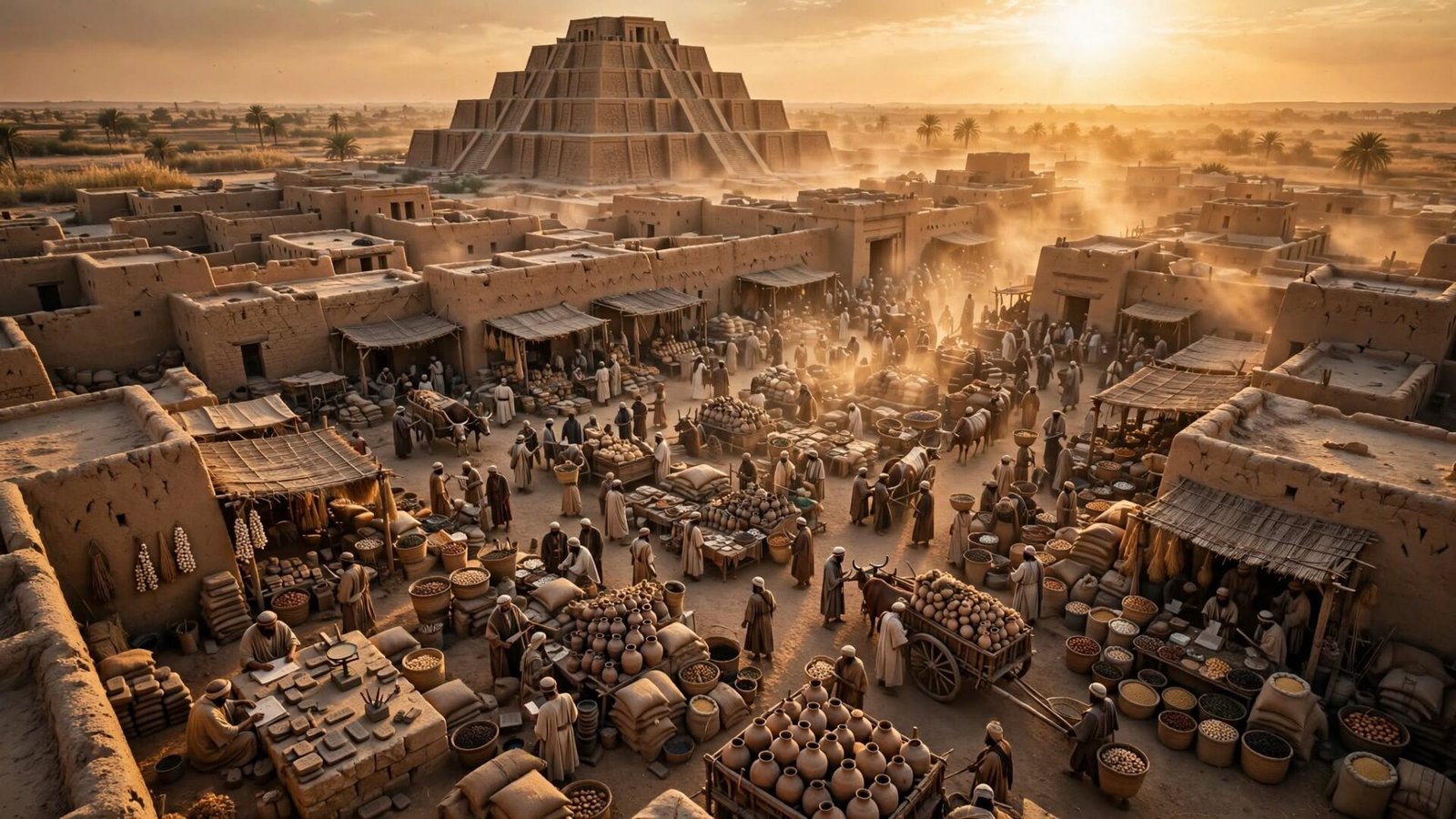
Nobody handed the ancient world a rulebook for running an economy. No Harvard-trained economists. No central bank governors. No spreadsheets, no interest rate committees, no quarterly GDP reports. And yet — empires stretched across continents. Millions of people got fed, clothed, housed, and paid. Merchants crossed deserts and oceans carrying goods worth fortunes. Debts were tracked. Loans were made. Wealth was built, stored, and passed down.
So the obvious question is: how on earth did they pull it off?
The honest answer is more fascinating than most people expect. Ancient economies weren’t primitive versions of our own. In many ways, they solved problems we still struggle with — inequality, resource distribution, large-scale labour coordination — using methods that were creative, ruthless, and surprisingly effective.
Mesopotamia: Where Someone First Thought to Write Down “You Owe Me”
Here’s a fact that deserves more attention than it gets: the oldest written records in human history aren’t love poems or epic battles. They’re receipts.

The Sumerians of ancient Mesopotamia — living in what is now southern Iraq — began writing around 3000 BCE, and the overwhelming majority of their earliest texts are economic documents. Grain in, grain out. Livestock borrowed, livestock returned. Days worked, rations owed. The cuneiform marks pressed into clay tablets were, at their core, a massive bookkeeping operation.
Why does that matter? Because writing didn’t emerge so that people could express themselves. It emerged because economies got complicated enough that human memory couldn’t keep up. Trade scaled past what any one person could track in their head, and someone clever figured out that clay doesn’t forget.
The Sumerian temple was the centre of this system — not just spiritually, but financially. Farmers brought surplus grain. The temple stored it in large granaries and issued clay tokens as proof of deposit. Those tokens circulated. You could use them to pay a craftsman, settle a debt, or buy something at the market. Strip away the religious trappings, and what you’re left with is a deposit receipt that functions almost exactly like a banknote.
The Babylonians, who came later, went further. Their famous Code of Hammurabi — carved into an enormous stone pillar around 1754 BCE — spent considerable ink on economic matters. What interest rate is legal on a grain loan? What does a hired ox cost per day? What happens if a builder’s shoddy work causes a house to collapse and kill someone? The code answered all of this. And the fact that they needed these laws tells you exactly how commercially active Babylonian society already was. You don’t legislate things that aren’t happening.
Ancient Egypt: The Pharaoh Was the Economy
Egypt took a completely different approach, and understanding it requires letting go of modern assumptions about how economies are supposed to work.
In Egypt, there were no private markets in the way Mesopotamia had them. No bustling bazaars where individual merchants competed for customers. Instead, the state — meaning the Pharaoh, and the massive bureaucracy beneath him — controlled the flow of virtually everything. Land belonged to the crown. Labour belonged to the crown. The harvest went to the crown first, and then the crown decided what everyone else got.
It sounds oppressive by modern standards. But it was remarkably good at doing the one thing an ancient economy absolutely had to do: keep people alive when things went wrong.
Egypt’s Nile floods were the engine of its agriculture. When the floods were good, grain harvests were enormous. When they failed, famine followed. The state’s answer was to build massive grain silos and store the surplus from good years to redistribute during bad ones. This is why Egypt was still functioning as a coherent civilisation for over three thousand years when most of its neighbours had collapsed, been conquered, or simply disappeared.
The pyramids illustrate the labour side of this economy better than anything else. For most of the 20th century, the standard story was that slaves built the pyramids. It was a compelling image. It was also wrong.
Excavations near Giza in the 1990s uncovered the actual village where pyramid workers lived. It had bakeries producing industrial quantities of bread. It had breweries. It had a medical facility showing evidence of surgical care. The workers were paid in food, clothing, and beer — a wage package calibrated to keep skilled craftsmen motivated. Graffiti found on stone blocks shows work gangs gave themselves competitive names, like sports teams. These were not enslaved people being whipped into labour. They were workers who, in some cases, appear to have taken pride in what they were building.
That realisation reframes the entire Egyptian economy. It wasn’t exploitation in the modern sense. It was a colossal redistribution machine — collect from everyone, store centrally, deploy strategically, and keep the population alive and working.

The Indus Valley: The Economy Nobody Can Fully Read
The Indus Valley Civilisation is the most underappreciated ancient economy on the planet. Partly because it gets far less attention than Egypt or Rome. Partly because we still cannot read their writing.
Stretching across what is now Pakistan and northwestern India, this civilisation peaked between 2500 and 1900 BCE. Their cities — Mohenjo-daro and Harappa being the largest — were extraordinarily well-planned. Straight streets. Underground drainage systems. Standardised brick sizes are used consistently across cities hundreds of miles apart.
That last detail is the economic clue that changes everything.
Standardised brick sizes don’t happen by accident. They happen when a civilisation has decided that consistency matters — that things need to be interchangeable, measurable, and predictable across long distances. The same principle applied to the Indus Valley’s weights and measures, which were remarkably uniform across a huge geographic area. Merchants in a port city on the Arabian Sea were using the same measurement units as traders near the Himalayan foothills. That’s not a coincidence. That’s deliberate economic infrastructure.
They traded internationally. Sumerian texts reference a trading partner called “Meluhha”, which most scholars believe refers to the Indus region. The exports were carnelian beads — incredibly labour-intensive to produce and highly valued — along with cotton textiles and timber. This was not subsistence trading. This was specialised production for distant markets.
What makes the Indus economy genuinely puzzling is what’s missing. There are no obvious palaces. No royal tombs stuffed with gold. No monuments glorifying a king or a god-king. Compared to Egypt or Mesopotamia, there is almost no visible concentration of wealth at the top. Whether that reflects a merchant-led society, a more democratic political structure, or something we simply haven’t found yet, nobody knows. The script remains undeciphered. The Indus Valley keeps its economic secrets close.
Ancient China: Monopoly as a Business Model
If the Indus Valley economy is puzzling, ancient China’s economy is grimly logical. It is the story of a state that understood, very early, that controlling a scarce and desirable resource was the most reliable path to power — and then spent centuries trying to maintain that control against every market force pushing back.
Silk was the crown jewel. For hundreds of years, China was the only place on earth that knew how to produce it. Sericulture — the raising of silkworms and the painstaking process of harvesting their cocoons — was a closely guarded state secret. Attempting to export silkworm eggs or mulberry seeds, the food the worms ate, was at various points a crime punishable by death. The result was a trade advantage of extraordinary duration. The Silk Road—the network of trade routes connecting China to Central Asia, Persia, and eventually Rome—was built on this single product’s desirability in markets that couldn’t make it themselves.
Salt was a different kind of monopoly, but arguably more important. Without refrigeration, salt was the only practical way to preserve food across seasons. Whoever controlled salt controlled, in a very real sense, who could survive a winter. Chinese dynasties fought constantly to monopolise salt production and distribution. The revenues were enormous. So was the corruption. Salt officials were among the most bribed people in Chinese imperial history, and fortunes were made by merchants clever enough to navigate the grey zones between legal and illegal salt trading.

Currency took longer to develop but followed a similar logic. The Zhou Dynasty introduced bronze coins shaped like spades and knives around 1000 BCE — practical shapes because the coins could double as tools. Over centuries, these evolved into the round coins with square holes that became the iconic image of Chinese money. When the Qin Dynasty unified China in 221 BCE, standardising the currency was one of their first economic moves. It wasn’t just symbolic. It meant that merchants from one end of the empire to the other could do business without first negotiating which coins they’d accept and at what rates. Economic integration followed political unification almost immediately.
The Roman Empire: Close Enough to Feel Familiar
Walk through ancient Rome’s economy, and something interesting happens: it starts to feel recognisable.
Roman banks weren’t called banks, but they functioned like them. They took deposits. They made loans. They facilitated currency exchange for travellers moving between regions with different coinage. Merchants formed business partnerships with legal contracts governing profit splits and liability. Maritime traders developed arrangements where a group of investors would fund a ship’s voyage in exchange for a share of the returns — with the debt forgiven entirely if the ship sank. That’s not far from modern venture capital with built-in insurance.
The scale of Roman commerce was staggering. A grain merchant based in Alexandria, Egypt, could sell a cargo to a buyer in Rome without either person ever being in the same room, conducting the transaction through a chain of agents and legally binding contracts. The Roman legal system — obsessive about written agreements, enforceable debts, and contractual obligations — made this possible. Commerce needs trust, and Rome’s legal infrastructure generated trust at scale.
Pompeii, preserved by volcanic ash in 79 CE, is the best snapshot we have of a Roman commercial city mid-operation. The streets were lined with tabernae — small commercial shops selling wine, bread, cooked food, cloth, and every other category of goods. The city had multiple bakeries with millstones still in place. It had thermopolia, ancient fast-food counters where hot food was served to people who, like today’s urban workers, didn’t have time or space to cook at home. This was not a subsistence economy. It was a consumer economy, and it had all the familiar pressures.
Including inflation. Roman emperors, facing military costs they couldn’t otherwise cover, gradually reduced the silver content of their coins — the ancient equivalent of printing money. Prices rose. Trade suffered. Confidence eroded. The economic turmoil of the third century CE is directly linked to the political chaos of the same period, when Rome cycled through over twenty emperors in fifty years. The lesson wasn’t unique to Rome. Debase your currency, and the economy will eventually make you pay for it.
The Thread Running Through All of Them
Five civilisations. Five different approaches. And yet the same patterns keep appearing.
Every one of them built systems people could trust. The Sumerian temple held your grain honestly. The Roman court enforced your contract. The Indus merchant used the same weights as every other Indus merchant. Without that bedrock of trust, none of it works. You can’t have commerce if people think they’re going to get cheated every time they transact.
Every one of them learned to produce and store more than immediate need required. Surplus is the raw material of wealth. Egypt’s grain silos, Rome’s warehouses, and China’s strategic salt reserves — they all understood that prosperity isn’t just about production. It’s about having something left over when things go sideways.
Every one of them benefited from specialisation. A society where everyone grows their own food and makes their own tools is a poor society. A society where some people grow food, some make pottery, some build ships, and some keep records is a rich one. Division of labour is genuinely ancient. The Romans didn’t invent it. Neither did the Greeks. It was already running at full speed in Sumerian temple economies five thousand years ago.

And every one of them treated information as infrastructure. Clay tablets, papyrus records, and standardised weights — these are all technologies for the same purpose: making economic relationships legible across time and distance. An economy where people can’t verify what was agreed, what was paid, or what is owed is an economy stuck at the village scale. The moment you can record and retrieve that information reliably, the economy can grow.
What All This Actually Means
The monuments are what we photograph. The pyramids, the Colosseum, the Great Wall — they’re the visual proof that ancient civilisations existed and mattered. But monuments are symptoms. They’re what happens after you’ve already solved the harder problem.
The harder problem is organising thousands or millions of people to produce collectively, distribute fairly enough to keep the system stable, and trade effectively with the world beyond your borders. Ancient civilisations solved this without anything we’d recognise as modern financial infrastructure.
What they had instead was something harder to build and easier to lose: functioning social trust, creative institutional thinking, and a clear-eyed understanding that isolation makes everyone poorer. That’s not a historical footnote. That’s the core of every economy that has ever worked, at any point in human history — including the one you’re living in right now.



+ There are no comments
Add yours