


School history training typically focuses on the big stuff. We spend years memorising the dates of major wars, dissecting the dense clauses of peace treaties, tracing the lineages of kings and queens, and sketching the broad strokes of the Industrial Revolution. And while all of that is undeniably vital for understanding how the modern-day globe came to be, it additionally completely leaves out absolutely the wildest, most unhinged components of the human tale.
The truth is, history isn’t just a dry, dusty timeline of political events neatly organised in a textbook. It’s a chaotic, bizarre, and deeply hilarious soap opera. Humans (and sometimes animals) have been making wildly unpredictable choices for thousands of years.
If you dig deep enough into the archives, step away from the major battles, and look at the footnotes, you’ll find stories that sound like they were pulled straight out of a Monty Python sketch, a surrealist painting, or a fantasy novel. We are talking about literal wars waged against flightless birds, historical timelines that completely mess with your perception of reality, and military bears earning salaries.
Grab a cup of coffee and get ready to question everything you thought you knew about the past. Here is a deep dive into 10 historical facts that sound entirely fabricated but are absolutely, undeniably, 100% true.

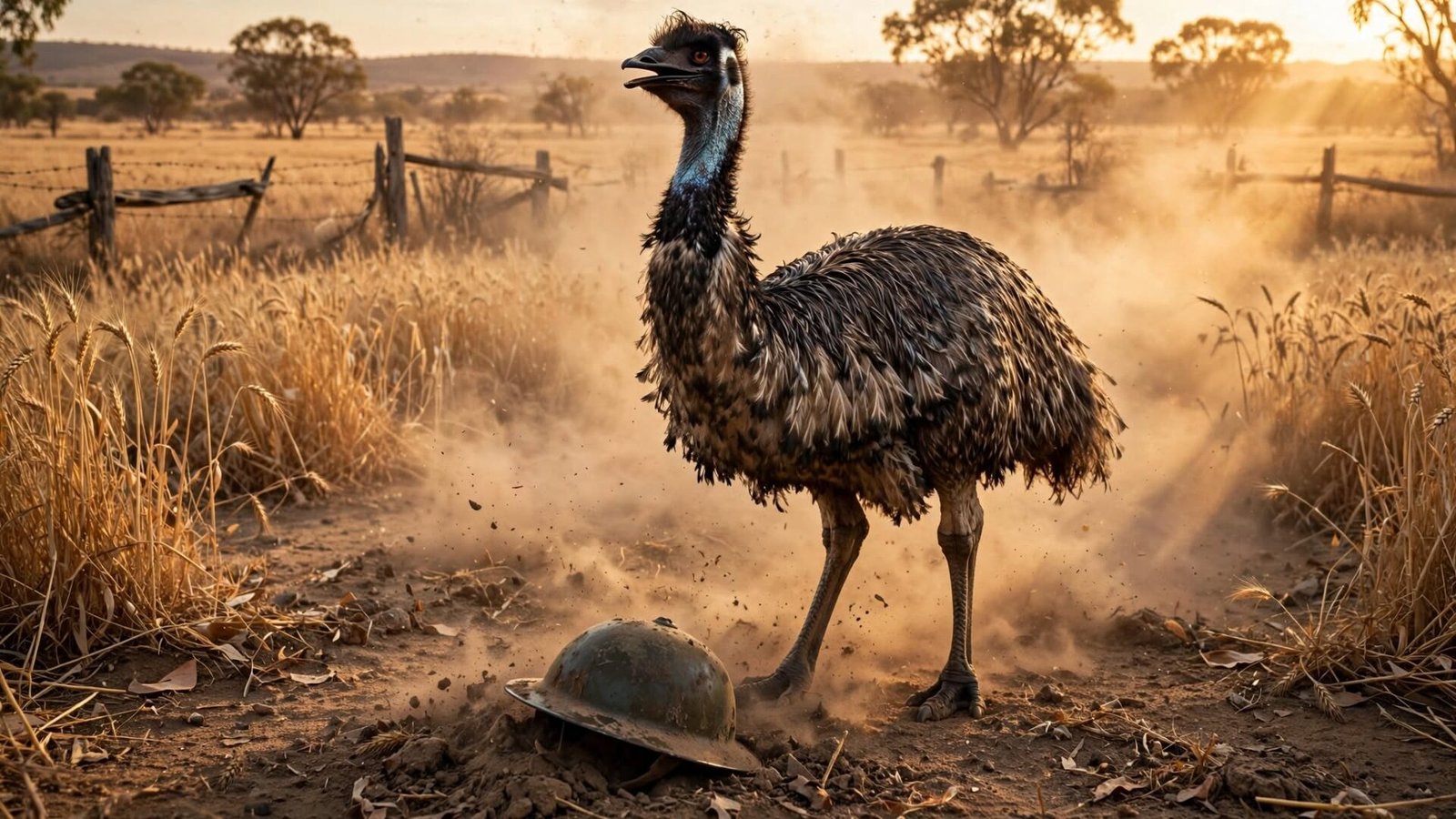
1. Australia Once Fought a Literal War Against Emus (And Lost)
Let’s kick things off down in Australia, a continent already world-famous for harbouring wildlife that seems actively hostile to human existence. In the summer of 1932, Western Australia faced a massive, unprecedented crisis. A booming population of roughly 20,000 emus had migrated into the farming regions of the state. These giant birds were tearing up wheat crops, destroying fences, and ruining the livelihoods of local farmers who were already struggling through the harsh realities of the Great Depression.
The farmers—many of whom were hardened World War I veterans—demanded immediate action from the government. They knew what they needed to handle the situation: machine guns.
So, the Australian government did what any completely logical government would do in this scenario: they sent in the actual military.
Commanded by Major G.P.W. Meredith of the Seventh Heavy Battery of the Royal Australian Artillery, a small squad of soldiers armed with Lewis machine guns and 10,000 rounds of ammunition marched into the scorching outback to cull the birds. This bizarre military operation became officially known as the Great Emu War. Sounds like an easy, albeit unfair, victory for the guys with the automatic weapons, right?
Wrong.
It turns out emus are essentially the tanks of the bird world. They are incredibly fast, capable of reaching speeds of 30 miles per hour, and their thick, tough feathers acted almost like Kevlar armour against the bullets. Worse yet, the birds seemed to possess an innate grasp of guerrilla warfare. Instead of flocking together to be shot, they scattered into small, erratic groups, rendering the heavy machine guns virtually useless. The guns jammed, the soldiers grew exhausted, and the birds kept eating the wheat.
After a few weeks of comical failure, a staggering amount of wasted ammunition, and only a small handful of casualties on the emu side, a humiliated Major Meredith was forced to call a retreat. The Australian military literally surrendered to giant birds. The emus won the war.
2. Oxford University is Older Than the Aztec Empire
When we attempt to arrange historical events on a timeline in our heads, we often depend on popular culture aesthetics. When we consider the Aztec Empire, we picture historical, mythical antiquity—stepped pyramids hidden in jungles and civilisations lost to time. When we think of Oxford University, we picture vintage stone homes; certain, however, it feels a part of present-day European history.
Our internal timeline is completely, hopelessly warped.
Here is the mind-bending reality: teaching at Oxford University started in the year 1096. It wasn’t officially recognised as a fully chartered university until a bit later, but academics were gathering, debating, and lecturing there before the turn of the 12th century.
Now, let’s look at the Aztecs. The founding of their magnificent, sprawling capital city, Tenochtitlán (which sits exactly where modern-day Mexico City is located today), happened in the year 1325.
Let that sink in. By the time the very first stones of the Aztec capital were being laid down in Central America, students in England had already been complaining about their strict professors, drinking in local taverns, and studying for exams for over two hundred years. Oxford had a robust academic community, while the Aztec Empire was literally just an idea.
3. Napoleon Bonaparte Was Once Defeated by a Horde of Bunnies
Napoleon Bonaparte became arguably one of the greatest naval commanders in human history. He conquered big swaths of Europe, commanded huge, fiercely loyal armies, and instilled deep worry in the hearts of rival nations. But his greatest, most humiliating tactical blunder didn’t happen on a snowy battlefield in Russia or at Waterloo. It happened in a grassy field in the summer of 1807.
To celebrate the signing of the Treaties of Tilsit, Napoleon’s chief of staff, Alexandre Berthier, decided to organize a massive outdoor rabbit hunt. Berthier wanted to deeply impress his boss, so he went all out, acquiring an estimated 3,000 rabbits to ensure the hunt was an extravagant success.
The problem? Instead of hiring locals to trap wild hares, Berthier’s men took the easy route and bought tame, domesticated farm rabbits from local peasants.
When Napoleon strutted into the field, surrounded by his most elite generals, the cages were opened. Berthier expected the rabbits to scatter in terror, providing target practice. Instead, the domestic bunnies saw the emperor and immediately assumed he was the farmer bringing them their daily lettuce.
Thousands of hungry, fluffy bunnies charged Napoleon.
At first, the men laughed, assuming it was a cute mistake. But the sheer volume of the swarm quickly became terrifying. The rabbits swarmed Napoleon’s legs, climbing up his majestic military jacket. His men tried frantically to beat them back with riding crops and sticks, but the fluffy horde was relentless, surrounding him in a fuzzy, twitching sea. The great conqueror of Europe, the man who brought empires to their knees, was forced to flee in absolute panic to his velvet-lined carriage and literally retreat from a bunch of farm bunnies.

4. Cleopatra Lived Closer in Time to the iPhone Than to the Great Pyramid
We have a bad habit of grouping all of “Ancient Egypt” into one big, dusty bucket. Pyramids, pharaohs, mummies, the Sphinx, Cleopatra—it all feels like it happened at roughly the same time in some sandy, sepia-toned era. But the Egyptian civilisation lasted for an unfathomably long time. It is one of the longest-lasting empires in human history.
The Great Pyramid of Giza was built around 2560 BC for the Pharaoh Khufu. It was an ancient, crumbling wonder even to the later generations of Egyptians.
Cleopatra VII, the famous, brilliant queen who romanced Julius Caesar and Mark Antony, was the very last active ruler of the Ptolemaic Kingdom of Egypt. She was born in 69 BC.
If you do the math, roughly 2,500 years passed between the building of the Great Pyramid and the birth of Cleopatra. Meanwhile, only about 2,000 years have passed between Cleopatra’s time and the invention of the iPhone, the Moon landing, or whatever modern milestone you want to use.
This means Cleopatra would have looked at the Pyramids exactly the way we look at the Roman Colosseum or the ruins of ancient Greece today: as incredibly ancient history built by people she felt completely disconnected from.
5. A Bear Fought in World War II (And Held an Official Rank)
During the dark, brutal days of the Second World War, the Polish II Corps had a very unusual, highly furry soldier in their ranks. While passing through the mountains of Iran in 1942, a group of Polish soldiers encountered a young boy carrying an orphaned Syrian brown bear cub in a sack. They bought the bear in exchange for some Persian coins, chocolate, and a Swiss Army knife.
They named him Wojtek (meaning “Happy Warrior”) and raised him on a highly questionable diet of condensed milk from a vodka bottle, fruit, marmalade, and eventually, beer and lit cigarettes, which he would swallow whole.
Wojtek wasn’t only a quirky unit mascot; he was taken into consideration as one of the boys. He grew to weigh nearly 500 kilos, found out how to salute his commanding officers, wrestled affectionately with the soldiers across the campfire, and slept in their tents on bloodless nights to keep their heat.
When the unit was deployed to fight alongside the British in Europe, British transport ships strictly forbade mascot animals from boarding. So, the Polish army found a brilliant bureaucratic loophole: they officially drafted Wojtek into the military. He was given the rank of Private, complete with a serial number, a service record, and a paybook.
During the incredibly bloody Battle of Monte Cassino in Italy, Wojtek actually pitched in to help the war effort. Observing his comrades struggling to carry heavy crates of artillery shells under enemy fire, the massive bear stood on his hind legs and began copying them. He carried 100-pound crates of live ammunition to the front lines without dropping a single one.
He survived the battle, was promoted to corporal for his bravery, and lived out his retirement peacefully at the Edinburgh Zoo in Scotland, where his antique army buddies could occasionally visit and toss him cigarettes.
6. The Shortest War in History Lasted Exactly 38 Minutes
Wars are usually defined by their gruelling length. They drag on for years, sometimes decades, reshaping borders and economies. But the Anglo-Zanzibar War of 1896 was over before most people in London even had time to finish their morning tea.
The conflict kicked off on August 25, 1896, when the pro-British Sultan of Zanzibar suddenly died. His ambitious nephew, Khalid bin Barghash, immediately seized power and moved into the royal palace without seeking British approval. The British Empire, which basically treated Zanzibar as a protectorate and preferred a more compliant ruler, issued a strict ultimatum: step down and leave the palace by 9:00 AM on August 27, or face the wrath of the Royal Navy.
Khalid called their bluff. He barricaded himself inside the wooden palace with about 2,800 loyal men, a few artillery pieces, and the royal yacht anchored nearby.
At exactly 9:02 AM, the British warships anchored in the harbor opened fire. The bombardment was utterly devastating and entirely one-sided. By 9:40 AM, the palace was a burning pile of splinters, the defending forces had suffered roughly 500 casualties, the royal yacht was sunk, and Khalid’s flag was pulled down from the flagpole. The war was officially over in 38 to 45 minutes (depending on exactly when the final shot was recorded). Khalid managed to escape through a back door and seek asylum in the German consulate, leaving his men behind.

7. Carrots Were Originally Purple, Not Orange
If you ask a toddler to draw a carrot, they’ll straight away grab an orange crayon. Bugs Bunny eats orange carrots. Every supermarket shelf on the planet is filled with orange carrots. But for the vast majority of human agricultural history, the color orange was completely absent from the carrot genetic pool.
The original carrots, which were first cultivated by farmers in Central Asia (likely in modern-day Afghanistan) around the 10th century, were dark purple or pale yellow. They looked a bit like gnarled tree roots and had a slightly bitter, highly earthy flavor.
So how did we get the bright, sweet, orange carrots we dip in hummus nowadays? You can thank patriotic Dutch farmers in the sixteenth and 17th centuries.
Through careful, deliberate selective breeding, Dutch agriculturists controlled the cultivation of mutant yellow carrot traces into the candy, the plump, vibrant orange version we realise today. Legend has it they especially bred them to be orange to honour William of Orange, the chief of the Dutch independence movement. Whether it became a stroke of fierce nationalism or simply a virtually top agricultural practice, the orange carrot turned into something so massively superior in flavour, sweetness, and texture that it subsequently wiped its red ancestors completely out of the mainstream marketplace.
8. In 1518, Hundreds of People Danced Until They Collapsed
One sticky summer day in July 1518, a girl named Frau Troffea stepped out of her residence right into a slender road in Strasbourg (then part of the Holy Roman Empire) and began twisting, twirling, and dancing uncontrollably. There was no music playing. She didn’t have an expression of joy on her face; witnesses reported she looked distressed and terrified. But she couldn’t stop her limbs from moving.
Within a week, 34 other people had bizarrely joined her in the street. Within a month, roughly 400 people were dancing through the city in a massive, chaotic mob.
This terrifying event is known to historians as the Dancing Plague of 1518. Local physicians, deeply confused and referencing medieval medical texts, believed the cure for this “hot blood” was simply to let the victims dance it out of their system. So, city officials actually hired professional musicians, brought in pipers and drummers, and built a large wooden stage in the town square to keep them going.
This, unsurprisingly, was a terrible idea.
People danced for days on end without stopping for food, water, or rest. Dozens of human beings literally danced to their deaths, suffering big heart attacks, strokes, or succumbing to sheer exhaustion and dehydration in the summer heat. Modern historians and psychologists typically attribute this to a terrifying case of mass psychogenic contamination (mass hysteria) introduced via intense mental stress, famine, and the risk of disease that ravaged the vicinity at the time.
9. Ancient Romans Used Human Urine as Mouthwash
The ancient Romans were superb, visionary engineers. They built sprawling aqueducts that transported sparkling water throughout miles of terrain, invented indoor underfloor heating, and constructed huge concrete domes that still stand these days. But their normal dental hygiene routine leaves a whole lot to be desired.
Romans, just like us, exceptionally valued white teeth and clean breath. Their secret, the last weapon for a marvellous smile? Human urine.
Scientifically speaking, urine contains ammonia, which is a splendid natural bleaching agent and an enormously effective stain remover. The Romans found out that swishing a mouthful of elderly pee around in their mouths really lifted stains and left their enamel pearly white. In fact, urine was such a highly valuable, sought-after commodity in Rome that people placed large terracotta pots on the street corners to collect public waste. The “fullers” (laundry workers) also used it to bleach togas.
The call for turned so high that Emperor Vespasian truly levied a tax at the urine change. When his son criticised him for making a living off something so disgusting, Vespasian famously held a gold coin below his son’s nostril and declared, “Pecunia non olet” (Money does not stink).
The absolute most prized urine was imported in barrels of the manner from Portugal, because it was believed to be the strongest and best in the marketplace. Just preserve that visual in your thoughts the next time you complain about the minty burn of modern-day mouthwash.

10. The First Person to Survive Niagara Falls in a Barrel Was a 63-Year-Old Teacher
When we think about intense daredevil stunts, we typically imagine younger, heavily sponsored adrenaline junkies hopped up on energy drinks searching out viral fame. But the absolute pioneer of the ultimate American daredevil stunt—going over the raging waters of Niagara Falls in a wooden barrel—was a 63-year-old, Victorian-era widowed schoolteacher named Annie Edson Taylor.
In 1901, Taylor was struggling financially and terrified of spending her final years in a poorhouse. To secure her retirement, she decided to pull off a stunt no human being had ever survived. She designed a custom, pickle-shaped barrel made of thick oak and iron hoops, padded the interior with an ordinary mattress, and took her pet cat along for a test drop over the falls (the cat survived, though likely very annoyed).
On October 24, her 63rd birthday, Taylor strapped herself in. The barrel was sealed with a cork and pressurized with a bicycle pump before being set adrift. After plunging 167 feet over the terrifying brink of Horseshoe Falls, the barrel bobbed violently in the turbulent rapids below. Rescuers hooked it and pried the lid off, fully expecting to find a gruesome scene.
Instead, Taylor emerged alive, walking away with nothing more than a small, bleeding gash on her head and a mild concussion. She had successfully conquered the falls.
Unfortunately, her manager quickly stole her famous barrel and ran off, robbing her of most of the wealth she had hoped to earn from speaking tours. But she left us with an iconic piece of advice. Her quote to the frantic press right after emerging from the water?
“No one ought ever do that again.”
History is Stranger Than Fiction
We spend so much time looking at the past via the critical, rigid lens of academia that we overlook records that were lived by way of actual, fallacious, chaotic, and frequently completely ridiculous people. The fact is delightfully messy. It entails tax-deductible physical fluids, competitive agricultural branding, and actual army-grade bears.
These incredible, bizarre events serve as a fantastic reminder that the human story is infinitely more entertaining than any fictional movie script could ever hope to be. And the best part? History is happening right now, too. Someday, many years in the future, human beings will possibly appear back at some of the things we keep in mind flawlessly every day nowadays, shake their heads, and be surprised by what on earth we had been thinking.
But until that day comes, we are able to simply be ad infinitum thankful we do not have to shield our backyards from a coordinated strike by way of 20,000 indignant emus.



+ There are no comments
Add yours