


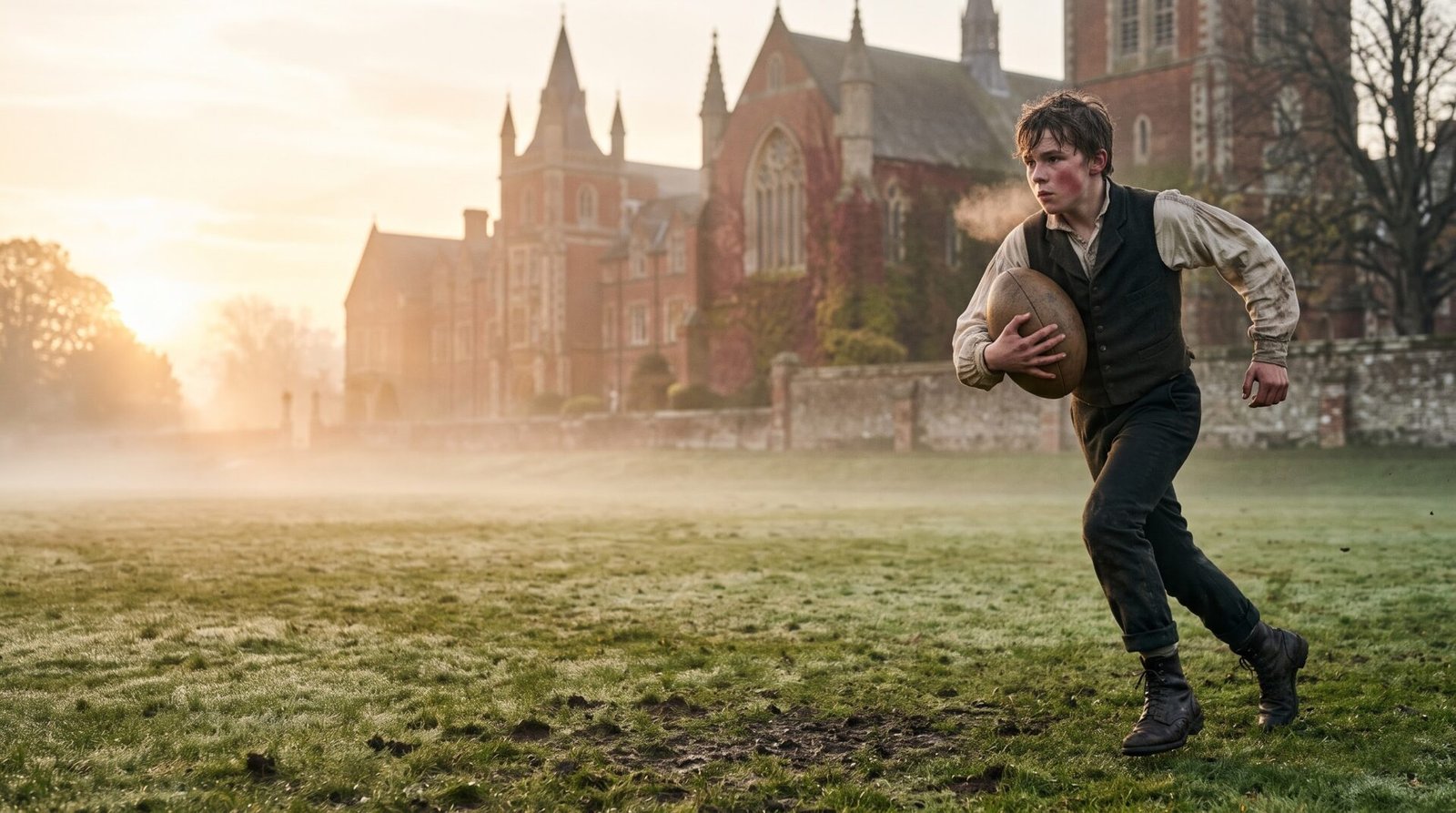
Walk through one of the grounds at Rugby School in Warwickshire, and you will find a small plaque stating that ‘with fine disregard for the rules of football as they were played, William Webb Ellis picked the ball up in his arms and ran with it, thus inventing the modern game of rugby’ (1823). This is a great story! A bored teen, a muddy pitch, and a momentary rule-break led to the invention of rugby football. His name appears on the Rugby World Cup, and schoolchildren learn the story. Commentators often reference it in major finals. However, almost nothing can be proved, and much of the story was probably never true.
So who was William Webb Ellis, and how did the story even start? What actually happened on the pitch in the early 1800s?

Who Was William Webb Ellis?
Unlike many legends, William Webb Ellis was a real person, and his life can be reasonably well documented.
William was born on the 24th of November 1806 in Salford, Lancashire. His father was an army officer named James Ellis, who died in 1812 during the Peninsular War while fighting at the Battle of Albuera. His mother, Ann Webb, raised her two boys on a widow’s income. They moved to the town of Rugby to give the boys the opportunity to go to Rugby School as ‘town boys’ (day pupils from local families, who receive free or low-cost education).
William joined in 1816, aged 9. Overall, he was a successful student who was a talented cricketer. He was good enough to play cricket at a high level. In 1825, he moved to Brasenose College, Oxford. He continued to play cricket and eventually gained holy orders. As a clergyman, he worked in various parishes in London. In 1855, he became the rector of St George’s Church in Magdalen Laver, Essex. He never married and passed away on 24th February 1872 in Menton, in the south of France.
However, during his lifetime, no one seems to have linked William Webb Ellis with the invention of rugby. No classmates, teachers, family members, or friends at Oxford, or the press. He was a simple clergyman who passed away abroad.
The Legend Itself
According to the popular version of the story,
During a game of football in 1823 at Rugby School, William Webb Ellis caught the ball. According to the rules of the time, players were not meant to run with the ball if they caught it. However, instead of stopping and either kicking or passing the ball, William ran towards the opposition goal with the ball tucked under his arm. The other boys were shocked. Eventually, this idea became popular and developed into a new sport.
While this version is neat and confident, the more you look into the sources, the messier it gets!
The Man Who Told the Story: Matthew Bloxam
The story was written down over 50 years after the supposed event and 4 years after the death of William Webb Ellis. In October 1876, an old Rugbeian named Matthew Holbeche Bloxam wrote a letter to the Rugby School magazine ‘The Meteor’.
Matthew Bloxam was an antiquarian and local solicitor who spent his life researching church architecture and local history. In his letter, he mentioned that he had heard that ‘the habit of running with the ball originated with a boy named Webb Ellis who, disregarding the rules, caught the ball and ran with it’. (1823). He was a ‘fair cricketer’ and a town boy.
Looking closer, we can see a few issues.
Bloxam left the school in 1820, meaning he wouldn’t have been at the school when the event supposedly happened. He was just passing on information.
He never stated who the information came from. In a later letter in 1880, he said that the information came from an Old Rugbeian but would not state who.

This story was published at a very specific time. Rugby football had been becoming increasingly popular. The Rugby Football Union had been established in 1871, and the first international match between Scotland and England had been played in the same year. There were lots of clubs forming around the country. People wanted to know the origins of this new sport, and Rugby School was proud to be considered the birthplace. This meant a clean story was needed.
This doesn’t prove Bloxam was lying; however, it does mean that the whole story is based on one man’s second-hand memory.
The 1895 Investigation
By the 1890s, there was a lot of debate surrounding the story. Therefore, the Old Rugbeian Society decided to investigate.
A committee was formed to gather evidence. They spoke to old boys who had been at the school in the 1820s and 1830s. They looked at what Bloxam had said and tried to find anyone who could remember the event.
They found that many old boys who were around the correct time couldn’t remember any incident. Some were certain that the game in the 1820s was strictly kicking, and running with the ball would have been a clear foul. No one could confirm that William had done anything impressive.
The report published in 1897 didn’t completely dismiss the story however was cautious. ‘The whole of the evidence relating to this matter is derived from the statement of one individual and is of a purely hearsay character. ‘There is therefore no independent confirmation.’ Basically, the committee couldn’t confirm the story.
Despite this, the school went ahead and installed the commemorative stone in 1895. This is still there today. The story had grown too large.
How Football Actually Worked at Rugby School
To understand how unreliable the story is, we need to know how football was played in public schools two hundred years ago.
There wasn’t one version of football. Each school had its own variation depending on the pitch and traditions. Eton played a wall game, and Harrow played with a heavy ball on a muddy pitch. However, rugby was a rougher and more free-flowing game.
There could be dozens of boys playing on each team, and games could last the whole afternoon. Shoving, pushing, and hacking (kicking opponents’ shins) were all part of the fun. The oval-shaped ball was made from an inflated pig’s bladder covered in leather.
Catching the ball was allowed. In fact, if you caught the ball cleanly (before it hit the ground), you could claim a mark. This allowed you to take a free kick. You could take a step back and kick the ball in any direction you wanted. So some handling was involved in the game.
What wasn’t allowed (at least in the early rules) was running with the ball. This is where the story comes in. However, the story is complicated, as it seems to have gradually developed in Rugby.
Some historians have stated that boys would often run with the ball for a few paces after catching it. This was gradually accepted by more and more people. Others suggest that in the 1830s running with the ball became accepted due to a boy named Jem Mackie. He was said to be very enthusiastic about running with the ball. In 1845, the first set of rules was written down by three pupils. Running with the ball was allowed in certain situations. This is the earliest concrete evidence we have of handling and running being part of the game at Rugby School.
Notice how this shows that it was a gradual development.

How Rugby Really Evolved
Even though William didn’t invent the game in an afternoon, how did rugby become rugby?
Unfortunately, no one invented it. It developed.
The 1845 rules were a huge development. This gave the game a structure that could be taught. Around this time, Thomas Hughes’ novel Tom Brown’s Schooldays became popular (1857). This gave people around the country a romantic view of the football played at Rugby School. Old boys moved on to universities and clubs and tried to play the game.
However, every group of players had their own slight variations. When the Football Association was formed in 1863 to create a unified set of rules, there was a huge debate about handling and hacking. Clubs that preferred carrying the ball and tackling went their own way. This caused a permanent divide. Association football (what most of the world now knows as soccer) and rugby.
In 1871, representatives from different clubs got together at the Pall Mall Restaurant in London to develop the Rugby Football Union. Rules were put into place to give the game a proper structure, and it began to resemble what we know it as today. In 1895, another split occurred due to arguments over payment for playing. A new version of rugby called rugby league was formed using different rules.
No one has ever said that this all started because a boy by the name of William Webb Ellis picked up the ball. This was added later.
Why the Myth Refuses to Die
Humans love a creator. It is easier to remember that there was one person at one point in time. Having a hero and someone breaking the rules makes the story far more memorable than the truth. The truth does not have a name and was developed over many decades.
The Rugby School was very proud of this connection, so they were only too happy to attach their name to the story. The plaque, celebrations and stories within the school’s history help to create a sense of authority.
The trophy also helps. During the first-ever Rugby World Cup in 1987, the winner received the Webb Ellis Cup. Every 4 years, the captains pick up the trophy, which is made of gilded silver. This allows the entire sport to connect with the name. The story is brought back to life every tournament.
Something often forgotten is that in 1958 a rugby fan by the name of Ross McWhirter went looking for Ellis’ grave. He found it in a cemetery in Menton. However, it was in poor condition. The Rugby Football Union repaired it, and it became a minor pilgrimage site for fans. Although we do not know the true story from 1823, Ellis is now forever connected to the story.

So, Myth or Reality?
Overall, the evidence shows that
William Webb Ellis was a real person who attended Rugby School during the correct time period.
There is no evidence to show that he created rugby by running with the ball in 1823. The information given comes from one second-hand source many decades later and cannot be verified by an investigation from old boys at the school. It is mostly seen as a legend today by historians.
The game was developed through a long and complicated process. Many schoolboys were involved in many rule changes and arguments. Running with the ball slowly became part of the football game played at Rugby School. The game we know today was developed by creating rules, club meetings, and a few key splits in the 19th century.
Does this mean the story is pointless? No! It can still tell us something. It shows how much people want something to have a definite start. A school, sport, and trophy can all help to create an amazing story. Although William may not have changed football in an afternoon, his name has helped rugby develop its identity more than most real creators could ever dream of.
As the 220th anniversary of his birthday comes around on the 24th of November, it’s a great time to remember him for who he really was. An average man whose name became bigger than him.
Frequently Asked Questions
Did William Webb Ellis really invent rugby?
There is no reliable evidence to suggest he did. The story comes from one letter in 1876 based on what someone else told the author. Investigations couldn’t confirm it.
When did the story first appear?
The story appeared in October 1876 in a letter written by Matthew Bloxam in the Rugby School magazine.
What did the committee decide in 1895?
The committee from the Old Rugbeian Society decided that the story came from one unconfirmed source. They couldn’t confirm that Ellis had done what was claimed.
Is the Webb Ellis Cup named after a real person?
Yes! Ellis was a real pupil at Rugby School who became a clergyman. It was named after him due to the story.
When were the first written rules created?
The first known set of rules was written in 1845 by pupils at Rugby School. The first national laws were created by the Rugby Football Union in 1871.



+ There are no comments
Add yours