


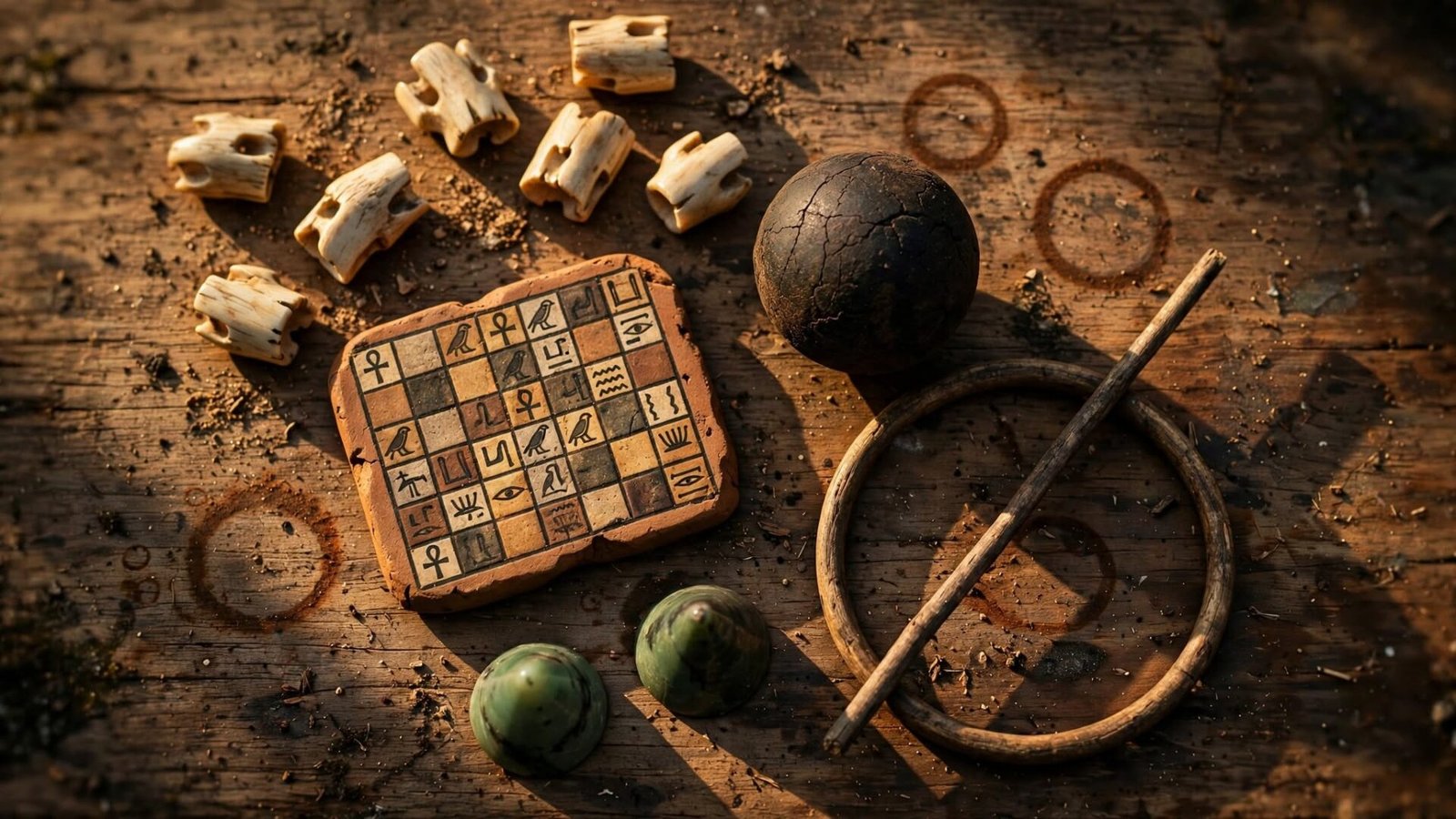
My grandfather once tried to teach me a game using sheep bones.
Not toy bones. Real ones—smooth, yellowed, and small enough to sit comfortably in your palm. He called them by a name I couldn’t pronounce and showed me how to toss them and catch them on the back of your hand. I was maybe eight years old and far more interested in my Game Boy.
I never learnt the game. He passed away three years later. And I’ve thought about that afternoon more times than I can count.
This article isn’t just about games. It’s about everything that travels inside them—the rituals, the rivalries, the Saturday afternoons that stretched into evenings, the grandparents who tried to pass something down, and the grandchildren who were too distracted to receive it.
Here are twelve traditional games that the world played for centuries—some for thousands of years—and then stopped. Most are gone. A few survive on life support. All of them deserved a longer run.
So Why Do Traditional Games Actually Die?
The easy answer is technology. Screens ate everything. And yes, that’s partly true.
But it doesn’t explain why games were dying long before smartphones arrived. Mob football was already fading in the 1850s. A trap ball was gone before television existed. Stoolball nearly disappeared during the Victorian era.
The real answer is messier. Games die when the physical spaces that hosted them vanish—when streets get paved and fenced, when common land gets sold, and when children are no longer allowed outside alone. They die when the social rituals surrounding them collapse. They die when nobody thinks to write the rules down because everyone already knows them, until one day nobody does.
And they die when one generation decides—not maliciously, just thoughtlessly—that there are easier ways to spend an afternoon.
That’s the part that stays with me. Nobody murdered these games. We just looked away.

1. Knucklebones — The Game Augustus Caesar Played as a Child
Here’s something worth sitting with: archaeologists have found knucklebones in Egyptian tombs that are five thousand years old.
Five thousand years. That’s older than the Roman Empire, older than the Greek city-states, and older than almost everything we think of as ancient civilization. And for most of that time, across most of the world, children were playing the same game—tossing the ankle bones of sheep or goats, trying to catch as many as possible on the back of the hand.
Greek vase paintings show young women laughing mid-toss, knucklebones frozen in the air. The Roman writer Ovid mentioned the game casually, the way you mention something everyone already knows. Augustus Caesar—the first Roman Emperor—reportedly played it as a boy.
The game had no board. No setup. You just needed the bones and another person. Which is probably why it lasted so long.
And which makes it slightly bizarre that it’s almost completely gone now.
2. Hoop and Stick — Three Thousand Years of Pure Running
Picture a child on a cobblestone street in 1870s Paris. Now picture a child on a dirt path outside a Native American village in 1400. Now picture a child in ancient Egypt, 1000 BCE.
All three are doing the same thing: chasing a rolling wooden hoop with a stick, keeping it upright, and running as fast as they can.
Three thousand years. Countless cultures. One game.
The hoop and stick appear in paintings, woodcuts, and illustrations across Europe, Asia, Africa, and the Americas. It required nothing—literally a hoop and a stick—and it gave children something that turns out to be surprisingly hard to replicate: the feeling of speed, of control, of a simple skill getting sharper every time you practised.
It didn’t die because something better replaced it. It died because factory-made toys arrived, and suddenly “simple” felt like “lesser”. Nobody made that decision consciously. The market made it for them.
3. Stoolball—The Great-Grandmother of Cricket and Baseball
Most people have never heard of stoolball. That’s a genuine shame, because without it, neither cricket nor baseball might exist in their current forms.
The game started in 14th century Sussex, England, and the premise was straightforward: one player defended a milking stool while another threw a ball at it. If the ball hit the stool, the thrower scored. If the defender hit it away, they ran. Over a few centuries, it evolved—proper batting, multiple players per side, and formal innings.
What makes stoolball unusual is who played it. In an era when women were largely excluded from public sport, stoolball was specifically associated with women. Village girls played it openly on the green. It travelled to early American colonies with English settlers. There are records of it being played in Virginia in the 1600s.
Then cricket got organized. Then baseball got organized. Both attracted money, infrastructure, governing bodies, and professional players. Stoolball attracted none of these things.
It still exists in a handful of Sussex villages. If you squint at the right field on a summer Sunday, you might see a game. But the tradition that once spread across two continents now fits inside a few postcodes.
4. Rathera—The Chariot Game That Became Kho-Kho
Most Indians know Kho-Kho. Fewer know that the version played today is a simplified shadow of something far older.
The original game was called Rathera, and it was played on horse-drawn chariots. Teams chased each other across open fields in vehicles. The rules were intricate. The playing area was vast. The game was embedded in warrior training culture—it developed agility, strategy, and the ability to pursue and evade under pressure.

When chariots became obsolete, someone adapted the game to foot. That was practical and understandable. But the adaptation stripped out most of the complexity. Kho-Kho is a fine sport—fast, physical, and genuinely exciting to watch—but it isn’t Rathera. The ancient game, the one that required chariots and warriors and enormous fields, is simply gone.
This is worth thinking about: sometimes games don’t die cleanly. Sometimes they get slowly simplified until what remains shares a name with the original but very little else.
5. Mob Football—When the Whole Town Was the Pitch
The rules of medieval mob football were uncomplicated: get the ball to the other end of town.
That was it. No field boundaries. No player limits. No referee. Teams numbered in the hundreds. The “pitch” was every street, every alleyway, and every market square between two fixed points. Games started at noon and sometimes ended after dark.
The ball was usually an inflated pig’s bladder. Windows got broken. Goods stalls got knocked over. People got hurt, occasionally seriously. English towns tried to ban the game dozens of times across several centuries and consistently failed because the game was tied to Shrove Tuesday, and Shrove Tuesday was tied to community identity in ways that made it nearly impossible to legislate away.
The Football Association formed in 1863 and created something orderly and exportable. The mob game slowly retreated.
One version survives: the Royal Shrovetide Football game in Ashbourne, Derbyshire, still played annually with the entire town as the pitch. It’s wonderful. But it’s a museum piece now, a heritage event rather than a living tradition—and the dozens of other English towns that once held similar games have been quiet for over a century.
6. Patolli—The Game You Could Lose Your House Playing
When Spanish conquistadors arrived in Mesoamerica in the early 1500s, they found Patolli everywhere—they played in streets, in courtyards, and in the homes of commoners and nobles alike.
The board was cross-shaped. Dried beans served as dice. Colored stones moved around the board according to the throw. Stakes could include gold, jade, feathered garments, and food—and according to some accounts, players occasionally wagered their own freedom.
More than a game, Patolli was a religious practice. The god Macuilxochitl presided over play and gambling. Before matches, players sometimes burnt incense and offered prayers. Winning wasn’t just luck; it carried spiritual meaning.
The Spanish suppressed it as incompatible with Christianity. The game went underground for a generation and then disappeared almost entirely. We have the boards in museums. We have Spanish colonial descriptions of the rules. We have no living tradition.
Something important to note: the Spanish didn’t just ban a game. They severed a community’s relationship with chance, fate, and the divine—a conversation that Patolli had been facilitating for over a thousand years.
7. Kottabos—The After-Dinner Game of Ancient Greece
Ancient Greek dinner parties—symposia—had a specific rhythm. Food, then wine, then conversation, then Kottabos.
The game: flick the last drops of wine from your cup using a precise wrist movement; aim for a small bronze disc balanced on a tall bronze stand across the room. If you hit it cleanly, the disc fell and struck a metal basin below with a clear ringing sound. That was your point.
It sounds like a drinking game dressed up with bronze equipment. And maybe it was. But it was also a genuine skill—written about by poets, painted on pottery, and mentioned in philosophical texts. Good players were admired. Bad players were teased.
What killed Kottabos wasn’t anything dramatic. The symposium culture that contained it gradually dissolved as Greece’s cultural dominance faded into the Roman era. Without the dinner party, there was no game. It couldn’t exist outside that specific social ritual.
Some games are inseparable from the worlds that created them. When the world goes, so does the game.

8. Ulama—The Oldest Team Sport in Human History
If you want to understand how old the Ulama is, consider this: when the earliest evidence of the game was left behind, the Egyptian pyramids had not yet been built.
Ulama is 3,500 years old at minimum. Players kept a heavy solid rubber ball—up to four kilograms—in the air using only their hips, forearms, or knees. Hands and feet were forbidden. The sport required extraordinary physical conditioning and practiced technique. Amateur players didn’t just pick it up.
The rubber itself was a technological achievement that went unrecognized for centuries. Mesoamerican civilizations were processing rubber into usable form two thousand years before Charles Goodyear received his patent in 1844 and got the credit.
Ulama was sacred. Its connection to the movement of the sun gave every match a cosmological dimension beyond sport. Losing carried consequences that historians still debate.
Spanish colonization suppressed it. Today, a small number of elderly men in Sinaloa, Mexico, still play a version. The knowledge lives in their hands and their muscles. When they’re gone, it’s gone.
I don’t know how else to say this: we are watching the final innings of a 3,500-year-old sport happen in real time, and almost nobody is paying attention.
9. The Ba Game—Scotland’s Forgotten Mob Sport
Two days a year, in Kirkwall, Orkney, the entire town still splits into Uppies and Doonies and spends hours trying to push a cork-filled leather ball to opposite ends of town. No referee. No rules worth mentioning. Hundreds of players. Complete chaos.
The Ba Game is glorious and strange and genuinely unlike anything else in modern sport.
But what most people don’t know is that Kirkwall is a survivor. Dozens of Scottish towns once held their own versions—mass football contests tied to local calendar events and community identities. During the 19th and early 20th centuries, one by one, the other towns stopped. Some cited disorder. Some cited modernization. Some just quietly let a generation pass without organizing the game, and that was enough.
Kirkwall kept going. The others didn’t. The difference between a living tradition and a lost one is sometimes just stubbornness—somebody deciding it’s worth the trouble one more year.
10. Mehen—The Board Game With No Surviving Rules
Mehen is one of the oldest board games ever found. Boards have been dated to approximately 3000 BCE. The board shape is a coiled serpent—Mehen was both the game and the name of a snake god in Egyptian mythology—divided into segments spiraling inward from tail to head. Lion-shaped pieces moved along the segments.
That’s everything we know for certain.
The rules were never written down. Nobody who played Mehen thought they needed to write the rules down, because everyone knew them. It was like writing down the rules of catch—why would you?
Then the Old Kingdom collapsed. The game disappeared. The rules lived only in the mouths and memories of players, and when the players were gone, the rules went with them.
We have dozens of beautifully preserved Mehen boards in museums around the world. We have no idea how to play the game.
It’s one of the strangest losses in human history—an artefact without its instructions, a conversation where only one side survives.
11. Trap Ball—The Game Baseball Quietly Replaced
Trap Ball never stood a chance once baseball got organised.
The game was simple: strike a small wooden lever to launch a ball into the air, then hit it as far as possible with a bat. Children played it in colonial America and across 17th– and 18th-century England. It shows up in period woodcuts, children’s books, and court records when someone inevitably broke a window.
But Trapball had no governing body, no professional league, and no newspapers covering its results. Baseball had all of those things within a few decades of becoming standardized. Trapball’s informal, neighborhood nature—which was its charm—turned out to be its weakness. Without structure, it had no way to survive competition from a sport that had figured out how to organize itself.

12. Senet—Played for 2,000 Years, Then Forgotten in One
Tutankhamun was buried with four Senet boards.
That single fact tells you everything about what this game meant in ancient Egypt. It wasn’t entertainment to be left behind in life—it was something worth carrying into the afterlife.
Senet boards have been found dating to 3100 BCE. Wall paintings show Egyptians playing with evident seriousness. In later periods, the game became explicitly tied to the soul’s journey after death—each square mapped to a spiritual test, and each throw of the casting sticks a moment of divine judgement.
The game was played across Egypt for two full millennia. More than twice as long as Christianity has existed.
And then, somewhere around the Roman period, it stopped. Not banned. Not suppressed. It just… ceased. Possibly because the religious framework that gave it meaning dissolved under Roman cultural influence. Possibly for reasons nobody recorded.
Modern scholars have reconstructed plausible rule sets. But plausible isn’t the same as certain. What we’re left with are exquisite boards, scattered fragments of written reference, and a complete absence of anyone who remembers how it actually felt to sit down and play.
The Thing None of Us Want to Admit
Every game on this list had people who loved it.
Not casually—genuinely, deeply loved it. Patolli players who prayed before their matches. Greek aristocrats who practised their Kottabos wrist technique before dinner parties. Scottish towns that organized their entire calendar around the Ba Game.
Those people aren’t abstract historical figures. They were as real as anyone reading this. They had preferences and rivalries and favourite moments. They taught their children how to play, expecting those children to teach theirs.
We are several links down a chain that started breaking quietly when nobody was looking.
Some of these games can’t come back—their rules are gone, and their contexts are unrecoverable. But knowing they existed, really understanding what their loss represents, seems like the minimum we owe them.
Every game on this list was, at some point, someone’s favourite part of the week.
That’s not a small thing.
If this piece made you think of a game from your own family’s history—one you half-learned and never quite finished learning—it’s probably not too late. Call whoever taught you. Ask them to show you again.



+ There are no comments
Add yours