


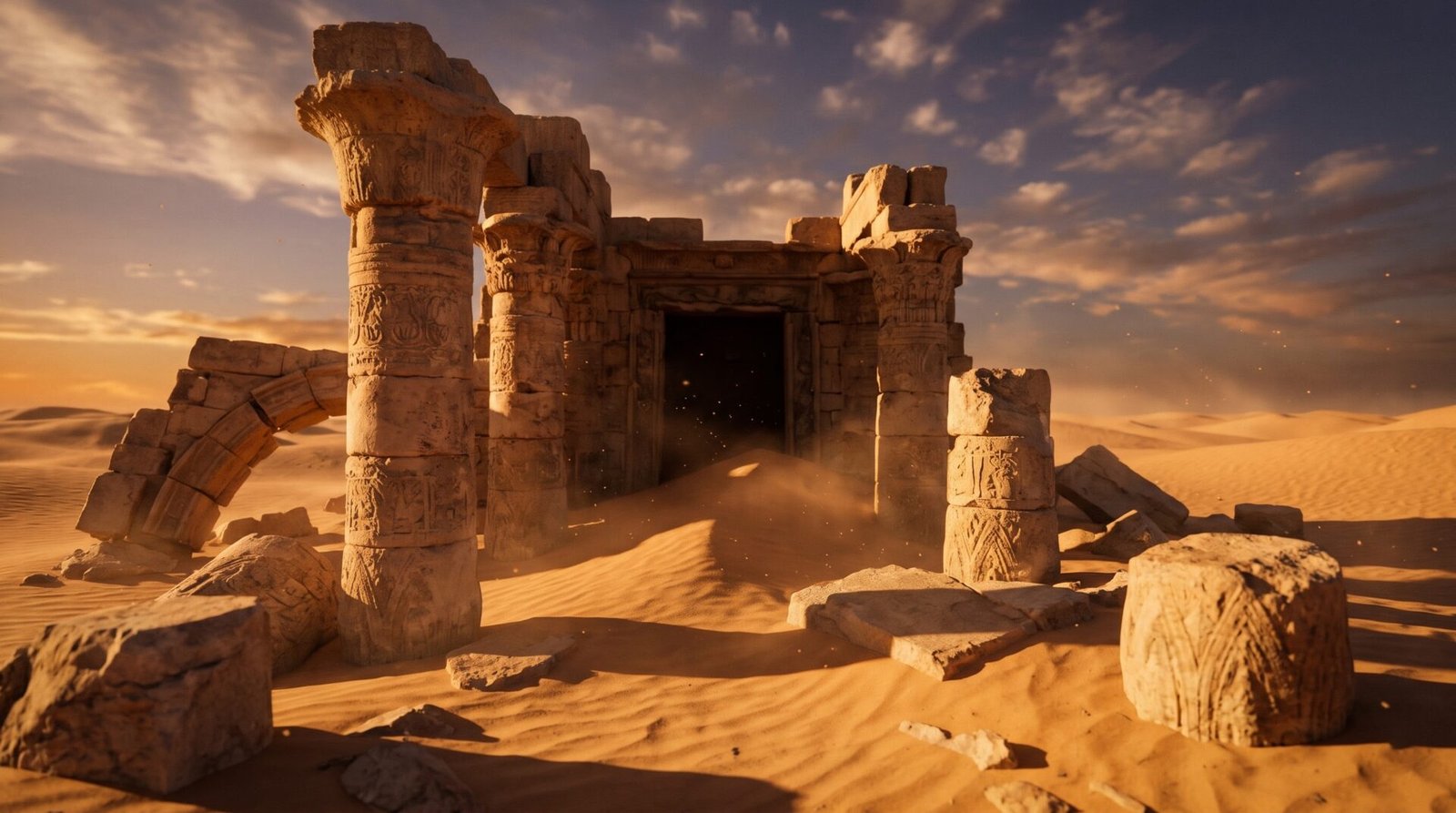
Although we tend to believe that we understand the past well, history books tell clear and concise stories of empires, battles, and monarchs who erected impressive buildings. However, the further back in time we go, the less clear-cut history becomes. Rather than a complete picture, we seem to be presented with a jigsaw with half the pieces missing. Ironically, we are far better equipped to investigate the past than our ancestors could ever have imagined. We can analyse the DNA of 1,000-year-old human remains. We can utilise satellites to map areas and identify long-buried cities. We can even explore the contents of sealed tombs without opening them.
Despite such technological advances, huge gaps in our historical understanding still exist. Accounts are inconsistent, architecture is incomprehensible, and entire civilisations seem to have disappeared.
Whilst these are of interest to academics, they are also intriguing and continue to inspire historians to question and re-evaluate our understanding of what ancient people were really able to achieve. Below I discuss seven of the most bizarre unsolved historical mysteries.

1. The Sea Peoples
Around 1200 BCE, the Mediterranean was a thriving area. The Egyptians were constructing temples, and the Hittites had established a huge empire in modern-day Turkey. On the sea, the Mycenaean Greeks were dominant. Trade was widespread, and so there was strong interconnectivity between all these groups. Thus, it was a highly developed and interconnected region.
However, within a few short decades, everything changed.
The Hittite Empire ceased to exist. Mycenaean palaces were set ablaze, and coastal cities in the Levant were razed. Even Egypt – which was fortunate enough to avoid total annihilation – was severely affected. Not only was there a change in leadership, but an entire era had effectively ended. Historians refer to this period as the Late Bronze Age Collapse.
So what caused this? Ancient Egyptian texts blame the ‘Sea Peoples’. Inscriptions describe these unexplained seaborne marauders and emphasise the ferocity of their attacks. Egyptian artwork portrays them as savage and wearing plumed headdresses. They are also illustrated as travelling in peculiar vessels.
But who were they?
Did they escape from another calamity? Was it a coalition of island-based pirates (possibly from places such as Sardinia and Sicily)? Or were they merely an indicator of wider issues such as huge droughts or earthquakes which led to food shortages and so encouraged migration and conflict?
Despite in-depth investigation for many years, we still do not have a definite answer to these questions. We are unaware of their language, culture, and even origin. They appear in history, wreak havoc, and then vanish – acting as phantoms from antiquity.
2. Building the Great Pyramid
Of the original seven wonders of the ancient world, only the Great Pyramid of Giza remains. With an age in excess of 4,500 years, it continues to perplex researchers.
Whilst we know that the pyramid was constructed for Pharaoh Khufu and that it was built from millions of stones (some of which weighed up to 80 tonnes – more than a laden semi-trailer), it is the extreme accuracy of its construction that is so puzzling.
The base is almost level, and the four sides are almost precisely aligned to magnetic north. Furthermore, the stones are fitted together so closely that not even a sheet of paper can pass between them.
Whilst there is much debate regarding how the heavy stones were transported, it is the logistics of building the pyramid as a whole that is so astounding. How did the ancients provide for and accommodate thousands of labourers? How did they manage an extensive supply chain, which would have spanned hundreds of miles? And how did they ensure that all involved remained so highly coordinated for many years?
There are numerous hypotheses. Perhaps stone transport was facilitated using either straight or spiral ramps. Possibly they also wet sand in order to assist movement. Some people believe that they may have had access to sophisticated, but now lost, technology. There is even speculation that they utilised sonic and vibrational methods to help shift stones.
Whilst some of these theories are quite fantastical, even the more realistic ones struggle to adequately explain how such an enormous and exquisitely constructed building could have been built. The Great Pyramid was not simply a burial site. It is a shining example of the exceptional level of coordination and engineering skill which the ancients possessed.
Although we know who built the pyramid and for what purpose, the method of construction remains beautifully mysterious.

3. The Indus Valley Civilisation and their Undecipherable Script
During the 1920s, archaeologists uncovered the remains of ancient cities, including Mohenjo-daro and Harappa, in what are now Pakistan and North-West India.
These were not primitive communities. Instead, they were large cities with highly organised street networks. They contained sophisticated drainage, communal bathing areas and even multi-storey buildings. Therefore, the Indus Valley Civilisation was one of the world’s oldest and most advanced urban cultures.
They existed concurrently with both ancient Egypt and Mesopotamia. Yet, unlike these other ancient cultures, the Indus Valley people did not construct monumental architecture or erect huge depictions of rulers and deities. Instead, they produced highly functional, well-designed and meticulously organised cities. They were also highly skilled at metalworking, agriculture and commerce.
Unfortunately, our knowledge of this culture is extremely limited. We do not know what they referred to themselves as, who governed them, nor what their beliefs and thoughts were.
This is because we are unable to comprehend their script.
Ancient members of the Indus Valley Civilisation manufactured numerous tiny seals, upon which they had engraved their script. Unfortunately, this script is totally unlike any recognised writing system. Moreover, the majority of the script is composed of just a few characters. Consequently, it is extremely difficult to translate.
Throughout the last hundred years, leading linguists and historians have attempted to decode it without success. Is it a full language? Or are these symbols merely for commercial and/or religious use? As we lack a Rosetta Stone – or similar ‘key’ to enable us to translate – we are unable to understand what the script represents.
Although the Indus Valley people were advanced and were in fact literate, time has been cruel and has silenced their voices. We can view their cities but are unable to hear their stories.
4. Egypt’s Lost Labyrinth
For thousands of years, ancient texts described a seemingly mythical giant labyrinth in Egypt close to a city known as Crocodilopolis.
The Greek historian Herodotus travelled to this labyrinth in the 5th century BCE. He stated that it was even more impressive than the pyramids. He described it as a sprawling subterranean and above-ground structure comprising 3,000 rooms. Intricate carvings adorned its walls, and it contained mysterious areas.
Other authors, including Pliny the Elder and Strabo, also wrote about this labyrinth. They described it as an immense temple complex devoted to the worship of the gods and stated that it was at least equal in magnificence to all other Egyptian structures.
Nevertheless, for centuries no one could locate this labyrinth. Historians gradually began to consider that it was purely mythical and that it was the product of the over-imaginative accounts of travellers.
Eventually, archaeologists associated the labyrinth with an area close to the pyramid of Amenemhat III at Hawara. Excavation of this area revealed the remnants of a large temple complex containing numerous rooms and corridors. However, the site was largely ruined and appeared to be a chaotic collection of rock formations.
It is possible that this was the fabled labyrinth. However, if this is so, the claims of 3,000 rooms and a two-storey structure appear greatly inflated. Moreover, Herodotus stated that 1,500 of these rooms were below ground. To date, these rooms have never been discovered.
Was the labyrinth indeed a grand, although now lost, ancient structure? Or was it in fact a comparatively modest temple complex which was greatly embellished by ancient authors? This mystery therefore skilfully straddles the boundary between archaeology and mythology.

5. The Purpose of the Nazca Lines
Within the arid landscape of southern Peru lie some of the most extraordinary ancient artwork in the world. Known as the Nazca Lines, these artworks comprise enormous ground carvings. In addition to basic geometric shapes such as lines and trapezoids, there are highly intricate drawings of various animals, including a huge hummingbird, monkey, spider, and whale. Some of these extend for over 1,000 feet.
As well as questioning how these enigmatic artworks were created, there is also the issue of why they were produced. Although the process of creation is relatively uncomplicated – involving removal of dark, sun-heated rocks to expose the lighter sand beneath – to achieve such wonderfully proportioned artwork on such an extensive scale, the Nazca people would have required some sort of aerial planning mechanism. Did they use sighting equipment comprising strings and pegs? Or did they possess flying technology? We are not sure.
Why then would the Nazca people devote so much time and resources to producing artwork which can only be fully appreciated from hundreds of feet up in the air? Given that they did not have access to hot-air balloons or aircraft, from ground level the artwork is virtually imperceptible.
Many differing opinions exist regarding this. Perhaps the artwork was intended for the gods. It may have been used for religious purposes to, for example, petition for good water supplies and/or agricultural yields. Alternatively, it may have indicated locations of underground water. Or perhaps it was part of an extensive star and planet tracking calendar.
Most probably, the artwork encompassed all of these aspects and more. It is highly likely that it was produced for religious reasons and so was directed at a divine audience. Nevertheless, we are still endeavouring to comprehend the Nazca mindset. These artworks are a stunning yet highly puzzling legacy of a culture which thought on an incomprehensibly large scale – a perspective which we can only fully recognise from above.
6. The Vanishing of the Maya
The Mesoamerican Maya were one of the most sophisticated ancient civilisations. They had a fully developed writing system. They also devised a complex mathematics system which included the notion of zero. They had an in-depth understanding of astronomy. They constructed impressive stone metropolises, which featured imposing pyramids and palaces. Around 800 CE, they were at the height of their power.
Yet for as yet unclear reasons, this flourishing Maya society eventually declined.
This decline is famously referred to as the ‘Maya collapse.’ Contrary to popular belief, it was not an abrupt occurrence. Rather, it was a slow deterioration which took place over a century or so. One by one, major Maya cities were deserted. Building activity halted, and monarchs lost authority. The once vibrant Maya population then seemingly receded back into the jungles.
Unlike several other mysteries discussed in this article, we actually have considerable information regarding the Maya. We know that they endured a sequence of devastating droughts. Analysis of lake sediments and tree rings has highlighted periods of extreme aridity. We also know that the Maya engaged in highly aggressive warfare, which may have contributed to societal instability. In addition, there is evidence of significant deforestation and topsoil depletion resulting from excessive farming.
However, none of these factors on their own appear to have been sufficient to bring about the Maya’s total downfall. More likely, a combination of these misfortunes occurred. Drought causes agricultural failure. Agricultural failure then results in starvation and social disturbance. Over-exploitation of natural resources then results in a vulnerable society. Subsequently, conflict ensues, and the whole system collapses.
What remains puzzling is why the Maya were unable to recover from these challenges. Obviously, of course, the Maya did not entirely vanish. Indeed, their descendants still reside in the region today. Yet why did the Maya forsake their magnificent cities? And why did they both lose power and knowledge?
It is a tale of a society which reached an unsustainable point and was thus unable to rebound. This mystery possesses a strikingly contemporary and warning-like quality.

7. The Voynich Manuscript
Picture a book which cannot be understood. This is the Voynich Manuscript.
Authenticity is not an issue. Carbon dating has established that it dates back to the early 15 th century. Within it are hundreds of pages covered in an extraordinarily beautiful but wholly incomprehensible script. The script is written in an alphabet which does not correspond with any known language.
Compounding the mystery, the manuscript also contains highly unusual imagery. Alongside pages showing various plants and herbs (although the majority of these plant species have eluded even the most knowledgeable botanists), there are pages illustrating exotic astronomical phenomena, circles and floating objects. Further pages demonstrate women bathing in pools which are interlinked via a complicated network of pipes and tubes. This appears to resemble early work on human or biological science.
For centuries, the globe’s leading code-breakers and linguistic experts have unsuccessfully attempted to decode the manuscript. Not even the renowned World War II code-breakers, who successfully deciphered the German Enigma code, have been able to do so. Thus, it is the epitome of how exceptionally difficult it is to solve a solitary, unmarked code.
There are numerous theories as to the manuscript’s nature. Some believe that it is in fact a highly sophisticated fake. Perhaps it was concocted by a clever individual either for financial gain or as an elaborate, centuries-long prank. Others consider it to be an actual book containing knowledge. It may have been written in a forgotten language, or it may have been encoded. It could relate to lost scientific knowledge. Or it may contain a compilation of herbal medicines. It might even be the private log of an alchemist.
Unfortunately, we do not know. Currently, the manuscript resides in a library at Yale University. It is a magnificently beautiful yet maddeningly elusive remnant from our past.
The Bottom Line
These mysteries emphasise that history is by no means fully understood. There are still dark corners and unanswered questions. There is much more to discover.
Quite apart from being academically interesting, these mysteries also act as voices from bygone eras. They continue to stimulate us to investigate, question, and speculate.
And that is what makes history such an engaging subject.



+ There are no comments
Add yours