


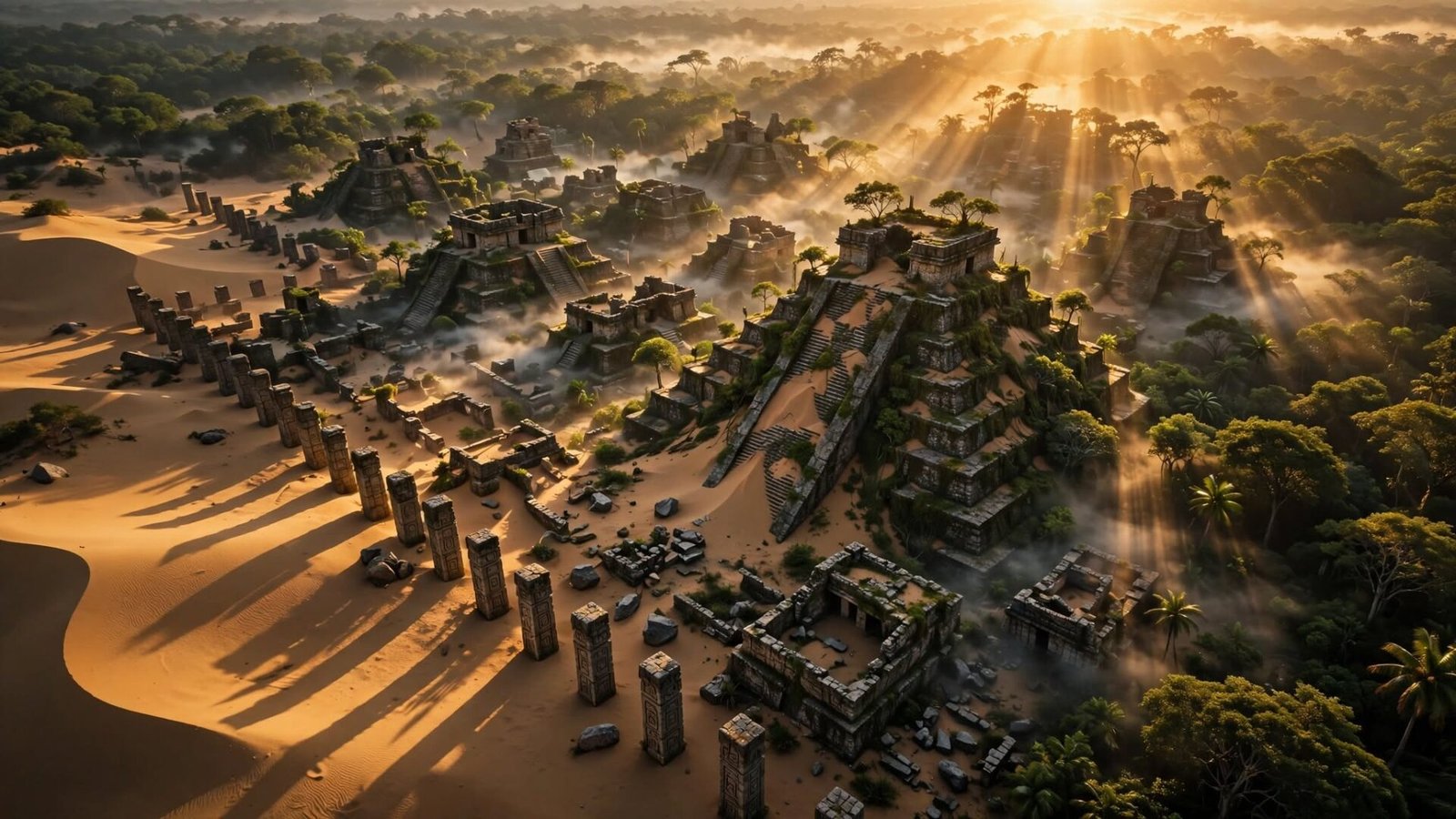
My history teacher had a poster on her wall — one of those laminated timelines that stretched from one end of the classroom to the other. Egypt on the left. Rome somewhere in the middle. A little Greek temple icon. Mesopotamia with its wedge-shaped writing. And that was more or less it. That was “ancient civilisation”.
I stared at that poster for years without once questioning what it left out.
Turns out, it left out a lot. Entire societies that built sewage systems before Europe dreamed of them. People who raised stone monuments so heavy and so precisely placed that engineers today still scratch their heads about them. Cultures that traded goods across thousands of miles, painted walls in vivid colour, and then — for reasons we’re still piecing together — simply stopped.
Nobody taught me any of that. And if you went to a fairly standard school anywhere in the Western world, nobody taught you either.
Here’s what the poster left out.

The Indus Valley: A Civilization That Had Better Plumbing Than Medieval London
Here’s a number worth sitting with: five million.
That’s kind of how many humans lived inside the Indus Valley civilisation at its peak, around 2500 BCE. For context, Egypt at the same time had maybe three million. Mesopotamia, which everyone remembers from history class, was smaller too. The Indus Valley was the largest civilisation on earth — and it barely gets a paragraph in most world history textbooks.
Spread across what’s now Pakistan and parts of northwestern India, the Harappan people (as archaeologists also call them) built cities that would look sophisticated even by modern standards. The streets in Mohenjo-daro weren’t random dirt paths — they ran in straight lines, laid out on a grid, with main avenues wide enough for cart traffic and narrower lanes branching off at right angles. Every home in the city is connected to a covered drainage system. Wastewater flowed out. Clean water came in. This wasn’t primitive. This was infrastructure.
What makes the Indus Valley genuinely eerie is the silence it left behind.
Their writing — scratched onto thousands of small stone seals — has never been deciphered. Not for lack of trying. Linguists, cryptographers, and computer scientists have all taken cracks at it. Nothing has cracked open the code. Which means we don’t actually know what these people called themselves, what they believed, what their laws said, or who made decisions. There are no grand royal tombs here, no statues of warrior kings, no obvious temples dedicated to named gods. The entire political and religious structure of this civilisation is a blank.
Around 1900 BCE, it began to unravel. River courses shifted. The climate dried. People moved. It wasn’t a sudden collapse so much as a long exhale – a civilisation slowly breathing out until it was gone. Archaeologists have been breathing life back into it ever since.
Göbekli Tepe: The Place That Broke the Textbooks
For most of the 20th century, archaeologists laboured with a reasonably cushy version of how early people got from wandering to settled life. Hunter-gatherers roamed. At a few points they discovered farming. Farming meant staying in one place. Staying in a single area caused villages, then cities, then temples, religion, and all the rest.
Neat. Clean. Logical.
Then in 1994, a Kurdish shepherd observed some oddly fashioned stones poking out of a hilltop in southeastern Turkey. He mentioned it. Someone came to look. And the comfortable model started coming apart at the seams.
Göbekli Tepe is a ritual complex — a series of circular enclosures filled with massive carved limestone pillars — that was built roughly 11,600 years ago. Eleven thousand six hundred years. That’s six thousand years before Stonehenge. That’s a full two thousand years before people in the region had even figured out agriculture.
Which raises the uncomfortable question: who built it, and how?
The solution is hunter-gatherers. People do not have permanent homes, grain shops, or pottery. People who had to move with the seasons and couldn’t count on next week’s food with any certainty. These are the people who somehow organised themselves to quarry limestone blocks weighing up to 20 tonnes; drag them across the landscape; carve them into T-shaped pillars covered in detailed animal reliefs – foxes, vultures, scorpions, strange abstract symbols – and erect them in precise circular arrangements.
The archaeologist Klaus Schmidt spent years excavating the site and came away with a theory that flipped the standard story on its head. He argued that Göbekli Tepe wasn’t built because people had settled down — it was the reason they settled down. The monument came first. The need to maintain it, feed the workers, keep the community together — that drove the transition to farming, not the other way around.
Whether Schmidt was exactly right or not, the site proved something irreversible: complex religious thought and the ability to organise massive collective labour are far, far older than we assumed. The capacity was always there. We just hadn’t found the evidence yet.

Cahokia: The American City That Outgrew Medieval London
Sometime around 1050 CE, a town on the banks of the Mississippi River in what’s now southern Illinois began doing something superb: growing quicker than almost anywhere else on the planet.
At its peak, Cahokia held somewhere between 10,000 and 20,000 residents — a real urban populace, dense and organised and linked with the aid of alternate routes that stretched from the Gulf of Mexico all the way up to the Great Lakes. The metropolis’s central feature was Monks Mound, a flat-crowned earthen pyramid whose base footprint is really larger than the Great Pyramid at Giza. Not as tall — but broader at the base than anything the Egyptians built.
The Mississippian people who built Cahokia weren’t stumbling around in the dark. They built Woodhenge — a series of large wooden posts arranged in circles, positioned to align perfectly with the sunrise on the solstices and equinoxes. This was deliberate, precise astronomical knowledge embedded in architecture.
For a city of its era, Cahokia was extraordinary. London in 1050 CE had maybe 10,000 to 12,000 people. Cahokia matched or exceeded it – on the other side of an ocean that Europeans didn’t know existed.
By 1350 CE, the city had been deserted. The reasons aren’t clear and probably weren’t simple: drought, soil exhaustion from extensive agriculture, political pressures, maybe all of the above. The mounds stayed. The people scattered. When European colonists arrived centuries later, they found the earthworks and had no framework for understanding them. Some assumed they were natural hills. Some assumed they were built by a “lost race” — a convenient fiction that erased the Indigenous people who were still living in the region.
Cahokia is a UNESCO World Heritage Site nowadays. A survey a few years back discovered that a massive majority of Americans had by no means heard of it.
The Minoans: Who Were Europe’s First Real Civilisation?
Before anyone in Greece wrote philosophy, before Rome laid a single stone of road, there was a civilisation on the island of Crete that modern archaeologists eventually named the Minoans – though nobody knows what the Minoans called themselves.
They were doing things in 2000 BCE that should genuinely surprise you. The palace at Knossos had flush toilets with clay piping. It had light wells — vertical shafts engineered to pull sunlight deep into the interior of a building. The walls were covered in frescoes that are, frankly, stunning: acrobats vaulting over the backs of charging bulls, women in layered skirts and elaborate jewellery, and schools of dolphins rendered in brilliant blue and white. These were not decorations slapped up by unskilled hands. They were state-of-the-art works of art made by folks who simply valued beauty.
The Minoans controlled sea trade routes across the eastern Mediterranean. Their goods — pottery, textiles, wine, and olive oil — showed up in Egypt, in mainland Greece, and in the Levant. They weren’t isolated. They were plugged into the ancient world’s economy.
They also left behind two writing systems. One of them, Linear B, was finally decoded in 1952 by a British architect named Michael Ventris, who discovered it was an archaic form of Greek — proof that Minoan culture had been absorbed by and profoundly shaped the Mycenaean Greeks who came after. The other system, Linear A, remains unread. Nobody is aware of what it says.

Around 1450 BCE, the palace way of life collapsed. Volcanic eruptions, earthquakes, and, in all likelihood, invasion all played roles. A few scholars have suggested — carefully and with appropriate caveats — that the sudden disappearance of a powerful island civilisation within the Mediterranean may also have seeded the legend of Atlantis. It’s an idea, not a fact. But it’s not an absurd one.
The Tartaria Tablets: Writing That Shouldn’t Exist
In 1961, a Romanian archaeologist was digging in Transylvania — yes, that Transylvania — and found something that created an argument that still hasn’t been settled: three small clay tablets covered in incised symbols, dated to approximately 5300 BCE.
If that date is correct, these are the oldest writings in the world. Older than Sumerian cuneiform by more than a thousand years. Older than Egyptian hieroglyphics by a comparable margin.
Some scholars think the symbols are genuine proto-writing — an early attempt to record language or information systematically. Others argue they’re ritual marks, religious symbols, not writing in any functional sense. The dating has been challenged. The debate rolls on.
But step back from the specific argument and the broader picture becomes interesting. The tablets came from the Vinča culture – a Neolithic society that flourished across the Balkans from about 5700 to 4500 BCE. These people had permanent settlements, copper equipment at an unusually early date, and steady symbolic traditions throughout an extensive geographic area. They were organised, skilled, and connected.
They also appear in almost no popular history of the ancient world. No documentaries, no textbook chapters, no museum wings. They’re a footnote, if that.
Why Is All of This Missing From the Story We Were Told?
The simplest answer is geography — specifically, European geography.
The people who professionalised archaeology in the 18th and 19th centuries were largely European. They could read ancient Greek and Latin. They had cultural and religious reasons to find Egypt fascinating (the Bible mentions it constantly). They had trade relationships with the Mediterranean. The civilisations they had direct access to, direct interest in, and direct tools to study — those are the ones that got studied.
The Indus Valley did not get extensive excavation until the Twenties; even then it moved slowly. Cahokia wasn’t designated a World Heritage Site till 1982. Göbekli Tepe sat in plain sight, misidentified as a mediaeval cemetery, till 1994.

That’s not conspiracy. That’s the ordinary operation of bias, limited resources, and the natural tendency to look where the light already is.
The good news is the light is spreading. LiDAR technology – laser scanning from aircraft – has discovered hidden city grids under the jungles of Cambodia and Guatemala that would have taken many years to find through traditional excavation. Ground-penetrating radar allows archaeologists to see underneath the surface without lifting a shovel. DNA analysis has upended popular histories that were settled for decades.
Every year, the map of human history gets redrawn a little. Every year, the timeline receives a little bit of a push back. Every year, something is discovered that wasn’t supposed to exist.
What the Ruins Are Actually Telling Us
There’s a quiet assumption embedded in the way most of us learned history — that human beings started simple and slowly got more sophisticated. That complexity changed into an achievement, earned over long centuries of incremental development.
The Harappans had town planning and indoor plumbing 4,500 years in the past. The builders of Göbekli Tepe organised monumental production 11,600 years ago without any of the benefits we anticipate. The people of Cahokia built a metropolis that rivalled something in mediaeval Europe, in an area that European mapmakers had marked as wilderness.
The sophistication was always there. The ingenuity was always there. Why wasn’t someone writing it down in a language that later scholars could easily read – or an archaeological establishment motivated to go looking in the right places?
History isn’t a straight line from primitive to advanced. It’s messier than that, older than that, and far more interesting than that.
The real story of humanity is still being excavated. Most of it, frankly, is still in the ground.



[…] Indus Valley Civilisation — additionally known as the Harappan Civilisation after its first excavated site — stretched throughout a territory larger than ancient Egypt and […]