


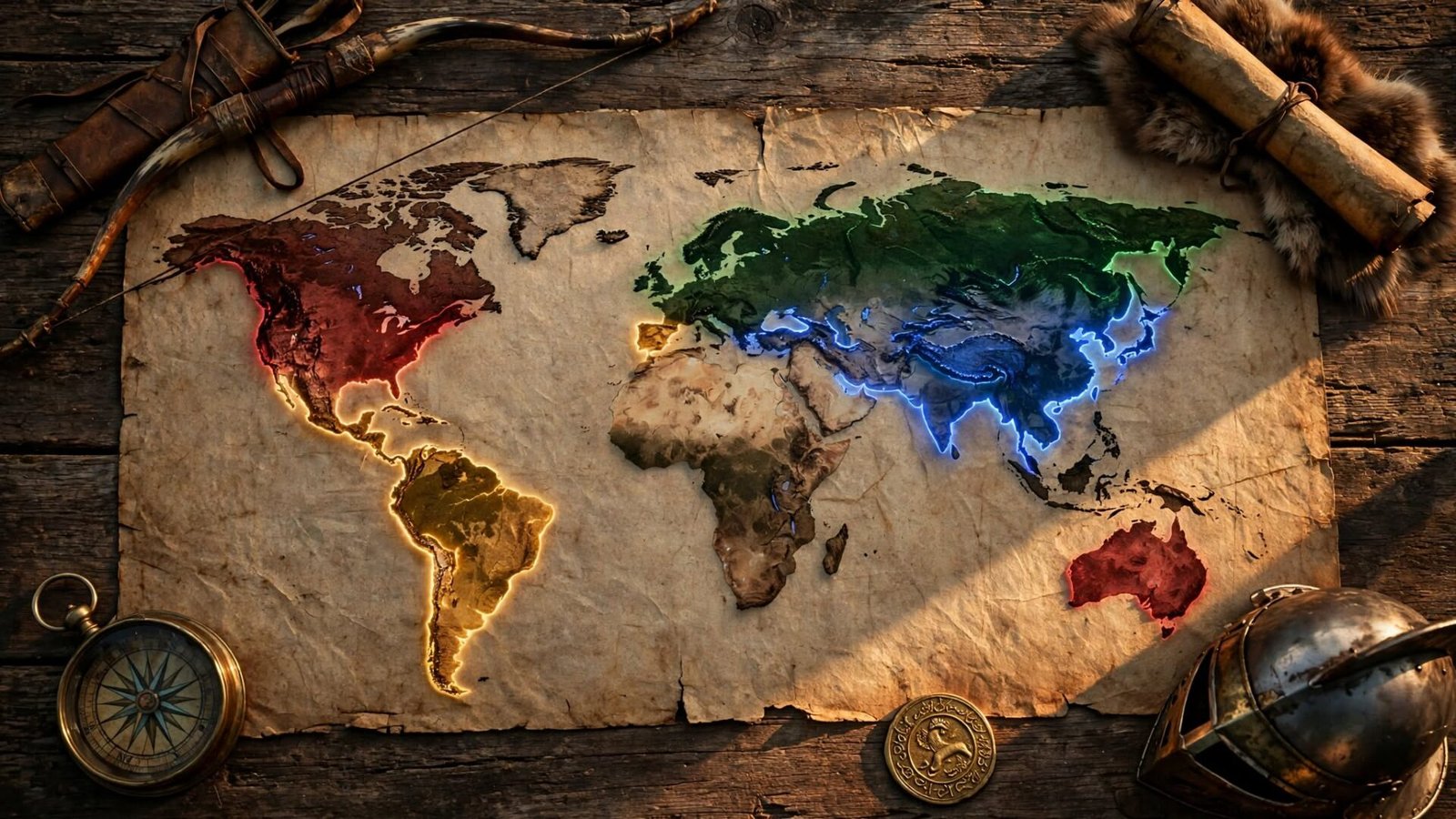
Open any world history textbook, and you’ll find those famous maps—Britain coloured red, the Mongols in blue, and Russia sprawling in green across a dozen pages. They look neat. Tidy, even. Like a person sat down with a plan and achieved it perfectly.
That’s no longer how it happened. Not even near.
Each of these coloured patches on the map becomes, at its centre, a management nightmare. Think about it: you’ve conquered a territory your quickest rider takes three weeks to cross. People there speak a language you do not recognise, worship gods you’ve got by no means heard of, and surely despise you. Now what? How do you collect taxes? How do you stop rebellions? How do you keep the whole thing from falling apart the moment the founder dies?
These ten empires figured it out. Each one differently. Some more brutal than others. But they figured it out—and that’s exactly why they’re on this list.

1. The British Empire—24 million km²
Here’s something that surprises people: nobody in London actually planned to build the biggest empire in history. There was no master blueprint, no secret document outlining global domination. The whole thing just… accumulated. A trading post here, a war of “protection” there, a port seized during some forgotten conflict—all of it piling up over three centuries until, by 1920, Britain somehow found itself ruling over India, Canada, Australia, Nigeria, South Africa, and a scattering of islands so numerous they barely fit on a map.
A quarter of the earth’s land surface. Under one crown.
The Royal Navy made the whole scheme physically possible. Britain is a small island. Without control of the seas, it could never have reached any of this. The navy wasn’t just about warships—it was the actual bloodstream of the empire, keeping the trade routes open, the supply lines moving, and the whole waterborne commercial network functioning. Take away sea dominance, and the British Empire would have collapsed before your grandfather was born.
But military power alone doesn’t explain three hundred years of staying power. What really kept things running was something far less romantic: a well-trained bureaucracy. Oxford and Cambridge were churning out administrators—men who got shipped off to Calcutta or Nairobi or Lagos carrying court systems, revenue structures, and enough procedural manuals to fill a warehouse. The empire, strangely enough, largely governed itself. London set the rules; local populations—particularly the elites who had good personal reasons to cooperate—did the actual day-to-day running of things.
When that system broke down, yes, there were soldiers. But soldiers cost money. Good paperwork was cheaper. The British turned that trade-off into a science.

2. The Mongol Empire—24 million km²
Sixty years. That’s roughly how long it took for the Mongol Empire to explode from a cluster of squabbling steppe tribes into the largest connected land empire ever recorded. The British Empire took three centuries to reach the same territory. The Mongols pulled it off in the time it takes for one generation to raise the next.
Genghis Khan—originally named Temüjin, born somewhere around 1162—didn’t exactly have a privileged start. Kidnapped as a boy. Enslaved as a teen. He built his early alliances via the same parts of real charisma and the form of cold political calculation that only comes from a person who discovered early that trust fees you dearly. By 1206 he’d delivered the Mongolian steppe under a single banner. Then came the expansion that still seems barely believable: northern China, Central Asia, Persia, the Russian principalities, and eventually Poland and Korea under his grandsons.
Everyone focuses on the cavalry, and fair enough—Mongol horse archers were something genuinely special. Mobile, disciplined, and famous for feigned retreats that sucked pursuing armies into devastating ambushes. But winning battles and building empires are two very different things.
What built the empire was something called the Yam—a relay postal system that ran across the entire Mongol-controlled world. Fresh horses and riders waited at stations spaced every few dozen kilometres. A message that would otherwise take weeks could cross the empire in days. In a world with no telegraph, no radio, nothing of the sort, the ability to communicate quickly was raw power. The Mongols had more of it than anyone else alive.
There’s also something people rarely mention about the Mongols: they were surprisingly tolerant rulers, at least toward people who surrendered. Cities that resisted? Annihilated, yes. But cities that submitted found their religions protected, their merchants kept safe, their daily routines more or less intact. Skilled craftsmen were sometimes relocated—not exactly voluntary, but they stayed alive and working. Commerce continued. The Mongol peace, strange as it sounds given how it was established, was real.

3. The Russian Empire—22.8 million km²
Russia’s expansion is one of the genuinely strange stories in imperial history, because it mostly moved sideways rather than outward. East. Always east. Across the Urals, through Siberia, past river systems most Europeans couldn’t name, all the way to the Pacific—and eventually across the Bering Strait to Alaska. By the mid-1800s, Russia spanned eleven time zones.
The tsars didn’t always lead this push. Often they were chasing it. Cossack communities—tough, semi-independent military frontiersmen who existed outside normal Russian social hierarchies—kept pushing east on their own initiative, looking for fur-trade profits and escape from the rigid feudal structures back home. They’d build a fort, demand tribute from local Siberian peoples, and eventually the Russian state would show up, recognise what the Cossacks had grabbed, and send administrators to formalise the claim.
Across all this staggering ethnic complexity—Ukrainian farmers, Tatar Muslims, Buryat Buddhists, and dozens of Siberian peoples—the Orthodox Church served as the empire’s cultural glue. It gave the Slavic core a shared identity and handed the tsars a legitimising story: God had ordained their authority. Resistance to the tsar was, in that framework, resistance to divine order. It wasn’t a perfect system. But it was functional, and function was enough.

4. The Spanish Empire—20 million km²
Columbus touched land in the Caribbean in 1492. By 1550—still within the living memory of people who’d been adults for that first voyage—Spain controlled most of Central America, the bulk of South America, the Philippines, large Caribbean territories, and coastal footholds in Africa. There is almost nothing comparable in the speed of that acquisition anywhere in colonial history.
How? Three factors working together with terrible efficiency.
First, technology: steel weapons, gunpowder, and horses were all unknown in the Americas. Spanish conquistadors weren’t just soldiers—to the peoples they encountered, they were something from another world entirely. Second, and far more devastating than any weapon: disease. The populations of the Americas had no immunity to smallpox, measles, or the other pathogens that arrived with the Spanish. The epidemics that followed contact killed somewhere between half and nine-tenths of certain populations, by various estimates. The conquest was horrifying on its own terms; disease made it near total.
Third: the encomienda system. Spanish colonists received formal grants of indigenous labour—officially in exchange for Christian instruction, in practice as a form of coerced servitude that was slavery under slightly different paperwork. The silver mines at Potosí, in what is now Bolivia, poured out quantities of metal that genuinely reshaped European economies and funded further expansion.
The Catholic Church wasn’t hovering at the edges of this system—it was woven all the way through it. Missionaries followed conquistadors. Dioceses reached into territories where no Spanish garrison was permanently stationed. The Church operated simultaneously as a genuine spiritual enterprise and a tool of colonial management, and it served both purposes without apparent contradiction.

5. The Qing Dynasty—14.7 million km²
When Manchu armies swept through the Great Wall and toppled the Ming Dynasty in 1644, the new rulers had an immediate and very concrete problem: they were a tiny minority governing an enormous majority. The Manchu numbered a few million. Han Chinese numbered in the hundreds of millions.
The Qing solution was more sophisticated than most history books give it credit for. Instead of demanding everyone adopt Manchu culture, they ran different presentations for different audiences. In front of Han Chinese subjects, the emperor appeared as a Confucian ruler—the Son of Heaven, upholding classical Chinese traditions of governance and scholarship. Among Mongolian peoples, he presented as a successor to the Great Khans. Among Tibetan Buddhists, he positioned himself as a devoted patron of the faith, almost a sacred figure. Same ruler, different faces, different throne rooms.
Call it political theatre if you want—it absolutely was. But it worked. It held Tibet, Xinjiang, Mongolia, Manchuria, and the Chinese heartland without requiring armies completely stationed anywhere to suppress steady rebellions.
The Grand Canal, already historic by the point the Qing took strength, supplied the physical backbone of economic integration. Grain from the productive Yangtze Delta moved north to feed Beijing. Without that supply line, the capital couldn’t function. Infrastructure enabling economic coherence—the formula appears across empires regardless of century or continent.

6. The Umayyad Caliphate — 11.1 million km²
Muhammad died in 632 CE. His community of believers controlled the Arabian Peninsula and not much beyond it. Eighty years later, the Umayyad Caliphate stretched from the Atlantic coast of Morocco and Spain to the Indus River in what’s now Pakistan. An entire civilisational world transformed within a single human lifetime.
Religion provided the energy. Administration provided the structure that turned that energy into something lasting. The Umayyads, sensibly, didn’t try to build a bureaucracy from scratch in conquered territories. They inherited the administrative machinery of the Byzantine and Sassanid Persian empires—and kept the same Greek and Persian civil servants running it while Arabic gradually replaced the previous languages of governance. The tax records, land surveys, and postal systems were all kept working, adapted, and refined rather than torn down.
That shift to Arabic as the language of administration across such a vast stretch of the world was itself an act of civilisational construction. It created an intellectual common ground that outlasted the caliphate by centuries—scholars from Spain to Central Asia could correspond and debate and trade ideas in the same language long after the political structure that spread that language had fragmented.

7. The Abbasid Caliphate — 11 million km²
The revolution that brought the Abbasids to power in 750 CE started as a rebellion against privilege. The Umayyads had run an Islamic empire with conspicuous Arab favouritism—non-Arab converts, regardless of their genuine faith, were treated as second-tier subjects. The Abbasids promised something genuinely different: an empire that belonged to all Muslims, whatever their background.
Moving the capital from Damascus to Baghdad—a brand-new metropolis, consciously constructed on the geographic centre of the empire, sitting astride the trade routes connecting the Mediterranean to Central Asia and India—announced the shift physically. Baghdad grew within a few generations into arguably the largest, wealthiest, and most intellectually energetic city in the world.
The House of Wisdom, Bayt al-Hikma, is what humans bear in mind today. It commenced as a translation venture: systematically rendering Greek philosophy, Persian astronomy, Indian arithmetic, and medicine into Arabic. But it became something more—a functioning research institution where scholars weren’t just translating but building on what they’d translated. Algebra. Optics. Advances in medicine and geography. While most of Europe was navigating its early mediaeval centuries with fairly limited scholarly infrastructure, Baghdad was solving quadratic equations and producing some of the most sophisticated maps of the known world.
The Abbasid caliphate held power partly through something you could reasonably call cultural gravity. Baghdad made itself the place every ambitious scholar, merchant, and administrator wanted to be. When the best minds in the world want to come to your capital, your capital benefits enormously. That talent produced administrative capacity, a technological edge, and an aura of prestige that translated, in the real world, into political authority.

8. The Yuan Dynasty — 11 million km²
Kublai Khan’s Yuan Dynasty gets folded into the broader Mongol narrative a bit too effortlessly. It merits separate attention because the hassle Kublai changed into genuinely fixing became unique and simply difficult: how do you rule China—with its lots of years of bureaucratic subculture, its Confucian student-gentry class, and its deeply rooted cultural identity—whilst you’re a conqueror whose human beings the Chinese culturally regard as outsiders?
Kublai’s answer was to perform Chinese-ness, at least publicly. He relocated the capital to Khanbaliq—the metropolis that would in the end turn out to be Beijing—and built a court that combined Mongol and Chinese ceremonial traditions. Military command stayed Mongol; day-to-day governance relied heavily on Chinese directors who knew what they were doing. He patronised Confucian institutions while the ruling class maintained distinctly Mongol customs among themselves.
It worked, up to a point, and not forever. The Yuan lasted less than a century before the Han Chinese rebellion ended it. But during its existence, the Silk Road functioned at probably its peak historical efficiency. Marco Polo’s account—however many embellishments accumulated over centuries of retelling—reflects something real: the Mongol peace created a corridor of safety and commercial activity linking China to the Mediterranean that was genuinely unprecedented. It wouldn’t exist again for a very long time.

9. The French Colonial Empire — 11 million km²
France’s overseas empire was actually built twice. The first version—including substantial parts of North America, the Caribbean, and portions of India—mostly unravelled after a series of 18th-century conflicts with Britain. The second was assembled more deliberately across the 19th and early 20th centuries, focused particularly on North and West Africa, Southeast Asia, and scattered Pacific territories.
What distinguished French colonialism, at least according to the French, was something called the mission civilisatrice—the civilising mission. The official line was that France wasn’t simply extracting resources or securing strategic positions; it was bringing French civilisation—language, secular law, rational governance, and education—to peoples who would benefit. This was, of course, a convenient rationalisation for conquest. But rationalisations with administrative consequences are different from empty ones.
The French genuinely invested in colonial education systems, legal infrastructure, and urban planning in ways that reflected the ideology. West African students could theoretically sit the same baccalaureate examinations as students in Lyon. French law applied, at least formally, in Dakar and Hanoi. The cultural transformation outlasted the political empire. Former French colonies today still operate legal systems drawn from the Napoleonic Code, conduct official business in French, and run educational systems bearing the marks of what France planted there.

10. The Achaemenid Persian Empire — 5.5 million km²
The Persian Empire under the Achaemenids is the smallest entry on this list and, honestly, the most interesting one—not because of its scale, but because of what it worked out about governing people that nobody else in that era came remotely close to understanding.
Cyrus the Great built the empire in the mid-6th century BCE around a principle that was genuinely radical for his time: conquering people didn’t require destroying what made them who they were. When he took Babylon in 539 BCE, he freed the Jewish people who had been held there in captivity. Local religious practices were respected. Competent local administrators kept their jobs. This is documented both in Hebrew scripture and in the Cyrus Cylinder—one of the earliest surviving documents that we might recognise as a human rights declaration.
This wasn’t compassion for its own sake. Cyrus was a pragmatist. Rebellions are expensive. People who’ve been allowed to keep their temples, their priests, and their cultural traditions have considerably less burning motivation to revolt. Tolerance was, at bottom, a cost-saving measure. But it worked, and the contrast with empires that ruled through pure terror and erasure is striking.
Darius the Great then formalised the administrative structure. The empire was divided into satrapies—provinces governed by royally appointed satraps with a degree of regional flexibility—all connected by the Royal Road, a 2,700-kilometre highway from the Aegean coast to the Persian heartland. Royal couriers on relay horses could cover that distance in roughly a week. Standardised weights, measures, and coinage made commerce work across dozens of languages. For 500 BCE, it was a system of extraordinary sophistication.
The Thread Running Through All of It
Strip away the dates. Strip away the specific places and the names of the rulers.
Put the British civil service administration next to the Persian satrapy system. Compare the Mongol Yam relay network to French colonial postal infrastructure in West Africa. Look at how the Qing presented different imperial identities to different ethnic groups and notice how closely that mirrors what earlier empires did with the same challenge.
The same basic logic keeps reappearing: make staying inside the system more attractive than trying to break out of it.
Roads that opened up trade. Currencies that let commerce function efficiently across ethnic and linguistic lines. Legal systems that gave people a way to settle disputes without picking up weapons. Administrative careers that gave local elites a genuine personal stake in maintaining the order that gave them their positions. The goal wasn’t happy subjects—it was subjects for whom rebellion simply cost more than compliance.
Empires that skipped this and tried to rule through sheer fear and extraction without any underlying system burnt out fast. Terror is exhausting to maintain. It requires constant reinforcement. A system that’s properly built, on the other hand, develops its own momentum—people behave in certain ways not because someone is watching but because the system has shaped what feels normal and sensible.
That’s the real story those coloured blobs on the history maps are telling, if you spend long enough looking at them. Not just that, these empires were large. Size by itself is just a temporary fact. System is what turns a temporary fact into something that lasts generations.



+ There are no comments
Add yours