


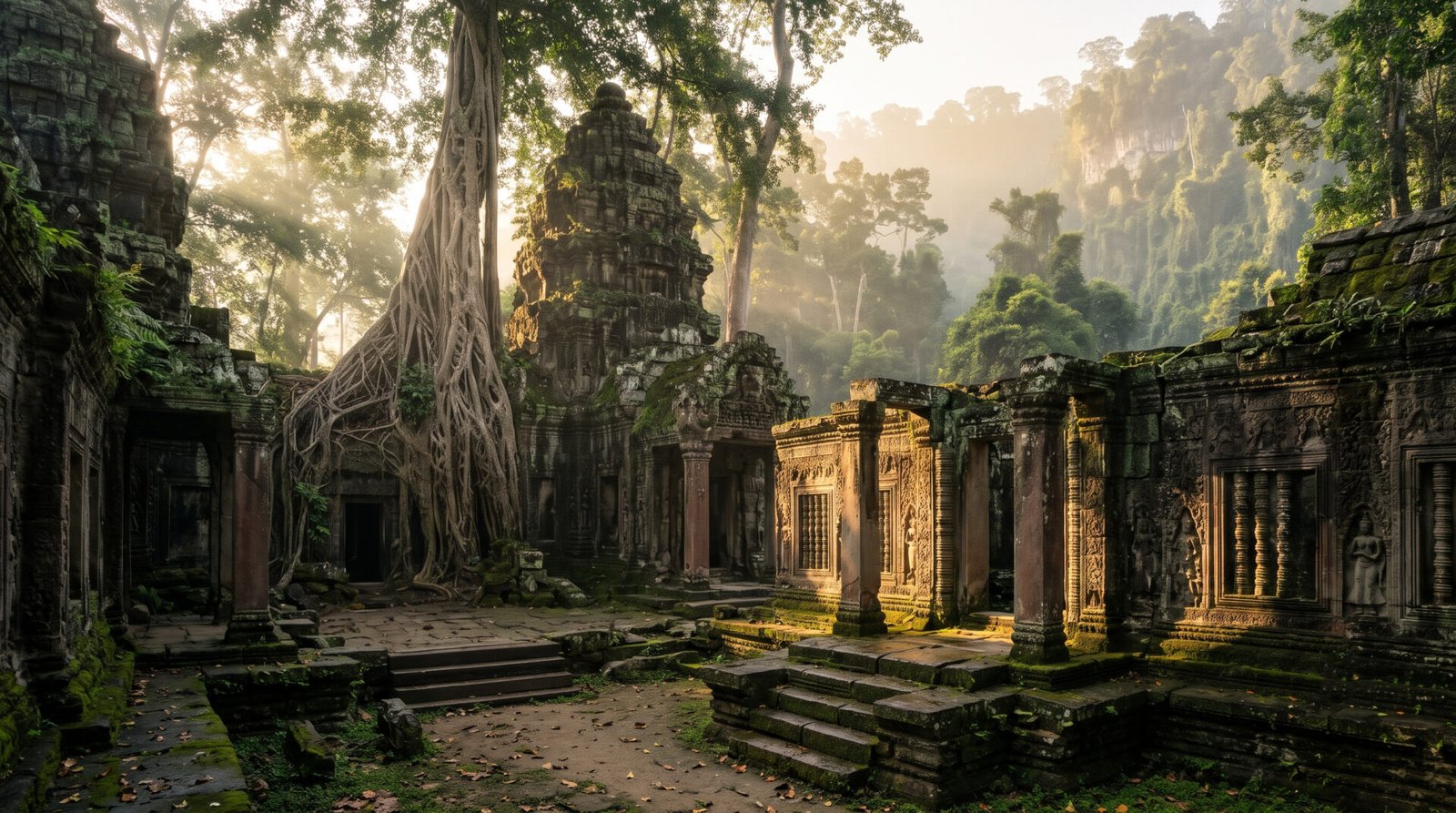
Whilst we are all familiar with some of the world’s most renowned temples, cathedrals and mosques – the temples of Greece, cathedrals of Europe and mosques of the Middle East – there are also many hidden temples. Although perhaps not as easy to locate, these temples provide a highly personal and moving experience. Being able to appreciate nature in its purest form, such as the rustle of leaves in the trees and not the noise of a thousand selfie sticks, and to connect to the rich history of a location in the stone beneath your feet, without the pressure of a group led by a guide with a megaphone, is a truly wonderful experience. In this article, we will discover six of the world’s hidden temples. These include temples that are architectural masterpieces, those that act as places of worship, and those that have been shrouded in mystery throughout history. Each has its own fascinating background and provides a window into a particular culture. A bonus is that all provide a moment of beautiful reflection that will stay with you for a lifetime.
Pick up your imaginary passport, and let us begin our expedition into the unknown.

1. Kailasa Temple – Carved Mountain (India)
Whilst normally people collect materials to then construct a building from the ground up, the Kailasa Temple in India was created in the reverse fashion. People carved a temple from the summit of a huge mountain, working downwards. There was no room for mistakes. This is precisely how the Kailasa Temple was formed in the Ellora Caves, Maharashtra.
Although it is a temple, the Kailasa Temple is also an amazing example of rock-cut architecture. Unlike the caves of Ellora, this temple is a free-standing multi-storey building which was also carved from a single block of basalt. Likely constructed in the 8th century by the Rashtrakuta dynasty, the temple was built from the apex downward. Within it, there is a courtyard, columns, halls, and a central shrine to Lord Shiva.
Its sheer size is astonishing. Measuring 164 ft in depth, 109 ft in width, and 98 ft in height, it is estimated that in excess of 200,000 tonnes of rock were excavated to form this temple. The vision and determination required to undertake such an endeavour are astounding. How did they manage this without modern machinery? Unfortunately, nobody knows for certain. However, the level of precision is exceptional. The temple walls are adorned with elaborate carvings illustrating stories from Hindu mythology. Equally impressive are the lifelike elephant statues that guard the temple entrance – you almost half expect them to roar!
As you step into the temple courtyard, you are literally inside what was once a mountain. It is an extremely moving experience and emphasises the incredible ingenuity and determination that humans are capable of. This is a location which really does encapsulate our ability to achieve the seemingly impossible.
Travel Guide
For cooler temperatures, the best time to visit is between October and March. The temple is situated in Ellora and is approximately 30 km from the city of Aurangabad. You can fly into Aurangabad and then hire a car or catch a bus. Although this is a popular attraction for local people, in order to maximise the potential for a more tranquil visit, it is advisable to go early in the morning.

2. Borobudur – Jungle Stone Mandala (Indonesia)
Deep within the jungles of Central Java, Indonesia, lies one of the world’s most impressive Buddhist temples. Borobudur is not only a temple but also a three-dimensional ‘mandala’ – essentially a stone spiritual map of the universe. For many centuries, Borobudur was concealed beneath layers of volcanic ash and jungle and was not rediscovered until the 19th century.
Built by the Sailendra dynasty in the 9th century, the temple was constructed as a place of pilgrimage. As you ascend the temple’s various levels, you are metaphorically travelling from the material world and progressing on the path towards enlightenment. Lower levels of Borobudur are lavishly decorated with carvings which illustrate the life of Buddha together with the effects of positive and negative karma. As you move upwards, the detail on the carvings becomes less elaborate, and the area becomes more open. Finally, at the summit, there are stupas containing Buddha statues.
The temple is an architectural wonder. Entirely shaped like a stepped pyramid, it is a stupendous feat of construction. Nevertheless, it is the detail that is so mesmerising. There are over 2,600 stone-relief carvings and 504 Buddha statues. Each relief has a narrative, and the quality of the workmanship is outstanding. It can easily occupy you for hours simply analysing the stories illustrated.
Equally spectacular, though, is Borobudur’s setting. Nestled within a verdant valley and encircled by volcanoes, it is a breathtaking environment. Ideally, you should visit at sunrise. At this time of day, the morning mist has not yet fully dispersed, and the first rays of sunlight gradually reveal the true magnitude of Borobudur. Watching the sun rise above the surrounding jungle and mountains with Borobudur’s outline as the foreground image is an experience that stays with you. The temple exudes an extraordinary atmosphere of both serenity and strength.
Travel Guide
Borobudur is approximately 40 km northwest of Yogyakarta. Again, you can fly into Yogyakarta and then hire a car or catch a taxi. The ideal period for visiting is during the dry season, which runs from May to September. In order to witness Borobudur at sunrise, you will need to arrive at the temple very early in the morning. Special tickets can be obtained to allow entry to the temple prior to the general public.

3. Konark Sun Temple – Chariot of the Sun God (India)
Another Indian temple – this one is entirely different. Situated in Odisha, the Konark Sun Temple is a stunning temple ruin. It reflects both the former opulence and subsequent decline of the location. Designed in the shape of an enormous chariot, it includes large wheels, horses, and a charioteer for the sun god (Surya).
Constructed in the 13th century by King Narasimhadeva I, this temple was once an awe-inspiring building that loomed over the coast. It was intended to be a model of Kalinga architecture. Perhaps the most recognised feature of Konark is the pair of huge wheels (approximately 10ft in diameter) which are positioned at the temple’s base. In fact, these wheels also function as sundials, and the precision of the carving of their spokes allows the time of day to be identified.
Although the main temple (sanctuary) is now ruined, and its main pinnacle has collapsed, the temple is still spectacular. The vastness of the chariot, the magnificent horses which appear to be straining at their bridles, and the beautiful detail of the temple are all a credit to the expertise and ambition of those who constructed it.
The temple walls are famed for their carvings, which showcase all facets of life in this period. From everyday existence to religion; from soldiers to dancers; and even eroticism – it is effectively a 13th-century stone encyclopaedia. Legend has it that the temple was so perfect that its architect, Dharmapada, was murdered to ensure he could never produce such an exquisite building again. Although a sad tale, it does underline just how incredible the Konark temple is believed to be.
Today, a visit to Konark allows you to travel back in time. The temple ruins are exquisitely beautiful, and it is easy to envisage the sound of the wind sweeping over the ancient stone and to imagine how lively the temple must once have been as a centre of religious fervour.
Travel Guide
The temple is in the town of Konark and is around 65 km from the city of Bhubaneswar. Once again, you can fly into Bhubaneswar and then hire a car. The best months to visit are between October and February. Don’t miss the annual Konark Dance Festival (December), which showcases classical Indian dancing against the backdrop of the temple. It is an enchanting event.

4. Pura Besakih – Mountain Mother Temple (Indonesia)
Returning to Indonesia, we now come to the mystical island of Bali. Pura Besakih, or Mother Temple, is the biggest and most sacred temple complex on the island. Again, rather than one temple, Pura Besakih comprises more than 20 individual temples. It is perched atop the slopes of Mount Agung – the highest and most sacred mountain on the island.
Pura Besakih is a stunning sight. Black pyramidal shrines (meru) climb the mountainside and are frequently obscured by cloud cover. The temple complex is an exemplary example of Balinese architecture and perfectly unites the spiritual and natural worlds. Throughout the temple, the rich aroma of incense pervades, and the gentle notes of traditional gamelan music can often be heard.
For the Balinese Hindu community, Pura Besakih has strong historical significance. It is thought that it has been a sacred location for many centuries, even before the existing temples were constructed. It has been a place of worship for in excess of one thousand years. Each of the 20-plus temples serves a particular function and is dedicated to a different deity. Consequently, Pura Besakih enables you to gain real insight into the core of Balinese religion.
The temple oozes atmosphere. Locals come here to pray and present fruit and flower offerings. Beyond its historic value, the temple is very much alive as an active place of worship. It radiates a strong sense of spirituality and connection to the divine. Furthermore, it appears to be exceptionally well integrated with the surrounding potent and volcanic landscape.
Travel Guide
Pura Besakih can be found in the eastern part of Bali. It is a 2-hour car journey from the main tourist areas of Kuta and Seminyak. The best time of year to visit is during the dry season (April-October). Dress modestly. Sarongs and sashes can generally be hired or bought at the temple entrance. Although there will be vendors and guides, a local guide can be useful in helping you to navigate the temple complex and share information relating to its history.

5. Temples of Baalbek – Giants’ Playground (Lebanon)
Picture the Romans at the peak of their power deciding to construct their most impressive temples in an area which would eventually be forgotten by the world. Baalbek, in the Beqaa Valley of Lebanon, is an absolutely stunning archaeological site. Even though it is not a small temple, it is undoubtedly a world treasure trove of archaeological interest. Furthermore, it is arguably the best-preserved Roman archaeological site in the world.
Most noticeable on the site is the Temple of Bacchus. Unlike Athens’ Parthenon, this is exceptionally well preserved. The columns are huge, and the engravings are highly intricate. Even more surprisingly are the massive stones that formed part of the temple’s base. There is further mystery at Baalbek in the form of the ‘Trilithon’. This consists of three massive stones which were also part of the base of the Temple of Jupiter. As well as being extremely large, these stones are among the largest ever to have been used in construction. Each stone is approximately 800 tonnes in weight! Given their massive size, some people have suggested that they could even have been made by giants or even primitive aliens.
Over the centuries, both historians and engineers have been fascinated by the means by which these large stones were conveyed and then raised into place. Undoubtedly, this is the most puzzling archaeological feature at Baalbek. When you view these stones, you rapidly feel extremely small. It is truly impossible to fully comprehend their vastness! Historically, Baalbek has served a variety of purposes. Originally, it was a sacred Canaanite site, then evolved into a Greek city before becoming a Roman temple area. Subsequently, it was converted into a Byzantine church and then a Muslim stronghold. All of these different time periods are apparent within the stone structures.
Travel Guide
Baalbek is located 85 km northeast of Beirut. Again, you can both hire a car and/or take a day tour from Beirut. Ideally, try to visit between spring (March-May) and autumn (September-November) to experience good weather. However, before travelling to Lebanon, please check your country’s travel guidelines, as this area can occasionally be politically unstable.

6. Göbekli Tepe – Temple Before Time (Turkey)
To round off our journey, we now explore the most interesting and oldest temple. Göbekli Tepe, situated in south-eastern Turkey, is not only a secret temple, but also the world’s oldest recognised temple. It has completely changed archaeologists’ perception of human history.
A number of circular temples have been built on a hilltop. They are supported by enormous T-shaped stones which are further embellished with detailed carvings. Remarkably, these temples were constructed some 9500 years ago – thousands of years before the invention of agriculture and the wheel. Therefore, our hunter/gatherer ancestors – previously considered to be basic and primitive – were not only capable of managing large-scale building projects but were also producing stunning artwork.
What was the function of Göbekli Tepe’s temples? Did they form part of an extinct religion? There are infinite theories as to this. However, all we currently know for certain is that after a few thousand years, the site was intentionally covered over. This is why it has been so well preserved for such a lengthy period of time. Since its rediscovery in the 1990s, our understanding of human civilisation has had to be revised.
Visiting Göbekli Tepe is extremely humbling. It enables you to physically handle stones which were carved by people who lived 12,000 years ago – well before the commencement of history as we know it today. It therefore provides a link to our most ancient ancestors and emphasises that although human innovation and our desire for spirituality are not new phenomena, they are in fact integral to our identity.
Travel Guide
Göbekli Tepe is close to the city of Şanlıurfa in south-eastern Turkey. Again, you can fly into Şanlıurfa and then take a taxi for around 20 minutes to reach the temple. As with many archaeological sites, the best time to visit is during Spring or Autumn. Also, please note that this site is a UNESCO World Heritage Site and is currently the subject of major archaeological study. Before travelling, check for up-to-date information and opening times.
Why Visit Hidden Temples?
Whilst there are many highly recognised and visited locations in the world, there is nothing wrong with travelling to these. However, there is often a certain enchantment associated with visiting less well-known sites – those which may require more exertion to access. In comparison to more mainstream locations, hidden temples can therefore provide an individual with a more personal, genuine and meaningful experience. Rather than simply being points of interest, they offer a portal to the essence of a culture, its history and its people.
They educate us regarding what it is to be human, our capacity for innovation, and also regarding the continuing mysteries that remain embedded in our collective past. Next time that you are planning a holiday, perhaps attempt to venture along less travelled routes. Who knows what incredible treasures await you in the more obscure locations?



+ There are no comments
Add yours