


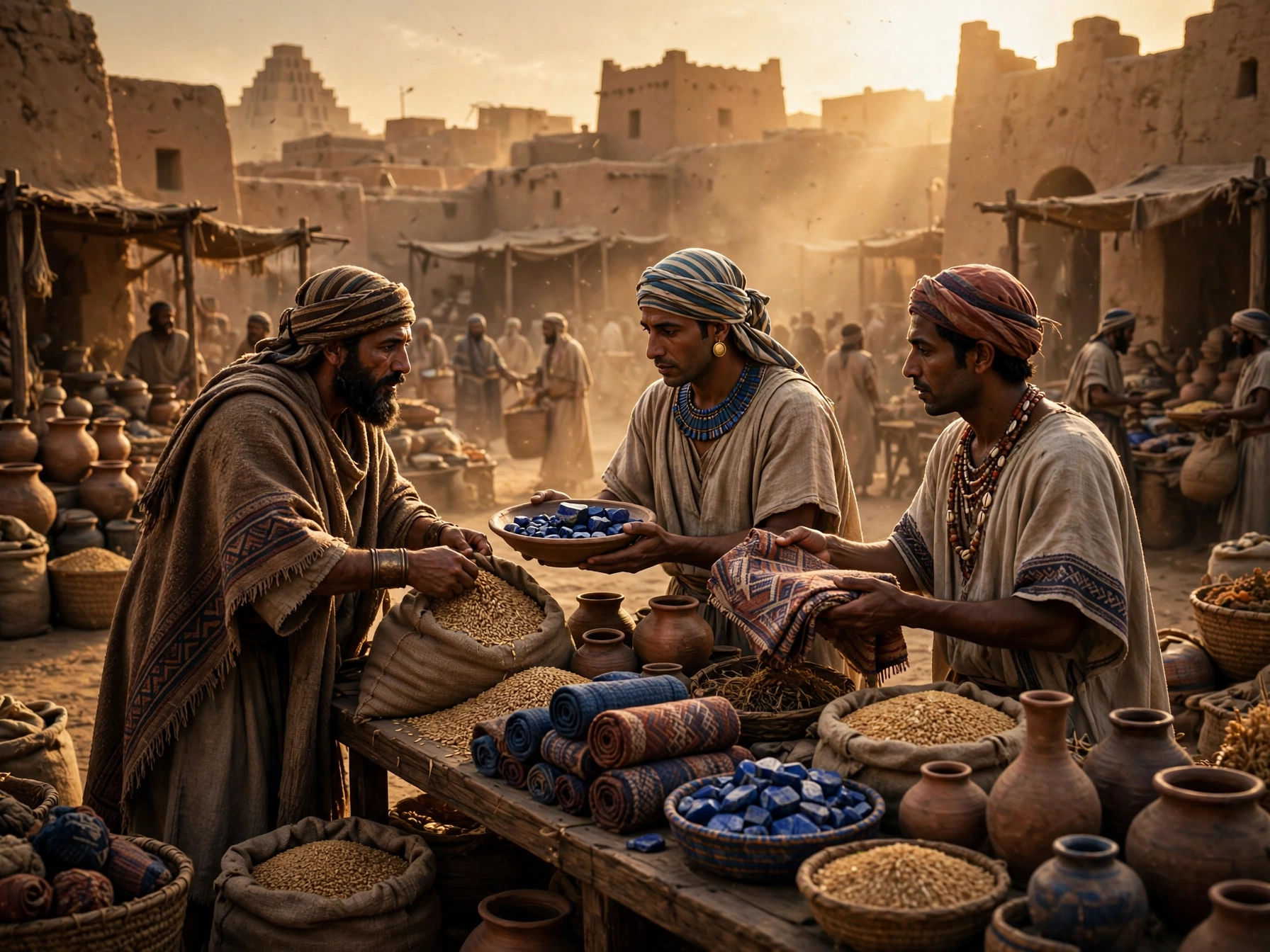
Imagine walking into a busy marketplace — vendors shouting, goods piled high, deals being struck left and right. Now strip away every coin, every banknote, every digital payment. What’s left?
Surprisingly? Everything still works.
That’s exactly how our ancestors operated for thousands of years. Long before the first coin was ever minted, ancient peoples were building complex, functioning economies that moved goods across continents, fed entire cities, and created wealth systems sophisticated enough to make modern economists stop and think.
The story of trade before money isn’t simple. It’s not just about humans swapping chickens for footwear. It’s a layered, deeply human story about social bonds, energy, and the fundamental need to connect through exchange.
Let’s dig into it.

What “Economy” Really Meant Before Money Existed
Most folks had been taught a neat little tale in school: human beings used to negotiate; bartering became inconvenient, so a person invented money, and that solved the whole thing.
Clean. Simple. Almost entirely wrong.
The reality is far more interesting. Before money — and even before formal barter — ancient societies ran on something far more powerful: relationships. The movement of goods in early human communities was deeply tied to social obligation, community standing, and mutual survival. Economy, in its oldest form, wasn’t about profit. It was about people.
Anthropologists today recognize at least three core systems that ancient civilizations used to move goods and resources:
The Gift Economy — giving freely with the social expectation of reciprocity over time. The Barter System — the direct exchange of goods and services. Redistribution—a central authority (often a temple or palace) amassing resources and redistributing them across the populace.
Each of those structures tells us something different about how ancient people understood value, tradition, and community. And none of them required a single coin.
The Barter Myth — And What Actually Came First
Here’s the thing about barter: economists have long used it as the “before money” placeholder. The idea that early humans simply swapped goods directly — your grain for my pottery — sounds logical. But when anthropologists and archaeologists actually examine ancient societies, formal barter systems are surprisingly hard to find as a primary economic model.
The famous anthropologist David Graeber, in his research on debt and economic history, pointed out that there’s virtually no archaeological or historical evidence of societies that primarily operated on direct barter. What we find instead is far more nuanced.
Barter certainly happened. Obsidian—the sharp volcanic glass used for equipment and weapons—was traded across giant distances in prehistoric Anatolia as long ago as 12,000 BCE. Neolithic farmers in Europe exchanged surplus grain for stone gear they could not make themselves. But these had usually been secondary exchanges, no longer the backbone of regular economic life.
The real foundation? Social exchange. Trust. Community.

The Gift Economy — Humanity’s Original Trade Network
Before barter, before money, before markets—there was the gift.
Gift economies operated on a principle that sounds almost radical today: you give without demanding immediate return. But that doesn’t mean you give for free. In gift economies, generosity creates obligation. When you give someone food today, you don’t hand them an invoice—but both of you understand, on a deep social level, that they owe you. Not in a transactional way. In a human way.
This system built the social fabric of early communities. It created alliances. It established a reputation. The person who gave the most was often the most powerful — not because they hoarded wealth, but because they had the most people indebted to them socially.
Some of the most wonderful examples of gift economies come from cultures that survived long enough for historians to record them. The Kula Ring of the Pacific Islands is one of the most studied. Communities across hundreds of miles of ocean exchanged ceremonial arm shells and necklaces in an elaborate, ongoing cycle of gift-giving. The objects themselves had little practical value. But the relationships they created? Invaluable. Trading partners were friends, allies, and safe harbors in dangerous waters.
In North America, the Potlatch ceremonies of Pacific Northwest Indigenous nations worked similarly. Chiefs would hold massive feasts and give away enormous quantities of goods — blankets, food, copper — to demonstrate their wealth and generosity. Status came not from what you kept, but from what you gave.
These weren’t primitive customs. They were sophisticated economic systems that maintained peace, distributed resources, and built networks spanning thousands of miles.
Mesopotamia—Where Economy Got Serious
Around 3500 BCE, in the river valleys between the Tigris and Euphrates, something new began to take shape. Sumerian civilization didn’t just trade — it organized trade. And in doing so, it invented concepts that still underpin modern economies today.
The Sumerian temple wasn’t only a religious building. It became a financial institution, a warehouse, a distribution center, and an accounting workplace all rolled into one. Priests accumulated grain, wool, and cattle from farmers and craftspeople, recorded the whole thing on clay tablets, and redistributed goods throughout the community. These clay capsules—essentially the world’s first receipts and invoices—survive to this day in museums, giving us a remarkably clean picture of how this system worked.
What’s lovely is that debt existed in Mesopotamia nearly 2,000 years earlier than coins were invented. Farmers ought to get hold of grain now and promise to return it with interest after the harvest. Workers could be paid in rations tracked on clay tablets. Merchants could travel with letters of credit rather than carrying heavy silver.
Speaking of silver, Mesopotamians did use it as a standard of value. But not as coins. Silver became measured by weight, in devices referred to as shekels, and used for massive transactions and record-keeping. Everyday change still came about via labor trade, grain, and social duty.
The picture that emerges from Mesopotamia isn’t of primitive human beings struggling to make ends meet. It’s a complex, layered economy with expert merchants, credit structures, interest charges, and international trade networks stretching from the Persian Gulf to the Mediterranean.
The Indus Valley’s Quiet Economic Miracle
While Mesopotamia receives the maximum of the historical economy’s attention, the Indus Valley Civilization—flourishing from around 2600 to 1900 BCE across what’s now Pakistan and northwestern India—achieved something quietly remarkable.
At its height, the Indus Valley turned into a home to some of the largest cities on Earth. Mohenjo-daro and Harappa were urban masterpieces of planning and sanitation. And they traded widely, extensively, and with a degree of standardization that still impresses researchers.

Archaeologists have found uniform weights and measures used consistently across settlements separated by over a thousand kilometers. This wasn’t unintentional. It points to a deliberate, prepared alternate network that required standardization to function. You can’t trade reliably if every city uses different measures.
What makes the Indus Valley economy particularly fascinating is what’s absent. Unlike Mesopotamia and Egypt, there’s very little evidence of large temples or palaces controlling economic activity. No royal storehouses dominating the landscape. No evidence of a warrior class extracting tribute.
The prevailing theory among researchers is that Indus Valley trade ran largely through merchant networks and mutual agreement rather than top-down control. Goods like carnelian beads, cotton textiles, timber, and ivory moved through these networks to Mesopotamia and the Persian Gulf, making the Indus Valley one of the ancient world’s great trading civilizations—one that barely gets a mention in most history textbooks.
Ancient Egypt — The Economy of Grain and Labor
Egypt’s economy changed into one constructed on foundations: grain and the Nile.
The annual flooding of the Nile deposited fertile silt throughout farmland, making Egypt one of the most agriculturally efficient regions within the ancient world. The pharaoh, as both political and divine ruler, theoretically owned all of it. In practice, this created a massive redistribution economy—grain flowed into royal and temple storehouses and was paid out as wages to workers, soldiers, and state employees.
The workers who constructed the tombs at Deir el-Medina were not slaves, as popular imagination regularly suggests. They were professional craftspeople who received an everyday fee in bread, beer, fish, vegetables, and, from time to time, copper tools. When payments were late — which happened — they went on what might be history’s earliest recorded labor strike.
Egypt did eventually develop a proto-currency: the deben, a copper weight used as a unit of account. A pair of sandals might be worth half a deben. A goat, perhaps two deben. But actual coins didn’t appear in Egypt until Greek influence arrived much later. Before that, goods and services were priced in deben units, but physical exchange was still in commodities.
When Did Money Actually Appear — And Why?
The first actual coins—standardized pieces of steel with a guaranteed weight and a legit stamp—seemed around 600 BCE in Lydia, a state in what is now western Turkey. The Lydians, sitting at the crossroads of essential change routes, wanted a way to facilitate transactions among strangers who didn’t share social bonds or agree on networks.
And this is the important thing: perception: money wasn’t invented because human beings were struggling to barter. It was invented because economies had grown so massive and so geographically spread that the non-public relationships that once backed exchange should no longer do the job alone.
Coins solved the trust problem at scale. You didn’t need to know the merchant personally. The coin itself carried guaranteed value, stamped by an authority both parties recognized.
But by the time coins appeared, the fundamental structures of the economy—credit, debt, pricing, interest, long-distance trade, and wages—had already been in place for thousands of years. Money didn’t create the economy. The economy created money.

What Ancient Economies Teach Us Today
Standing back and looking at the full sweep of pre-monetary trade, a few things become clear.
First, the economy is fundamentally social. Before there were markets, there were relationships. Trust was the original currency, and communities that built stronger trust networks traded more successfully than those that didn’t.
Second, complexity isn’t a modern invention. The Mesopotamians were running credit systems and international trade networks four thousand years before smartphones existed. Human ingenuity in the face of practical necessity is, apparently, timeless.
Third—and perhaps most interestingly—gift economies never actually disappeared. Open-source software, Wikipedia, community gardens, and mutual aid networks: these are all gift economies operating in the modern world, still running on the ancient principle that giving creates connection, and connection creates value.
Our ancestors didn’t need money to construct wonders. They needed something older, simpler, and more effective.
They needed each other.



[…] something your history teacher probably never said out loud: the stories we were taught about ancient civilisations were edited. Not necessarily wrong — just carefully trimmed. The uncomfortable parts got […]