


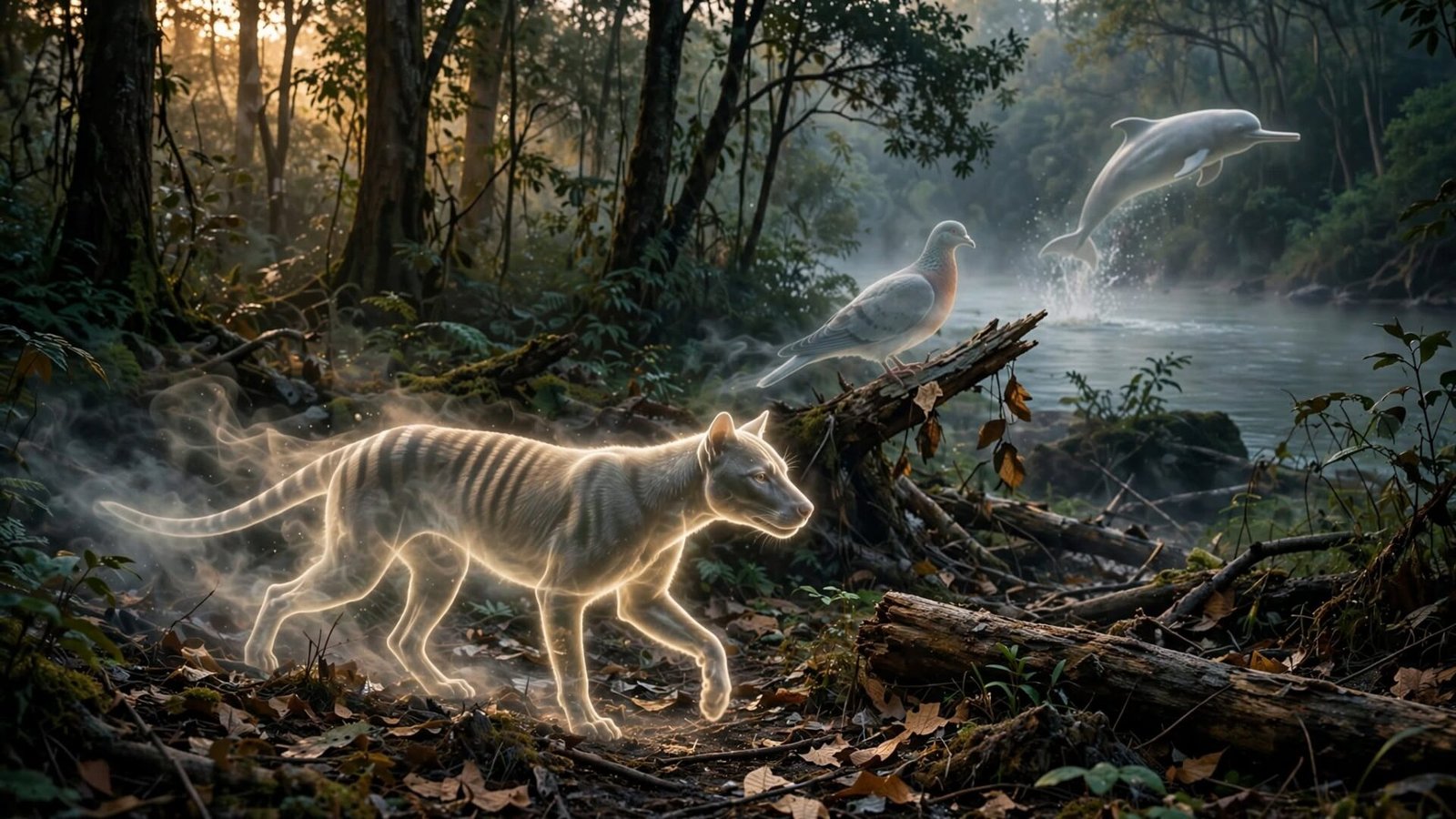
A sixty-two-second film sits in a storage room somewhere. Most people will never see it, let alone go looking for it.
It was shot in 1933. Hobart Zoo, Tasmania. On screen is an animal — striped across the back and hindquarters, lean in the way a working predator tends to be, moving with a gait that doesn’t match anything you have a word for. It’s not a dog. It’s not a cat. It opens its jaw extraordinarily wide. It pauses, glances toward the camera with the mild disinterest of something that has nowhere pressing to be, then looks away.
Three years after that footage was recorded, the animal was gone.
Not just that individual. Every single one of them. The whole species — finished.
There was no ceremony. No announcement. No flags at half-mast. The newspapers that week were busy with other things, which they always are. The way it happened was almost absurd in its smallness: a zookeeper forgot to bring the animal in for the night. It died alone in the September cold in 1936, and the world that had spent decades systematically hunting its kind to oblivion barely registered that the last one had now followed.
That’s almost always how extinction lands. Not as a dramatic moment that everyone collectively experiences, but as a quiet accumulation — one failed breeding season, one more empty survey, one morning you realise the mornings have been adding up for longer than anyone was paying attention. The grief, if it comes at all, comes late. The actual ending is almost always private.

Why the Twentieth Century Stands Apart
Species have been disappearing forever. Long before humans, long before anything we’d recognise as history. The fossil record is essentially an enormous catalogue of everything that didn’t make it — the ice ages that reset the board, the volcanic episodes, the asteroid that slammed into the Yucatan Peninsula sixty-six million years ago and erased around three-quarters of all life on Earth in what geologists call the Cretaceous-Paleogene extinction event.
So extinction isn’t the anomaly. What the twentieth century introduced was something different: speed.
Forests that had been standing since before written history were levelled in years, sometimes months, using machinery that could clear an acre before lunch. Wetlands were drained at a pace ecosystems had no mechanism to process. Rivers were dammed, deepened, rerouted, and industrialised. Ocean fisheries that had seemed inexhaustible became commercially unviable within a single generation, largely because fishing technology had become terrifyingly efficient.
Wildlife is actually quite resilient. The history of life on Earth is a history of surviving serious, sustained adversity. What evolution doesn’t have an answer for — what it genuinely cannot accommodate — is adversity that moves faster than reproductive cycles can keep up with. You cannot adapt to conditions that change more quickly than your species can produce and raise offspring. The twentieth century moved that fast, across essentially every habitat simultaneously, and left animals and plants with nowhere to retreat.
Stack habitat destruction on top of commercial hunting, on top of introduced species in ecosystems with no defences against them, on top of freshwater and atmospheric pollution, on top of the early decades of a climate shift that added new instability to everything — and you get a cascade of losses that scientists are still mapping.
That cascade hasn’t stopped.
The Animal That Shouldn’t Have Been Killable
If you encountered a thylacine today, it would genuinely stop you cold.
First impression: large, short-haired dog. Something’s off immediately — the stripes across the back and hindquarters, the tail that barely moves, and that jaw, which opened to an angle no jaw really has business reaching. Look longer, and you realise you’re not looking at a dog at all. It was a marsupial carnivore that had spent millions of years evolving in isolation at the southern edge of the world and had arrived, through an entirely separate evolutionary route, at something that looked vaguely canine and filled exactly the ecological niche a canine would fill. A remarkable accident of parallel evolution.
Before Europeans arrived, thylacines had already vanished from mainland Australia and New Guinea — most likely outcompeted by dingoes, which humans had introduced, possibly also pressured by hunting. Tasmania was the last place they existed, and they’d been living there successfully for a very long time.
What followed European settlement is a story with a depressingly familiar shape. The colonial government of Tasmania decided the thylacine was a threat to sheep farming. Whether this was even accurate is genuinely contested — there’s some evidence thylacines were blamed for losses actually caused by wild dogs — but accuracy became irrelevant in 1888 when the government formalised a bounty system. Two shillings and sixpence for an adult. One shilling for a pup.
The killing was thorough. Over roughly two decades, more than two thousand bounty claims were paid out. The actual number killed was higher; plenty of farmers couldn’t be bothered with the paperwork. By the 1920s, the species was rare enough that zoos were paying serious money for live specimens, which introduced yet another economic pressure on a population already in freefall.
Protection was finally declared in July 1936. By that point, the last known living thylacine was a single captive animal in Hobart Zoo. It died in September, alone. The date — the 7th — is now Australia’s National Threatened Species Day, which is about as melancholy a tribute as you can get.
Sightings have been reported from the Tasmanian wilderness ever since. Blurry photos. Thermal imaging that doesn’t hold up under scrutiny. People want it to be true, and the wanting is understandable. The probability is very low.

The One That Should Have Been Impossible to Lose
The thylacine’s story is about deliberate elimination. The passenger pigeon’s story is different — it’s about what happens when you eliminate something without even particularly intending to.
Getting across how many passenger pigeons existed is genuinely difficult, because the numbers resist imagination. Billions is the figure researchers use. To make it concrete, you need the historical accounts: flocks so large they blocked out the sun at midday, taking three days to pass over a single observation point. Nesting colonies covered hundreds of square miles. John James Audubon described the sound of a flock in flight as somewhere between a gale wind and a waterfall. A single colony documented in Wisconsin in the 1870s was estimated at 136 million birds, spread across more than 850 square miles of forest.
By any rational measure, the passenger pigeon was among the most successful bird species ever to have evolved. Its strategy — enormous numbers, colonial nesting at a massive scale — had worked for thousands of years. Then the railroads arrived.
Commercial hunters could now follow the flocks anywhere, slaughter them in vast quantities using nets and guns and sometimes simply poles and clubs, pack the carcasses into barrels, and have them in markets in Chicago or New York or Boston within days. Pigeon meat was cheap. Because it was cheap, the market was huge. Because the market was huge, the hunting never let up. And because the birds kept returning to the same communal nesting grounds — predictable, concentrated, and easy to find — hunters were ready for them every single time.
The collapse was built into the very survival strategy that had made the species so successful. Passenger pigeons needed large colonies to breed effectively. As hunting thinned the numbers, colonies began falling below the threshold at which they could function. Reproduction declined. Numbers dropped further. The remaining birds couldn’t form viable nesting groups. The spiral accelerated downward until there was nothing left to spiral.
The last confirmed wild passenger pigeon was shot by a fourteen-year-old boy in Ohio in 1900. The last individual anywhere on Earth — a female named Martha, who had lived at Cincinnati Zoo since 1902 — died on the first of September, 1914. She weighed 292 grams. Her body was packed in ice and sent to the Smithsonian, where it is still preserved.
Billions of animals gone in less than a human lifetime. It had never happened quite that way before, and it forced a genuinely new realisation: abundance is not protection. Numbers offer no guarantee. That idea had seemed unthinkable before the passenger pigeon made it undeniable.
A Rhinoceros Worth More Dead Than Alive
The western black rhinoceros didn’t go suddenly. It went slowly, with plenty of warning, plenty of conservation effort along the way, and a formal extinction declaration in 2011 that felt less like news and more like paperwork finally catching up to something everyone had known was coming for years.
The last confirmed wild sighting was in Cameroon in 2006. Subsequent surveys found nothing credible. The IUCN made it official five years later.
The cause was poaching, and the economics behind it are simultaneously simple and stubbornly resistant to clean solutions. Rhino horn is keratin — the same material as human fingernails and toenails — with no verified medicinal properties, despite centuries of claims in certain traditional medicine markets. On black markets in parts of Asia, it has at various points sold for more per kilogram than gold. For people living in poverty near rhino habitat, with limited economic alternatives, the financial case for poaching is almost impossible to counter through conservation messaging alone.
Some people hear that the western black rhino was a subspecies and conclude the loss was somehow less significant — the broader black rhino species still exists, after all. This misunderstands what subspecies actually represent. The western population had been genetically and behaviourally distinct for long enough to develop its own ecological adaptations, its own relationship with its specific landscape, and its own role in the web of interactions that made that landscape function. A subspecies is not a minor variation. It’s a specific, irreplaceable form of life. Gone is still gone, regardless of what taxonomic level you assign the name to.

Fifteen Million Years in One River
The Baiji — the Yangtze River dolphin — had been living in its river for approximately fifteen million years.
That number deserves a moment. Fifteen million years is longer than the entire genus Homo has existed. It’s longer than most of the large mammals still alive on Earth today have been in anything like their current form. The Baiji had been refining its existence in the Yangtze across a span of time so vast that it simply has no human frame of reference.
It was an extraordinary animal. Nearly blind — the silty water of the Yangtze offered almost no visibility, so functional eyesight wasn’t much of an advantage — it navigated entirely by echolocation with a sophistication that consistently impressed researchers. Pale blue-grey, distinctively built, with an upturned snout that made it unlike anything else. Along the river, it had cultural significance, was called the Goddess of the Yangtze in folk tradition, and was considered unlucky to harm in some communities.
That cultural weight offered essentially no protection once the twentieth-century Yangtze became one of the most intensively exploited river systems on the planet. Heavy shipping filled the water with engine noise that interfered with echolocation almost constantly. Fishing nets drowned animals that couldn’t see them in time. Construction blasting sent shockwaves through water — a medium that transmits pressure far more efficiently than air. The Three Gorges Dam restructured the river’s hydrology, fish populations, and sediment patterns in ways that cascaded through every ecosystem that depended on them.
The Baiji faced all of this at once, with no clean stretch of river to retreat to and with a population already too small to absorb ongoing losses.
In 2006, an international research team conducted a six-week, comprehensive survey of the entire Yangtze. The most thorough methods available. They found nothing — not a single animal. The species was declared functionally extinct: the term scientists use when a population is too small and too scattered to be self-sustaining, even if technically not at absolute zero.
Fifteen million years. Sixty years of industrial pressure. That’s the ratio.
The Bird That Was Trapped by Its Own Rarity
The Spix’s macaw was always a creature of narrow circumstances. Even at its historical best — hard to know when that was, because records are sparse — it lived in a specific type of dry woodland in northeastern Brazil called the caatinga: thorny, arid, visually austere, the kind of landscape most travellers moved through quickly without stopping. The bird had evolved to live there and, as highly specialised species tend to be, was poorly suited to living anywhere else.
Deforestation gradually and then rapidly removed the habitat. The caribeira trees the macaw depended on almost exclusively for nesting became increasingly rare. By the 1980s, field surveys were returning numbers in the dozens. The warnings were clear. The response was inadequate.
What accelerated the end was the particular cruelty of illegal wildlife markets. A bird this rare, this visually striking, this inaccessible through legal channels commands serious money from private collectors willing to operate outside the law. And here’s the trap: the rarer the wild population became, the more valuable each remaining bird was on the black market. The financial incentive to capture the last individuals actually intensified as the species approached extinction. The last known wild male was observed alone from 1990 until he disappeared in 2000, having apparently spent part of that period paired with a female of a different species entirely — an Illiger’s macaw — for lack of any alternative.
A captive breeding programme is ongoing. Reintroduction to Brazil has begun. Early results are described cautiously, as they should be. Whether this becomes a real recovery or simply the longest possible epilogue to the same story, nobody can say yet with confidence.
What the Data Actually Tells Us
Individual stories are easier to absorb than statistics. They have specific animals and specific places and specific moments of ending. But individual stories can also mislead — they make extinction feel like something episodic, isolated, and notable precisely because it’s rare.
The aggregate data pushes back on that.
The WWF Living Planet Index, which has tracked vertebrate wildlife populations globally since 1970, found in its most recent assessment that average monitored population sizes had declined by around 70 per cent since the index began. This covers mammals, birds, reptiles, amphibians, and fish across thousands of populations worldwide. It does not mean 70 per cent of species are extinct — it means the typical population today is roughly a third of the size it was fifty years ago. That’s a different kind of finding and, in some ways, more alarming than a simple count of extinctions.

Scientists who study extinction rates estimate that species are currently disappearing somewhere between 100 and 1,000 times faster than the background rate — the baseline pace of extinction that existed before humans became the dominant ecological force on the planet. Researchers refer to the current period as the sixth mass extinction. The five previous mass extinction events were triggered by asteroid impacts, massive volcanic episodes, and dramatic shifts in atmospheric composition. This one is us, happening on a human timescale, and most people are not living as though it is happening.
The Ones Still Here
The thylacine is history. The passenger pigeon is history. The Baiji is almost certainly history. Those losses are permanent — they can be understood and mourned, but they cannot be undone.
What’s different about the following is that they’re still here. The story isn’t finished yet.
The vaquita is a small porpoise found only in the northern Gulf of California. Current estimates put the population in the low single digits. It is not recovering. The Amur leopard, in the Russian Far East, numbers perhaps a hundred individuals in the wild. The Sumatran orangutan continues to lose forest as palm oil agriculture expands across its range. The hawksbill sea turtle faces simultaneous pressure on nesting beaches, in fishing nets that catch it as bycatch, and from continuing trade in its shell.
None of these are gone yet. Recovery is possible in principle and has happened in other cases. But it requires specific things that are genuinely difficult to sustain: adequate protected habitat, effective anti-poaching enforcement, political commitment from governments navigating complicated competing priorities, and long-term funding in a conservation world that typically operates in short project cycles. None of these conditions are impossible. They are simply hard to maintain at the necessary scale, over the necessary timeframe, without the kind of sustained attention that institutions tend to find genuinely difficult to hold.
On What Finality Actually Means
Extinction carries a specific weight that other kinds of loss don’t quite replicate.
When a person dies, something of them persists — in the people who loved them, in what they made and changed and said, and in the ways they altered the lives of others. When a species disappears, that mechanism simply doesn’t apply. The evolutionary solutions those animals had found to the problem of survival — the specific way they moved through their world, raised their young, located food, communicated, and navigated — ended completely. Not stored somewhere. Not archived. Ended.
The thylacine spent something in the range of four million years becoming what it was when it died alone in that enclosure in September 1936. The passenger pigeon refined its extraordinary communal strategy across geological time that makes all of recorded human history look like an afternoon. The Baiji navigated the Yangtze for fifteen million years before sixty years of industrial activity made it impossible.
We had those things. We don’t anymore. They are not coming back.
The honest question — not the comfortable one, but the honest one — is whether we are treating the coming decades as a genuine opportunity to change the pattern, or whether we are still relating to extinction the way most of us relate to that sixty-two seconds of 1933 footage: as something that happened to something else, somewhere else, on a timeline that doesn’t quite feel like ours.
The animals in that footage never got to maintain that distance.
At some point, neither will we.



+ There are no comments
Add yours