


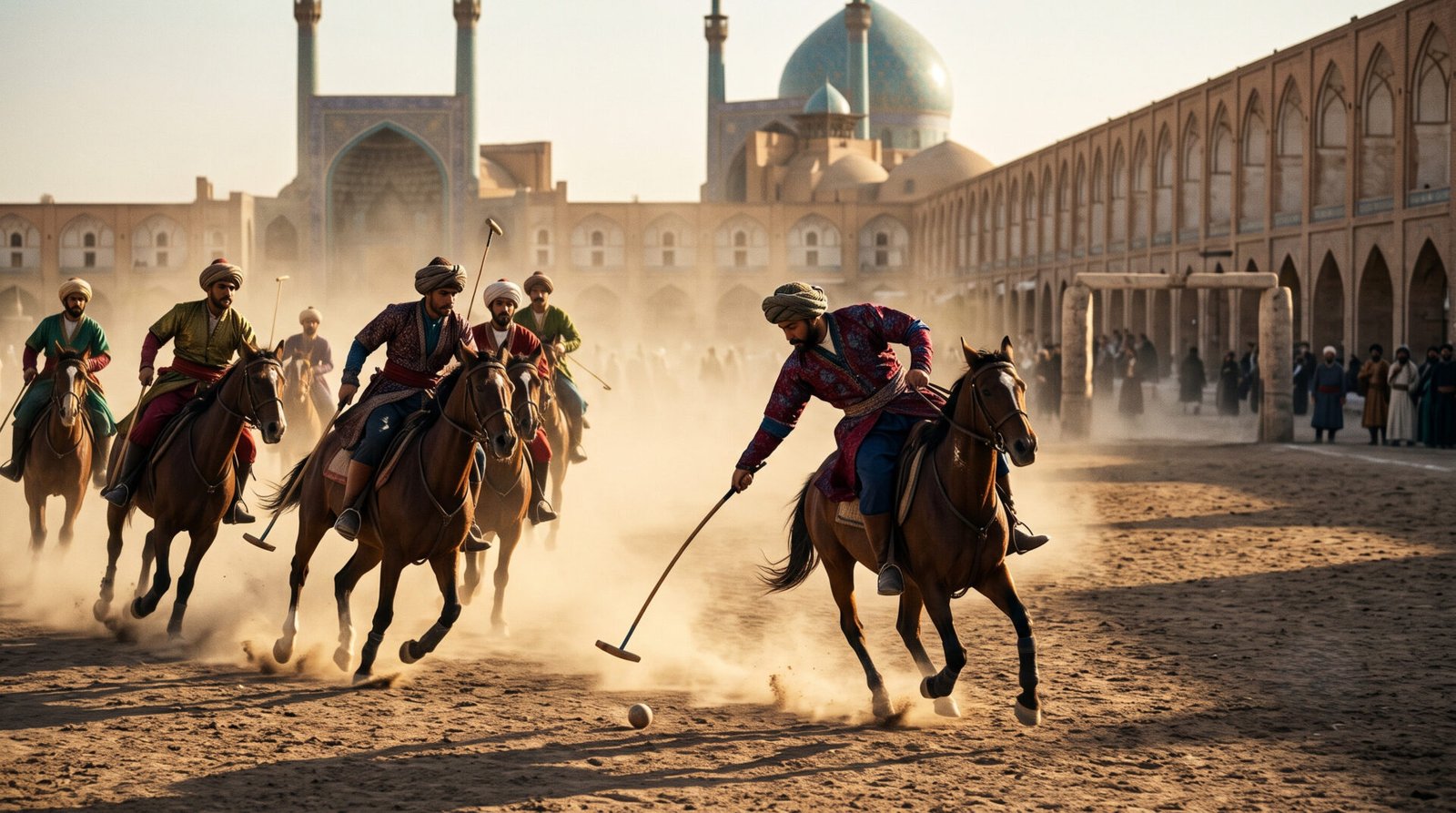
What images do you associate with ancient Iran (or Persia, as it was known for hundreds of years)? Perhaps opulent palaces, literature, and the bustling bazaars along the Silk Road. Throughout history, many empires have flourished and fallen within Iran. But what were the leisure activities of this ancient culture? How did the Iranians relax, entertain themselves, and showcase their talents? Although now we may associate modern-day sports such as football and basketball with worldwide appeal, organised games have been around for much longer. Ancient Persia in particular was extremely sport-orientated and had some of the most exciting (and in some cases horrific!) sporting activities. In fact, the modern-day sport of polo can actually trace its lineage back to an ancient Persian sport – Chogan. However, the story does not finish there.
Lift the lid on a world of gritty playing areas, galloping horses and impressive feats of physical prowess. These are just some of the ancient Iranian sporting activities which remain largely unknown to us today.

The Original Game of Kings – Chogan (Grandfather of Polo)
Contrary to the manicured pitches and refined nature of today’s polo, the ancient version of this sport – Chogan (also known as Chowgan) – was considerably more rugged, intense and hazardous. It was both a display of equestrian talent and also a form of military training. The kings were amongst its biggest fans.
Although the exact origin of the term ‘chogan’ is unclear, it is thought to derive from a Persian word for ‘mallet’. However, the sport itself has a long history, dating back over 2,500 years. Some historians believe that Chogan originated in the Achaemenid Empire (circa 550-330 BC), and it was certainly popular in the Sassanian period (224-651 AD) – the ‘golden age’ of the sport for the Sassanian aristocracy.
Picture a broad, open landscape rather than a well-manicured pitch. Frequently, the ‘ball’ was a firm, small wooden or leather inflated ball. There was also great variety in the ‘goal’, which could be an object, a particular rock or even a line on the ground. And all the players – who were all members of the aristocracy and elite soldiers – rode upon some of the finest horses in the world: the famed Nisean breed.
Chogan was definitely not a laid-back sport. Players rode their horses at high speeds, and large mallets were vigorously waved around. Players and horses frequently came into contact with each other. Besides remarkable dexterity, players also needed great bravery and tactical awareness. Often it was difficult to distinguish between good sportsmanship and outright fighting.
Furthermore, Chogan was closely associated with power. If a king was recognised as an exceptional Chogan player, then he was seen as favoured by the gods. Indeed, King Khosrow II was renowned for his chogan prowess. His talent was immortalised in Persian poetry and artwork. For this king, Chogan was a means of demonstrating his military capability without having to go to war. However, don’t be misled into believing that Chogan was a cerebral and refined sport. The Greek historian Herodotus relates how one king was so furious at losing a Chogan match that he ordered the opposing team to be imprisoned. What a bad loser!
As the Persian Empire grew, so too did the popularity of Chogan. The Byzantine Empire and the Mongols both embraced the sport. Interestingly, it was the Mongols who are thought to have introduced Chogan to China and India. In the 19th century, British army officers based in India became aware of a version of Chogan being played by the local population. Entranced by this sport, the British formalised its rules and introduced it to England, where it became known as ‘polo’. Next time you watch a polo match, therefore, remember its rugged, dusty and violent antecedents on the Iranian plains.

More Than Just a Game – The Ancient Arena of Varzesh-e Bastani
Whereas Chogan was regarded as the royal and military sport, Varzesh-e Bastani (or Ancient Sport) was the art of the general populace and soldier athlete. Again, this is not simply a sport. It is a complete culture, encompassing physical, mental, and spiritual development. Its heritage is deeply embedded within Persian history and mythology.
At the centre of Varzesh-e Bastani is a facility known as a zurkhaneh – or House of Strength. Entering a zurbakhaneh transports you to another era. Usually constructed as a dome, it contains a central octagonal arena (the gaud) where athletes train. Its acoustics are expertly engineered to amplify sound and thus produce a dramatic ambience.
As well as physical training, there are also highly significant spiritual elements to Varzesh-e Bastani. Sitting on a raised platform, the master of ceremonies (known as a morshed) beats a large drum (zarb). Rather than functioning as a modern-day coach, the morshed acts as a spiritual leader. He recites passages from the Shahnameh – a magnificent Persian collection of hero stories, including that of Rostam – alongside religious invocations and encouragement for the athletes. The beating of the drum establishes a mesmerising, almost meditative, mood which permeates the zurkhaneh.
Within the gaud, athletes (who are referred to as ‘pahlavans’ – heroes) undertake physical training using ancient apparatus. These include:
Sarbaz and Sang – Massive shield-like wooden slabs, frequently with metal masses affixed. Athletes do push-ups on these and move them backwards and forwards.
Meel – Large wooden maces – akin to Indian clubs but significantly larger. Athletes execute highly intricate coordinated movements with these.
Kabbadeh – A hefty iron bow with chains. Athletes raise this and shake the chains in a rhythmic manner to produce a loud noise that imitates sword clashing in battle.
Takhteh Shena – A large wooden bar. This is used for a unique type of push-up and is an outstanding test of both endurance and abdominal strength.
Alongside developing physical strength, Varzesh-e Bastani aimed to instil javanmardi – a Persian concept embodying chivalry and virtue. This embraced altruism, valour, modesty, and a commitment to justice. Thus, to be a Pahlavan was to be a strong individual. Within the zurkhaneh, the general public could absorb the morals espoused by ancient heroes. Hence, the Zurkhaneh functioned as a living Persian cultural museum.
Zurkhanehs can still be found in Iran today, and so this fascinating ancient culture continues to thrive, preserving the notion that in former times, physical strength and virtue were inextricably linked.

The Archer’s Gambit – A Sport of Accuracy
Alongside the vigorously active sports outlined above, the ancient Persians also enjoyed more delicate and precise sports. Although archery was a fundamental military skill, it was widely played as a sport. Kings and aristocrats would organise extravagant archery contests offering valuable rewards.
There was also another, less well-known, precision sport. People would mount horses and attempt to shoot a tiny target – often a hoop or coin – whilst galloping. Exceptional control, balance and eye-hand co-ordination were essential. As with Chogan, this too was a method of preparing for war and was also highly entertaining to watch.
Another, similarly less documented, sport was a sort of ancient joust. It is thought that riders attempted to dislodge a small item from a pole. Despite the obscurity surrounding the details of this sport, it is indicative of a culture which was keen to merge equestrianism with aspects of warfare.
A Sport of Strategy – Ancient Board Games
As well as enjoying physically active sports, the Persians were also big fans of board games and loved to engage in cerebral strategic duels in the cool, shady comfort of their palatial lounges.
Of these, the most renowned is backgammon (known as Takhteh Nard in Persian, which translates as ‘Battle on Wood’ – again, the name is highly descriptive!). Rather than purely a game of chance, backgammon was in fact a philosophical representation of life. It was a battle between two contrasting forces, and both chance and skill were involved.
Backgammon is often credited to Buzurgmihr, one of the great Persian sages, who lived during the reign of King Khosrow I in the 6th Century AD. It is said that an Indian king presented a chess game (also invented in India) to the Persian court and hoped that the Persian ‘wise men’ would then work out how to play it. Not only did Buzurgmihr manage to do this, but he then invented a new game called backgammon. This is a fantastic tale and underlines the intellectual rivalry and sophistication within the ancient Persian court.
There is fascinating symbolism within backgammon. The board symbolises the world and the pieces symbolise individuals. The dice are representative of fate – something beyond our control. Therefore, backgammon blends together elements of luck and strategy. Despite the unpredictable nature of fate, the game encourages people to apply their intellect and expertise.
Alongside backgammon, there is another more complex version of Nard. Again, this too used a board and dice. Although backgammon is the best-known type of Nard, all Nard games were extremely popular. As the Persians were so passionate about both poetry and philosophy, board games offered them an enjoyable and safe method of analysing and contemplating key topics such as life, fate and destiny.

Why Are These Sports Significant Today?
What is it about these ancient sports that we should be interested in?
They allow us to gain crucial knowledge regarding the core values of one of the world’s great civilisations. The aggressive nature of the Chogan game is indicative of a culture where bravery and sporting prowess were of prime importance. Similarly, the strongly spiritual and ceremonial nature of Varzesh-e Bastani illustrates a culture that felt there was a strong link between an individual’s physical and ethical strength. Furthermore, the cerebral nature of backgammon highlights a culture that was fascinated by philosophy and was keen to investigate ideas relating to fate and the human condition.
These ancient sports recognise the creativity, rivalry and deep contemplation which the ancient Persians engaged in. They enable us to connect with a culture that has impacted our own world in so many ways – for example, within the areas of the arts, science, religion and politics.
Next time that you watch a polo game on well-kept turf, construct a backgammon board or even walk into a conventional gym, take a moment to think about the scene. Imagine the ancient Iranian warriors swinging wooden mallets around; the sinewy pahlavans moving in an almost hypnotic manner as they lift large maces above their heads; and the wise men ardently discussing fate as they play Takhteh Nard. Although these ancient sports date back centuries, they are still highly relevant in present-day society. They embody our continued love of rivalry, our aspiration to excel, and our natural inclination to engage in activities. They also remind us that, regardless of when in history, aspects of life such as the thrill of achievement, the educational value of experiencing defeat, and the pleasure of taking part in sport are consistently pertinent.



+ There are no comments
Add yours