


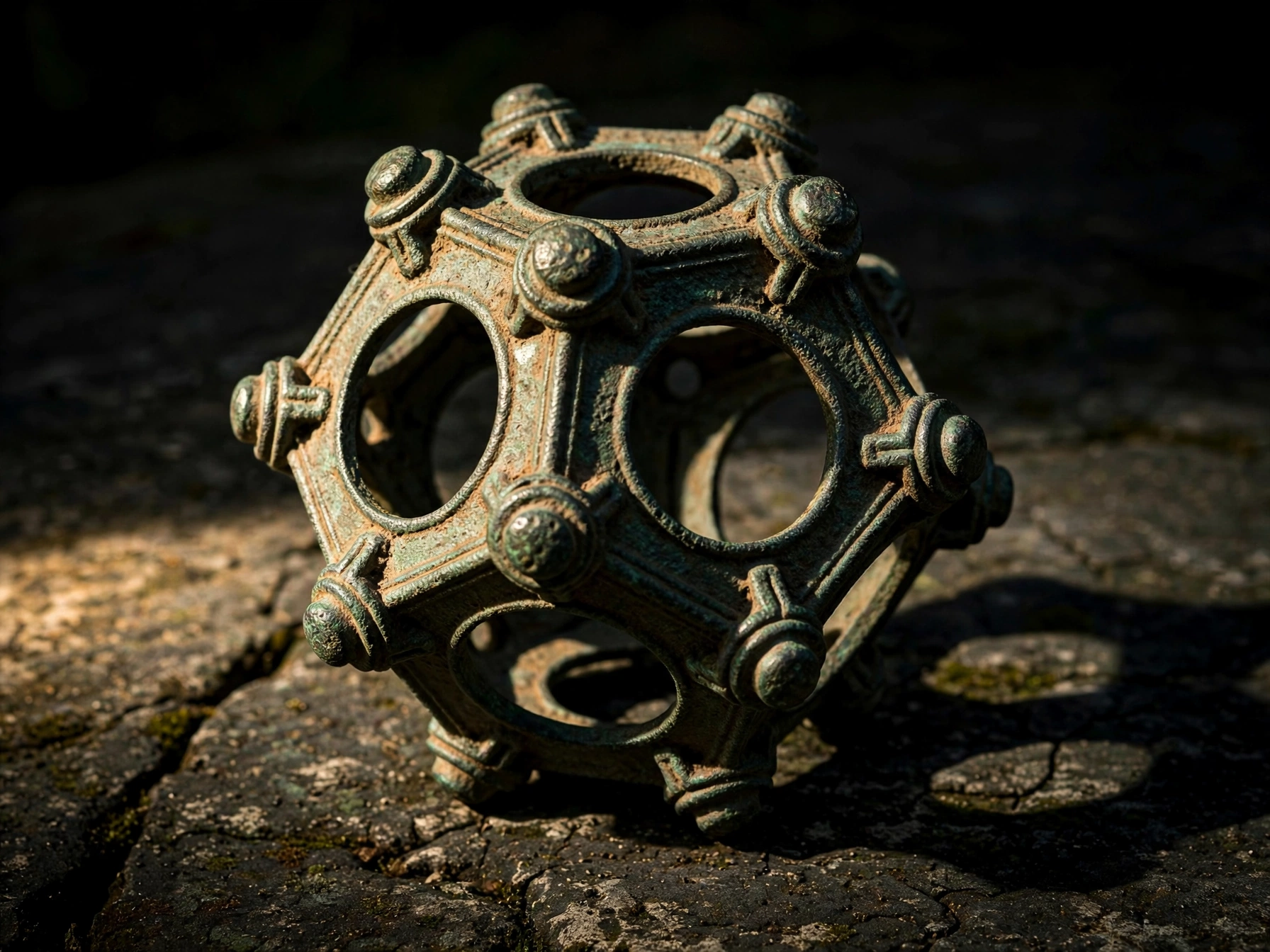
Imagine holding a small bronze object in your palm. It has twelve sides, each one a perfect pentagon. Every face has a circular hole cut through it — but each hole is a different size. At every corner where the faces meet, a small round knob sticks out. The whole aspect is hollow. It fits with no trouble in one hand, about the size of a huge apple.
Now consider that over 3,000 of those items had been dug up throughout England, France, Belgium, Germany, and the Netherlands. They all follow the same basic design. They were all made during the same three-century window — roughly 100 AD to 400 AD. And in all of the thousands of Roman texts, military records, market inventories, personal letters, legal documents, and wall graffiti that have survived from that era, not a single line mentions what they are.
Not one.
That is the mystery of the Roman dodecahedron. And it has been driving researchers quietly mad since 1739.

Found for Nearly 300 Years — Still Unknown
The first recorded discovery happened in the English Midlands in 1739. A farmer or a labourer – history didn’t bother to write down who, exactly – pulled a strange bronze object out of the earth, and someone thought it was worth noting. That note is one of the earliest records we have.
Since then, more than a hundred and thirty examples have turned up, almost all within the northwestern provinces of the ancient Roman Empire: Britain, Gaul (modern France and Belgium), and Germania (Germany and the Netherlands). They’ve been observed with the aid of expert archaeologists, amateur metal detectorists, and those just digging in their gardens.
Here’s what makes the geographic pattern so bizarre: the Roman Empire stretched from Scotland to Egypt, from Portugal to Iraq. These items have in no way been located in Rome. Never in Italy. Never in Spain, Greece, Turkey, or North Africa. Only in the cold, rainy, drizzly northwest frontier — the edge of the empire, where Roman soldiers shivered through British winters and Gaulish legions kept their boots muddy all year round.
That’s not a coincidence. That’s a clue. It just hasn’t told us anything yet.
The most significant recent find came in June 2023, when community archaeologists from the Norton Disney History and Archaeology Group in Lincolnshire, England, uncovered a dodecahedron in a sealed archaeological layer alongside third- and fourth-century coins and pottery. It was pristine — no damage, no wear, no corrosion. About 8 centimetres across, weighing 245 grams, composed of 75% copper, 7% tin, and 18% lead. This turned critical not just as it became intact; however, due to the fact that, for the first time, researchers had a specimen determined in its right archaeological context rather than plucked from the soil through a steel detector without a file of surrounding cloth.
By early 2024, that discovery had been featured on the BBC’s Digging for Britain; a Newcastle University doctoral student named Lorena Hitchens had become the primary full-time academic researcher committed to reading dodecahedra; and the number of examples located in Britain had reached 33.
The mystery was officially back in the spotlight.
What We Know for Certain — Before We Get to the Guessing
Let’s separate the facts from the theories, because the theories are where things get messy.
The objects range from roughly 4 centimetres to 11 centimetres — that’s golf ball to cricket ball size. Every single one is hollow. Every single one has twelve pentagonal faces, each with a circular hole, and every hole is a different diameter. Every corner has a knob. No two dodecahedra are identical in size or proportions, and yet they all clearly belong to the same category of object – as if made by different craftsmen following the same general idea but no single standardised blueprint.
They were expensive to make. Bronze casting at that level of detail required skill and time. These weren’t thrown together cheaply. Someone cared enough to commission them.
Almost none of them show signs of wear. That detail is important. If these were everyday tools – something used repeatedly, gripped and handled and worked with – you’d expect scratches, dents, and smooth patches where fingers wore down the metal over years. Most show almost nothing. They look, frankly, like they were made and then barely touched.

They’ve been found in wildly different contexts: in coin hoards, in graves of both men and women, near Roman villa sites, and in what appear to be refuse heaps. There’s no single type of burial or deposit that connects them all.
And now, thanks to residue analysis conducted on multiple specimens in 2025, we know something else: traces of burnt organic material, including lavender, thyme, pine or fir resin, microscopic carbon particles, and proteins consistent with animal blood, have been detected on several examples. These are substances that appear repeatedly in ancient data linked to Gaulish funeral rites, purification rituals, and practices of speaking with ancestors.
That closing finding hasn’t been published in a major peer-reviewed journal yet. But it’s pointing somewhere interesting.
Fifty Theories, Zero Winners
The list of proposed explanations for Roman dodecahedra is almost comedic in its length and variety. Historians and hobbyists have suggested roughly fifty different uses over the decades. Most collapse under basic scrutiny.
Candleholders. Wax was found inside one specimen, which sent people down this path. But the holes face in all directions — there’s no stable orientation that would hold a candle upright without wax dripping onto everything. Unlikely.
Military range-finders. The idea here is that a soldier could hold the dodecahedron up to one eye, sight through different-sized holes, and calculate the distance to a target based on which hole perfectly framed an object of known size. The theory sounds elegant until you notice that none of the objects are standardised. A range-finding tool only works if every unit is identical. These aren’t. Ruled out.
Dice. Twelve faces, perfect for gambling or divination. Except that the irregular distribution of weight — caused by the different-sized holes — makes them roll unpredictably. Any Roman gambler using one of these would have been losing money to physics, not fate.
Surveying instruments. No markings. No scales. No units. Real-world tests with replicas failed to produce useful measurements.
Glove-knitting frames. This one went viral on YouTube, and honestly the demonstration is charming to watch. The idea is that you wrap wool around the knobs and use the holes to shape the individual fingers of a glove. It works, in the sense that you can knit on a dodecahedron replica if you really commit to it. But there is no ancient artwork depicting this technique, no Roman text describing it, and historians of textile production point out that the type of knitting required wasn’t documented in Roman Britain. Also, why make a knitting tool out of expensive bronze? A timber version could do paintings just as well and be valued at a fraction of the price.
The debunking pattern here is constant: each realistic idea fails because either the gadgets do not perform the project well or no ancient record helps with the use or both.

The Theory That Has Actually Survived
Among researchers who study these objects seriously, one explanation has held up better than the rest — not because it’s proven, but because it doesn’t collapse.
Plato wrote about the dodecahedron in the Timaeus, one of his most influential dialogues. Among the five perfect geometric solids — what we now call the Platonic solids — the dodecahedron was the most complex and the most mysterious. Plato associated it with the cosmos, with the shape of the universe itself. For Pythagoreans, normal polyhedra had been no longer just mathematical curiosities. They were sacred. The dodecahedron, with its twelve faces — perhaps corresponding to the twelve signs of the zodiac or the twelve months — carried a weight that went beyond geometry.
Roman aristocratic culture was deeply soaked in Greek philosophy. This wasn’t abstract scholarship for them. It shaped how they understood the divine, the universe, and their place in both.
Now layer within the residue proof: lavender, thyme, pine resin, and animal blood – substances associated with Gaulish ritual practices. Layer in the geographic distribution: only the northwestern Celtic-influenced provinces, never Rome or the Mediterranean heartland. Layer in the pristine condition of most specimens: objects that weren’t used as tools but were kept, perhaps carried, and perhaps burnt during burial.
The emerging picture — and it’s still a picture, not proof — is of a ritual or sacred object. Something that carried symbolic weight in spiritual practice, possibly in a blended Celtic-Roman religious tradition that existed in the frontier provinces and nowhere else. Not a tool for doing something. A thing that meant something.
It wouldn’t be the first time an ancient object resisted utilitarian explanation because its purpose was entirely spiritual. We don’t ask what a rosary is “used for” in the mechanical sense. We understand that its value is symbolic.
The Silence That Speaks Loudest
Here is the detail that, once you notice it, is almost impossible to stop thinking about.
Romans documented everything. Their surviving literature runs to millions of words. We know the daily pay rates of Roman soldiers in the third century. We know the price of fish in Diocletian’s Edict on Maximum Prices from 301 AD. We have shopping lists scratched onto wooden tablets from Hadrian’s Wall. We have personal letters complaining about the weather, requesting socks, and asking relatives to send more money.
And in all of it – not one mention of a dodecahedron. Not in a soldier’s letter home. Not in a market record. Not in any inventory of temple objects or household goods. Not in any philosophical text discussing sacred geometry, despite the fact that such texts exist and were written during the same period when dodecahedra were being made and used.
This isn’t an absence caused by limited records. The Romans were meticulous. The silence around these objects was, apparently, total.
Three explanations have been offered. One: the objects were too sacred to write about openly; their meaning passed through oral tradition or initiatory knowledge rather than texts. Two: They were so ordinary and well-understood to Romans that no one thought to explain them, the way we don’t write down what a coffee mug is for. Three: the relevant records existed and were lost.
None of these is satisfying. All of them might be partly true. And that is the real shape of this mystery — not a clean question with a hidden answer, but a problem whose edges keep shifting every time you press on them.

Where Things Stand Now
Lorena Hitchens is still working on her PhD at Newcastle University. The Norton Disney dodecahedron has been through XRF analysis, 3D scanning, and metallurgical testing, with further scientific study planned. Residue analysis on multiple specimens is generating data that didn’t exist three years ago.
There is genuine momentum in the research for the first time in decades. The community archaeology movement has produced better-contextualised finds than almost anything the past two centuries of metal detecting turned up. We know more now than we did in 2020.
And yet the core question is, what were these for? — remains exactly where it was in 1739 when someone in the English Midlands pulled the first one out of the ground and presumably turned it over in their hands, puzzled.
The Romans were the greatest administrators in the historic world. They built roads that also exist, criminal structures that fashioned cutting-edge regulation, and an empire that lasted centuries. Somewhere on their bloodless northwestern frontier, they kept a secret so thoroughly that two millennia of human interest, modern-day technological know-how, and devoted instructional studies have not cracked it.
Maybe next year someone will find the letter. The inventory. The inscription on a temple wall. The one piece of text that makes everything click.
Until then, the dodecahedron sits in its museum case — twelve-sided, hollow, patient — and says nothing.
What do you think it was used for? Leave your theory in the comments — you wouldn’t be the first person to take a swing at this one.
Quick Facts Box
| Detail | Information |
|---|---|
| Date of manufacture | 2nd – 4th century AD |
| Total found | 130+ specimens |
| First recorded discovery | 1739, English Midlands |
| Materials | Bronze (copper, tin, lead alloy) |
| Size range | 4 cm – 11 cm |
| Found in | England, France, Belgium, Germany, Netherlands |
| Never found in | Italy, Spain, Greece, Egypt, or eastern provinces |
| Most recent major find | Norton Disney, Lincolnshire, 2023 |
| Current research | PhD study, Newcastle University (Lorena Hitchens) |
| Official verdict | Purpose unknown |



+ There are no comments
Add yours